

How to Write a Goal Action Plan and Stick to It
Somewhere, in a notebook or a notes app, you have a goal that has appeared on more than one year’s list. You meant it every time you wrote it down. You may even have started, with a burst of effort in the first couple of weeks, before work got busy and the goal drifted back to where it had been: important, unfinished, and waiting for a quieter month.
Wanting it was never the problem. The problem is what a goal leaves out. “Run a 10K”, “change careers” or “save more” describes where you would like to end up. It tells you nothing about what you should be doing at seven o’clock on a wet Tuesday evening, and that is the moment when a goal is either acted on or put off again.
A goal action plan fills that gap. It is a single page that takes one goal and works it down into milestones, weekly actions and dates in your calendar, with a plan for the days when things go wrong. If you have been wondering how to achieve your goals when wanting them hasn’t been enough, this article walks you through writing that page, using one example from start to finish.
Save this article
What a goal action plan is
A goal action plan is a written, one-page answer to four questions: what exactly am I trying to achieve, by when, what will I do each week to get there, and what will I do when something gets in the way. The goal sits at the top of the page. Everything underneath it is concerned with the weeks between now and the deadline.
It helps to be clear about what it isn’t, because other things often get mistaken for one. A vision board shows you what you want and why it matters. A list of goals records what you have chosen to pursue this year. A to-do list holds whatever happens to need doing. Each of these is useful, but none of them connects a result that is months away to an action you can take this week, and making that connection is the plan’s whole job.
Goals and action plans work as a pair. The goal gives the plan a direction and a reason, and the plan gives the goal a place in your calendar. With only one of them, you end up either busy without direction or inspired without progress.
Why goals fail without a plan
You may have come across the story of a Yale study in which the few graduates who had written down their goals went on to earn ten times as much as their classmates. It is quoted in countless books and seminars, and … It never took place.
The psychologist Gail Matthews, of Dominican University of California, discovered this when she went looking for the original, and she decided to run a real study in its place. Her research followed 149 people from a wide range of professions for four weeks, divided into five groups. The first group only thought about their goals. The second wrote them down. The remaining groups went further: one listed the actions they would commit to, one sent those commitments to a friend, and the last also sent that friend a short progress report every week.
People who wrote their goals down achieved significantly more than those who only thought about them. The group that reported to a friend every week achieved the most by a clear margin, with an average achievement score of 7.6 against 4.28 for the group that had kept its goals in mind.
The reason is not mysterious. A goal that lives in your head competes with everything else in there, and you can quietly renegotiate it whenever you like. Once it is written down with actions attached, you have something to check yourself against. And once another person is expecting to hear how the week went, skipping it carries a small cost that it didn’t have before.
Before you plan: choose a goal that deserves one
A plan takes about an hour to write and months to carry out, so it is worth making sure the goal has earned the effort. Three questions will tell you.
Is it yours? Many of the goals we carry were handed to us by a parent, a manager or the general noise about what a successful life looks like. Before you choose, look across your whole life and ask where a change would matter most to you. The Wheel of Life is a quick way to do that, and I’ve explained it in how to do a life audit.
Is it reachable in the time you have? A plan works best for something you could achieve in three to twelve months. If your goal is bigger than that, such as changing career or building a business, plan only its first stage. The ambition stays the same, and you get a part of it that you can act on now.
Is it the only one? Every plan claims hours in your week, and those hours have to come from somewhere. One goal with a plan will get further than four goals sharing your attention, so choose one, or two at most if they sit in different areas of your life, and put the rest on a list marked “later”. They will still be there when this one is done.
How to write your goal action plan, part by part
The plan has seven parts. I’ll build one example as we go, for someone who has wanted to run a 10K for three years and currently can’t run for more than five minutes without stopping. The same seven parts work for a savings target, a qualification or a career move, and you’ll find a second example further down.
1. Write the goal as a finish line
A usable goal lets you say, on a given date, whether you have done it. “Get fitter” fails that test, because on any day of the year you could argue it either way. “Run the Lakeside 10K on the first Sunday in June without stopping to walk” passes. It names a result, a way to measure it and a date.
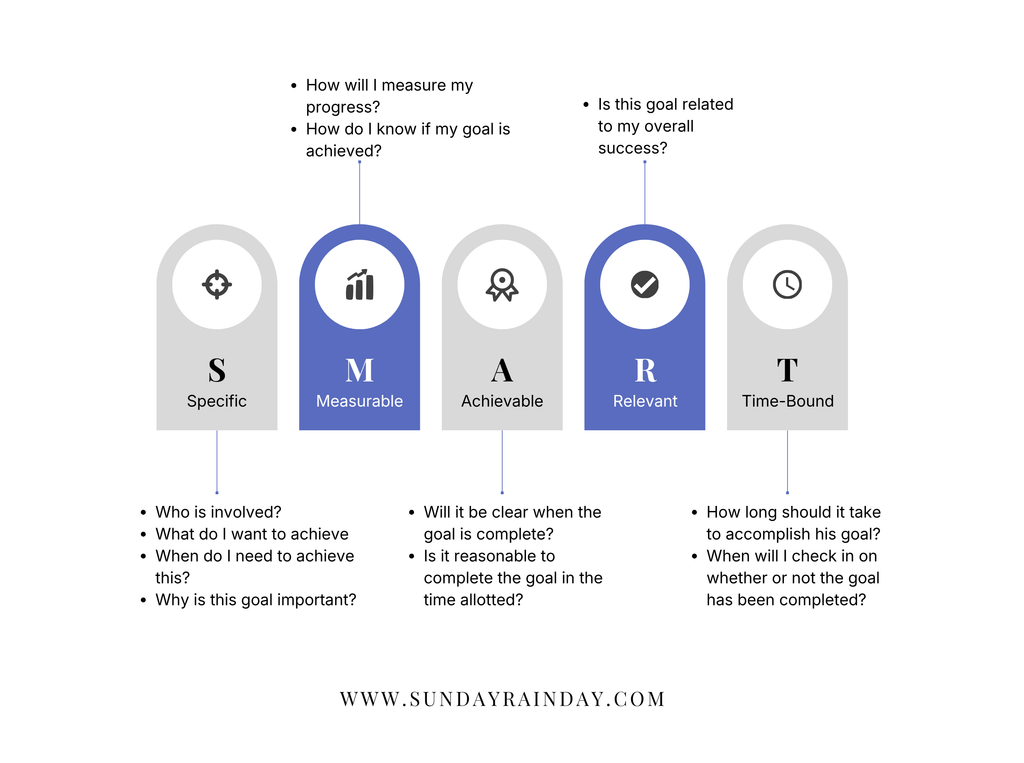
This is what the SMART framework is for. A goal written this way is specific, measurable, attainable, realistic and time-bound, and each of those words closes a loophole you would otherwise use later. “Specific” stops you redefining the goal when it gets hard. “Time-bound” stops you moving it to next year. “Attainable” and “realistic” are there to keep the goal within reach of the time and energy you really have, because a goal you privately believe is impossible will get no effort from you at all.
Underneath the goal, add one sentence about why you want it. Our runner might write: “I want to prove to myself that I can finish something physical.” You won’t need that sentence in week one, when enthusiasm is doing the work. You will need it in week seven.
2. Work backwards to milestones
A milestone is a checkpoint between today and the finish line: a smaller result, with its own date, that shows you are on course. Three to five is usually enough.
The trick is to set them backwards. Start at the deadline and ask what would have to be true a month before it, then a month before that, until you arrive at next week. For the 10K, twenty weeks away, the chain looks like this:
- Week 20: run the 10K
- Week 16: run 8 km without stopping
- Week 12: run 5 km without stopping
- Week 8: run 3 km without stopping
- Week 4: run for ten minutes without stopping
Planning backwards has an advantage that planning forwards doesn’t. When you start from today, each step is an optimistic guess, and you only find out near the end that the dates never added up. When you start from the deadline, you see straight away whether the first milestone is something you could reach from where you are now. If it isn’t, you can move the deadline or shrink the goal while that is still a calm decision.
Leave some slack as well. Nearly everyone underestimates how long things will take, a tendency psychologists call the planning fallacy, so a plan with no spare weeks in it is a plan that will be behind by the second month.
Finally, decide now how you will mark each milestone. The finish line is months away, which is a long time to work without anything to look forward to, and a small reward at each checkpoint gives you something closer to aim at. It could be new running shoes at 5 km, or a massage at 8 km. This is the part of the plan I enjoy writing most, and it does more for staying power than it looks.
3. Turn each milestone into actions you control
A milestone is still a result, and you can’t do a result. You can only do the things that lead to it. So under your first milestone, list the actions that will produce it if you repeat them.
For “run for ten minutes without stopping by week 4”, that might be:
- Choose a beginner running programme (once, this week)
- Buy proper running shoes (once, this week)
- Follow the programme’s three sessions each week
- Do ten minutes of stretching after each session
There is a simple test for whether something is an action: could you do it today if you had the time? “Get faster” fails. “Run on Tuesday, Thursday and Sunday” passes. The difference matters because results are only partly in your hands, while actions are entirely in them, and a plan made of things you control is one you can’t fail at through bad luck.
Notice that the list contains two kinds of action. One-off tasks, like buying the shoes, need a date and then disappear. Repeated actions, like the three weekly sessions, are habits in the making, and they are where most of the progress comes from. If building those is the part you find hard, I’ve covered it separately in how to make habits stick.
Keep the list short, with two to four actions per milestone. And plan only the next milestone in this much detail, because what you learn in the first month will change what the second month should look like.
4. Give every action a day, a time and a place
An action with no slot gets done when you “find the time”, which in a full life means it doesn’t get done. So each repeated action goes into your calendar as a recurring appointment, with a place attached: Tuesday at 7:00 from the front door, Thursday at 18:30 from the office, Sunday at 9:00 in the park.
This step has some of the strongest evidence behind it. The psychologists Peter Gollwitzer and Paschal Sheeran reviewed 94 tests of what they call implementation intentions, which are plans that spell out in advance when, where and how you will act. They found that making such a plan had a medium-to-large positive effect on whether people reached their goals. Deciding the moment beforehand means that when it arrives, there is nothing left to deliberate, and deliberating is where most good intentions are lost.
I learnt how much the slot matters the slow way. For years I planned my workouts for after work and skipped most of them, because after a long day they were the easiest thing to drop. Moving them to the early morning or my lunch break was the only change I made, and it was the one that worked. So if you keep missing an appointment with yourself, try a different time before you conclude that you lack discipline. Often the slot is the problem.
5. Plan for what will get in the way
You already know most of your obstacles. They are the same ones that stopped you last time: the meeting that overruns, the rain, the evening when you are too tired to think, the week away for work. A plan that pretends these won’t happen will last until the first one does.
Write down the three most likely, and give each one an answer in the form “if this happens, then I will do that”:
- If it is raining on a run day, then I will run for fifteen minutes anyway.
- If I have to work late on Thursday, then I will run on Friday before breakfast.
- If I miss a week through illness, then I will repeat the previous week of the programme.
Decisions made in advance like this are far easier to keep than decisions made in the moment, when you are cold or tired and every excuse sounds reasonable.
It also helps to define a minimum version of each action, the smallest amount that still counts. For our runner that might be ten minutes at any pace. On a bad day the minimum keeps the appointment alive, and keeping the appointment is worth more than the distance.
The last obstacle is time itself. The hours your plan needs are currently being spent on something else, and unless you decide what gives way, nothing will. If you are not sure where your time goes, write down what you do for two or three ordinary days. Many people find an hour or so a day that went to their phone without their ever choosing it, and that hour is usually where a plan can live.
6. Decide how you’ll track it and who you’ll tell
Tracking can be as simple as a sheet of paper on the fridge with a box for every planned action and a tick in each one you did. Its value is that it shows you the truth. After a month you can see that you have never once missed a Sunday and have missed three Thursdays out of four, which tells you exactly which part of the plan needs changing.
Then comes the step most people leave out, and the one the Dominican University study found mattered most: tell someone. Choose one person, send them your goal and your weekly actions, and agree that you will message them every Sunday with two lines, saying what you did this week and what you will do next week.
Pick this person with some care. You want someone who will read the message and reply, and who is on your side without being so kind that a missed week goes unremarked. They don’t need to share your goal. If you can also find someone who has already done what you are attempting, ask them what they would do differently. A person a few steps ahead of you is usually a better guide than an expert who has forgotten what the beginning felt like.
7. Plan a reward for every milestone
Many of us are better at reaching goals than at noticing that we have reached them. We finish the course, hit the savings target or cross the finish line, feel pleased for an afternoon, and by Monday we have moved on to the next thing. We never stop to take in what we did, so an achievement that took five months gets about five hours of our attention.
Psychologists have a name for what is happening here: hedonic adaptation. We get used to improvements in our lives remarkably quickly. Something that looked like a distant summit a year ago becomes, almost as soon as we are standing on it, simply the place where we live now. This trait helps us recover from hard times, but it costs us in good ones, because an achievement you don’t deliberately mark will slide past almost unfelt. You then arrive at your next goal with no real sense of having succeeded at the last one, which is a tiring way to live.
The remedy has a name too. The psychologist Fred Bryant calls it savouring, which means deliberately giving your attention to a good experience so that it registers and lasts. A reward you have planned in advance is the simplest way to make yourself do it.
A reward therefore does two jobs. Before the finish line, it gives you something to look forward to, which matters in the weeks when the goal itself still feels far away. After it, the reward makes you pause, pat yourself on the back and acknowledge what you have achieved before the next goal takes over.
This applies to the small victories as much as the big one. When the Harvard researchers Teresa Amabile and Steven Kramer analysed nearly 12,000 diary entries written by 238 people at work, they found that of everything that could lift a person’s mood and motivation during a day, the most powerful was making progress in work that mattered to them, even when the step was small. They called this the progress principle. Small wins do much of the work of keeping you going, but only if you notice them, so every milestone in your plan deserves a reward of its own.
In practice, write a reward next to each milestone now, while you are planning, and let the size grow with the achievement. Our runner might choose new running shoes at 5 km, a massage at 8 km and a weekend away after the race. Pick things you will enjoy and that don’t work against the goal, and then take them when you have earned them, even if the week is busy. This is the part of the plan I enjoy writing most, and it is the one people are most tempted to skip.
The one-pager goal action plan
Put together, the seven parts fit on a single sheet. Here is the runner’s plan next to the same template filled in for a very different goal, so you can see how it adapts.
To use it as a goal plan template, copy the left-hand column onto a page and fill in your own answers, one row at a time.
| Part of the plan | Fitness goal | Career goal |
|---|---|---|
| Goal | Run the Lakeside 10K on the first Sunday in June without stopping to walk | Have three interviews for a product manager role by 30 September |
| Why it matters | To prove to myself that I can finish something physical | I want work where I help decide what gets built |
| Milestones | Week 4: ten minutes non-stop. Week 8: 3 km. Week 12: 5 km. Week 16: 8 km. Week 20: race day | End of May: course finished. End of June: two portfolio case studies. End of July: CV rewritten and ten conversations with people in the role. End of September: fifteen applications sent |
| Rewards | New running shoes at 5 km, a massage at 8 km, a weekend away after the race | A weekend away when the course is finished |
| Actions for the next milestone | Choose a programme and buy shoes this week. Three sessions a week. Ten minutes of stretching after each | Two course modules a week. One page of notes per module |
| Day, time and place | Tuesday 7:00 from home. Thursday 18:30 from the office. Sunday 9:00 in the park | Monday and Wednesday 20:00 at my desk. Saturday 10:00 at the library |
| If-then plans | Rain: fifteen minutes anyway. Late on Thursday: Friday before breakfast. Missed week: repeat the previous one | Weekday session lost to work: Sunday at 17:00. Module runs over: finish it before starting the next |
| Minimum version | Ten minutes at any pace | Twenty minutes of one module |
| Tracking and accountability | Tick sheet on the fridge. Two-line message to a friend every Sunday | Module checklist. Sunday message to a former colleague |
Keeping your plan alive: the weekly review
A plan that is written once and never looked at again is not much better than a list of resolutions. What keeps it working is a short review at the same time every week. Sunday evening suits most people, and it is also when your progress message is due.
Fifteen minutes is enough to answer three questions. What did I do this week, compared with what I planned? What got in the way? And what are next week’s actions, and are they in my calendar?
Once a month, look at the milestone as well. If you are on course, write out the actions for the next one in detail. If you are behind, you have two honest options. You can move the date, or you can change the actions by adding a session, switching to a slot you are more likely to keep, or shrinking the minimum version. Both are a normal part of planning, and most plans need one or the other at least once. What doesn’t help is quietly abandoning the whole thing because the original dates no longer work. A 10K run in July is still a 10K.
Sometimes the review tells you something else. You are keeping up with the plan, and you have noticed that you no longer care about where it leads. People change, and a goal you set a year ago was chosen by someone with slightly different priorities. If the goal has stopped serving the life you want, you are allowed to stop on purpose and give those hours to one that does.
And when you do reach the finish line, take the reward you promised yourself and look back at where you were in week one before you pick the next goal from your “later” list. The pause matters, because the memory of having finished is what you will draw on the next time a plan gets difficult.
From one goal to the whole picture
A single plan gets a single goal done. Choosing which goals are worth a plan in the first place, and making sure they add up to a life you want, is a bigger piece of work.
The Life Plan Template is the workbook I made for that. Across 47 pages and 38 worksheets, it takes you through a life audit and your core values, then helps you set a ten-year vision and break it down into five-year, three-year and one-year milestones and a three-month plan. It includes worksheets for writing SMART goals and a goal action plan for each one, along with progress and habit trackers, so everything in this article has a page waiting for it.
Frequently asked questions
What is a goal action plan?
A goal action plan is a one-page document that turns a single goal into scheduled work. It states the goal and its deadline, breaks it into dated milestones, lists the weekly actions that lead to the next milestone, and fixes a day, time and place for each of them. A complete plan also includes if-then answers for likely obstacles and a way to track progress.
How do you write an action plan for a goal?
There are seven steps to achieve a goal with a plan. Write the goal as a specific result with a date. Work backwards from the deadline to set three to five milestones. List the actions you control that will get you to the first milestone. Put each action in your calendar with a time and place. Write if-then plans for the obstacles you expect. Choose how you will track progress and who you will report to each week. Finally, plan a reward for each milestone and for the finish.
What is the difference between a goal and an action plan?
A goal is the result you want, such as running a 10K by June. An action plan is the route to it: the milestones, the weekly tasks and the appointments in your calendar. The goal answers “where am I going?” and the plan answers “what do I do this week?”. Goals and action plans depend on each other, because a goal alone gives you nothing to do, and actions without a goal have no direction.
How do you achieve your goals when motivation runs out?
By building the plan for the days when you have none. Motivation is high when you set a goal and unreliable a few weeks later, so the parts of the plan that matter most are the ones that work without it. A fixed slot in your calendar removes the daily decision. A minimum version gives you something small enough to do when you are tired. And a weekly message to a friend means someone will notice if you stop.
How many goals should I work on at once?
One, or two if they belong to different areas of your life, such as one for health and one for work. Every plan needs several hours a week, and it is easy to overestimate how many spare hours you have. Finishing one goal and moving on to the next will take you further in a year than splitting your attention between five.
What should I do if I fall behind on my action plan?
Work out why before you change anything. If the actions were realistic and you simply missed them, look at the time slot and the obstacles, and adjust those. If the actions were too ambitious, reduce them or move the deadline. Either change keeps the plan alive, which is the aim. The one response that reliably ends a goal is deciding that being behind means it is over.
