

How to Tell When You’re Outgrowing Your Life (and What to Do Next)
Nearly every one of us will face this feeling one day. On paper, the life is a good one. Nothing has fallen apart. The job is fine, the relationship is fine, the flat is fine. And yet you catch yourself lying in your bed on a random Monday night thinking: I can’t do this for another year.
Something in you has quietly moved on without the rest of your life noticing. If this is what you are feeling right now, you are probably not breaking down. You are far more likely to be outgrowing your life and those are not the same thing, even though they can feel very similar from the inside.
This article is the piece I wish someone had handed me the first time I felt it: what it actually means to outgrow a chapter, the psychology behind why it feels so disorienting, and what to do once you’re ready to start figuring things out.
Save this article

What it actually means to outgrow your life
Put simply, to outgrow your life is to become a person your current life was not built for. You designed the life you have now (consciously or not) around who you were when you built it.
The career made sense for that person. The routines fit that person. The goals belonged to that person.
Then you did the thing you were supposed to do: you kept growing. So your values shifted, your tolerance for certain things dropped, your sense of what matters quietly reorganised itself. And at some point the gap between who you’ve become and the life built for who you were grew wide enough to feel. That gap is the whole phenomenon.
It’s the ordinary, uncomfortable cost of having changed, and anyone who keeps growing will pay it more than once. This is the distinction we usually miss. Most “signs you need a fresh start” advice treats the feeling as a symptom of something broken. Sometimes it is and we’ll get to that, because it matters. But far more often, the urge to start over is a signal of growth that has outpaced its container.
Read as a breakdown, it makes you anxious. Read correctly, as outgrowing, it becomes one of the most useful signals your life will ever send you.
Why it feels so disorienting: the psychology most articles don’t explain
Now you might wonder: if outgrowing a chapter is a normal part of growing, why does it feel like the floor is tilting and your whole life is crumbling down? That’s because of the order things happen in.
The psychologist William Bridges, who spent his career studying how people move through change, made a distinction that reframes the whole experience: a change is the external event, but a transition is the internal, psychological process. And in his model, every transition starts with an ending.
Before you can step into the next version of your life, something has to be released: an identity, an assumption, a story about who you are. So the disorientation you feel is the ending doing its work.
William Bridges called the stretch that follows the neutral zone. The in-between where the old life no longer fits and the new one hasn’t arrived. Anthropologists have a word for the same territory: liminality, the threshold state in every rite of passage where a person is no longer who they were and not yet who they’re becoming.
It is, by design, a place of not-knowing and our culture has almost no tolerance for it.
We want the resolution, the clean before-and-after which is why so many people try to sprint through the threshold stage by making one dramatic decision. However, this part of the journey is just as important as what comes next as it gives you a chance to hit pause and reflect on where you stand with honesty.
There’s a second piece of psychology worth naming, because it explains the most confusing version of this feeling. The one where everything went right and you still feel off. Researchers who study wellbeing describe this as the arrival fallacy.
The arrival fallacy is our assumption that reaching our goals will create a lasting sense of fulfilment, when in fact the feeling fades quickly. And this happens more frequently than we imagine: you can hit every goal you set and discover these goals belonged to an earlier version of you.
If this is you right now, you can feel that hollow “is this it?” and still be grateful. The two sit side by side more often than people admit, and the hollowness usually points to the goals that were never really yours.
Most regrettable life decisions are made in the threshold, by someone who couldn’t stand to stay in it a little longer.
The signs you’ve outgrown your life
In practice, the signs that you’ve outgrown your life fall into three connected clusters and one that means something different entirely.
1. Signals of misalignment: the life no longer fits who you’ve become
This is the deepest signal, and the easiest to talk yourself out of, because nothing is visibly wrong.
A lack of fulfilment that no achievement explains
You could write a list of everything that’s going well, and the list would be accurate. The job is stable, the people around you would call it a success, and there is no obvious problem to point at. But none of it reaches the part of you that feels empty, and that’s exactly what makes this sign so easy to dismiss.
We tend to assume fulfilment is the sum of good circumstances, so when the circumstances are good and the fulfilment isn’t there, we conclude the problem must be us. More often, those circumstances were chosen by an earlier version of you, and they are still serving her needs rather than your new ones.
When getting what you wanted feels strangely flat
We’ve already discussed the arrival fallacy, but it deserves a second look here, because it shows up as a sign in a very particular way. You finally get the promotion, the flat, the relationship, or the savings number, and the satisfaction lasts about a week.
Then everyday life settles back in, except now there’s no goal left to explain why you feel the way you do. The pattern to watch for is repetition: if every achievement fades faster than the one before, the goals themselves were probably not the right ones for you. A good place to start is to pause and ask yourself these self-discovery questions before you set the next one.
Going through the motions
Some days you’ll notice you’re performing your life rather than living it. You say the right things in meetings, you answer “good, busy” when someone asks how you are, and you show up to Sunday lunch and play the part everyone expects.
Nothing about it is false exactly, but none of it feels like it’s coming from you either. Because you’re still functioning, nobody around you notices, and for a long time you might not either. The clearest tell is the relief you feel when you’re finally alone and can stop acting.
Related read: How to Stop Living on Autopilot
When easy decisions start to feel heavy
Decisions that used to take seconds now take days. Should you say yes to the project, go to the dinner, renew the lease? You used to answer these on instinct, because the values underneath them were settled and your choices simply followed.
When those values shift, the instinct goes quiet, and every decision has to be reasoned through from scratch. Your internal compass has been recalibrating without telling you, and until it settles, even small choices need conscious effort. The effort to decide is a clue in itself, because it shows you exactly where your old priorities have stopped working for you.
2. Signals of restlessness: the pull toward something you can’t yet name
A flatness no holiday can fix
You book the trip because you’re sure you just need a break. And the break is lovely: you sleep, you read, and you remember what your shoulders feel like when they aren’t up by your ears. Then you come home, open your laptop on Monday morning, and the flatness is waiting for you exactly where you left it.
That’s the useful part of this sign, because it rules out the simplest explanation. If rest had fixed it, the problem was tiredness, but when rest doesn’t change anything, the cause of the problem is what you’re doing with your days rather than their pace.
Daydreaming about a different life
Everyone daydreams, so this sign is all about frequency and texture.
You find yourself scrolling property listings for a city you’ve visited once, reading about people who left their jobs for something smaller and stranger, or mentally redesigning your week on the train home. Doing so can feel like an innocent way to escape, and occasionally it is.
But pay attention to what keeps recurring, because those daydreams are often the first rough draft of values you haven’t put into words yet. You don’t have to act on them, only take them seriously enough to notice what they have in common.
The quiet not this
Then there’s the low hum that shows up in ordinary moments: a Tuesday afternoon, a Sunday evening, the walk from the car park to the office. It doesn’t come with a plan or a clear alternative, only a simple and stubborn not this.
You may have tried to argue with it by listing all the reasons you should be grateful, and noticed that the list is convincing and yet changes nothing. The feeling isn’t making an argument, so it can’t be defeated by one. It’s the sense that some part of you has already moved on and lost interest, while the rest of your life is still standing where it was.
3. Signals of quiet grief: mourning the version of you that’s ending
This one surprises people, because it feels like loss, even when the future you’re heading toward is one you want.
Nostalgia that doesn’t match your circumstances
You might find yourself missing things you didn’t even like at the time, such as a cramped first flat, a job you complained about constantly, or the way your friendships were years ago. Or you feel a heaviness you can’t explain, a sadness without any clear loss behind it. This can be confusing, because nothing has actually ended yet.
Grief doesn’t always wait for the event, though, and sometimes it shows up when part of you senses a chapter closing before the rest of you has agreed to turn the page. What you’re usually mourning is the person you were back then, and how certain you were about who she was.
Feeling disconnected from people and routines
Conversations with old friends start to feel like reruns, pleasant but predictable. The routines that used to anchor your week (Friday drinks, the gym at seven, the Sunday reset) still happen, but you watch yourself doing them from a slight distance, as if through a window.
This often comes with guilt, especially when the people involved haven’t done anything wrong. Most of the time, nobody has: you’ve simply changed faster than your shared habits have.
When the old labels stop fitting
Someone asks what you do, and the answer you’ve given for years suddenly becomes uncomfortable. The labels you built your identity around, whether a job title, a role in your family, or being “the reliable one”, are still accurate on paper, but they describe someone you were a few years ago. And you haven’t decided yet what new label should replace them, which leaves an uncomfortable gap whenever you try to describe yourself.
This is the liminal state in its purest form: no longer who you were, and not yet who you’re becoming. It can feel like losing yourself. Give it time, and that empty space is where you start to hear yourself think again, because a new sense of self needs space before it can take shape.
Grief is the ending William Bridges described, felt from the inside. Experiencing it means that a real transition has begun, not that you made a mistake.
A note on feeling lost specifically: it’s one of the most common entry points to all of this, and it has its own map, so if you’re unsure of what to do next, here are 17 things to do when you feel lost in life.
4. The fourth cluster and why it changes everything
There is a fourth set of signals that often gets folded into “signs you need a fresh start,” and it shouldn’t be, because it points somewhere completely different. These are signals of distress rather than signals of growth. The difference matters enormously because they call for a different response. Outgrowing your life asks you to change something. Distress asks you to tend to yourself first.
Exhaustion you can’t sleep off
Everyone gets tired, and a hard week will wear anyone down. But this is different: you sleep a full night, sometimes a full weekend, and wake up just as depleted as when you went to bed. The tiredness sits deeper than your body, so even things you used to enjoy start to feel like tasks on a list. When this pattern is tied to work, the World Health Organization calls it burnout, the result of chronic workplace stress that hasn’t been successfully managed. In the restlessness cluster, a holiday restores you but leaves the flatness in your life untouched. Here, rest doesn’t restore you at all.
When stress moves into your body
Chronic stress rarely stays in your head. It shows up as tension headaches, a jaw you clench in your sleep, a stomach that’s always slightly off, or colds that arrive every time you finally slow down.
Most of us learn to work around these symptoms rather than listen to them, because each one on its own seems too small to take seriously. Together, though, they’re your body telling you it has been running in emergency mode for far too long.
Reaching for things to numb out
We all have a way of switching off at the end of a long day, and a glass of wine or an evening of scrolling is not a crisis.
The signal to watch for is compulsion: the extra drink you didn’t really decide to pour, the hours on your phone you can’t account for, the shopping, the overworking that leaves no quiet moment to feel anything in.
What these behaviours have in common is relief: each one turns down the volume on something too loud to face directly. When you notice you need them more than you used to, it’s a sign something is off.
Changes in how you eat and sleep
Sleep and appetite are often the first things to change under stress, and the last things we notice. You might lie awake at 2 a.m. with your mind racing, or sleep ten hours and still struggle to get up. Or your appetite may disappear for days, or you find yourself eating without really being hungry.
These shifts matter because they’re so basic: when rest and nourishment are disrupted, everything else becomes harder to think clearly about, including your life.
When flatness turns into numbness
A life that feels flat is different from being unable to feel much of anything at all. In the restlessness cluster, you still feel the pull of the daydreams and the sharpness of not this.
Here, even the things you used to love leave you cold: good news barely registers, time with friends feels like going through the steps, and the future has no colour. Clinicians call this loss of pleasure and interest anhedonia, and it is one of the core symptoms of depression.
Depression is very different from the other signs we have covered in this post. It isn’t a sign that you’ve outgrown anything, and it isn’t something to push through alone.
If what you’re experiencing lives mostly in this fourth cluster, please read the caution near the end of this piece before you make any large decisions. You cannot cross a threshold well from an empty tank, and some of these signals, like depression, deserve support, not a reinvention plan.
Outgrowing your life vs. running away from it
Once you suspect you’ve outgrown a chapter, one honest question helps separate the people who transition well from the people who just keep detonating their lives: am I moving toward something, or away from something? Both feel like the urge to change, and from the inside they’re hard to tell apart. The difference shows up in how they behave over time.
Running away is recognisable by its shape. It’s always reactive and urgent anywhere but here, and as fast as possible. It tends to blame a single external thing (this job, this city, this person) as though removing it will resolve the problem. But most importantly, it repeats: the same feeling often reappears a year or two into the fresh start.
The people who change their lives well usually know what they’re walking toward before they leave.
Outgrowing is quieter and far more directional. It sounds like “I’m meant for a different shape of life,” even when you can’t yet describe it. This feeling survives a good night’s sleep and a genuinely restful week.
No matter the situation and what you feel, if the feeling is still there when you’re rested and calm, take it seriously. The test isn’t foolproof, but it’s clarifying: escape wants to subtract a problem; growth wants to move toward a truer fit.
And if you can’t yet tell which one you’re in, don’t worry: that’s not a failure. In fact, it’s the exact reason the next part exists.
What to do next: how to cross the threshold without blowing up your life
In this situation, most people have the same instinct once the feeling is undeniable: to make one big decision fast. Quit, leave, end it, sell everything.
But you have to resist that for a moment. Because a life transition handled healthily has three parts, and making dramatic decisions skips the two that matter most.
Honour the ending. Before you rush to the new thing, let yourself acknowledge what’s actually coming to an end. Whether it’s a role, an identity or a relationship, this chapter of your life genuinely served you by helping you find who you really are. Naming what’s ending, and letting yourself feel the loss of it, is what lets you close the chapter and finally move forward without dragging the old story behind you.
Stay in the threshold on purpose. This is the hardest and most valuable move: to be in the not-knowing without immediately resolving it. Instead of making a decision, gather information about yourself. One question does most of the work here: What do I actually value now, regardless of what I once wanted?
Then, take one aligned step. Make it small, honest and reversible, in the direction of what really fits. It can be a conversation, an experiment, a small commitment. And then another. You don’t need to redesign your entire life this week, and trying usually backfires. The work is simpler: stop building on the old blueprint and start building on the current one.
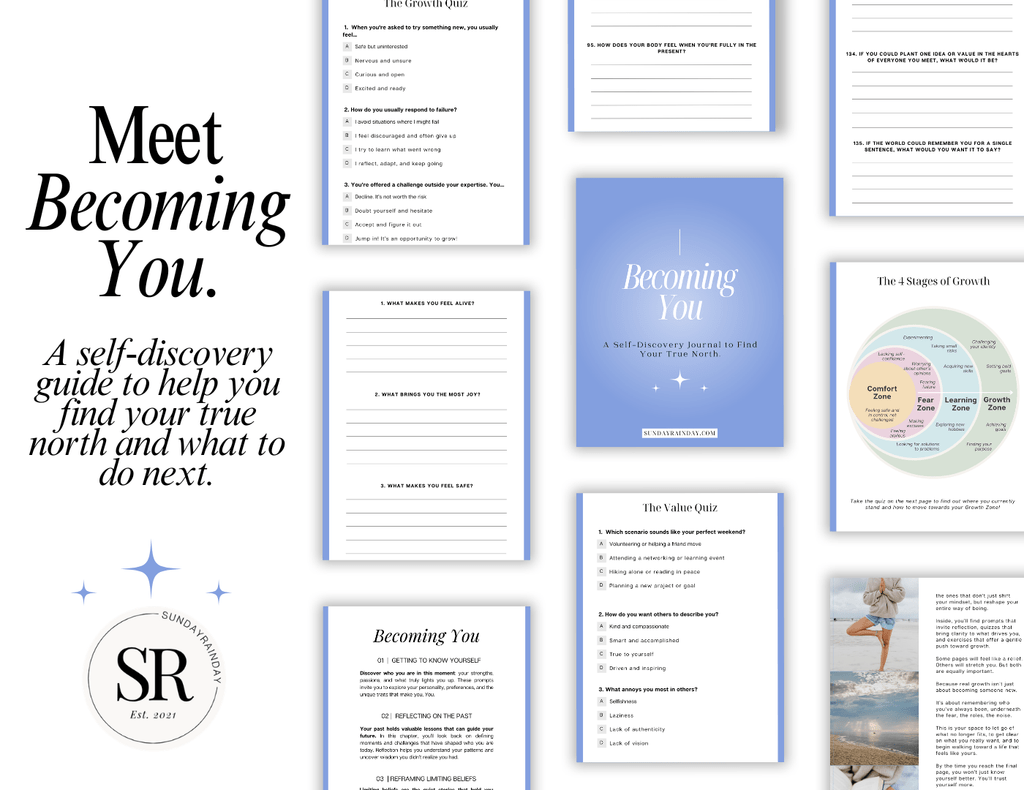
This is the whole reason Becoming You exists: a way to move from I’ve outgrown this to here’s the life I actually want to build, one deliberate step at a time, without the reckless leap. Becoming You is a 106-page guided journal built for exactly this stage. It walks you through honouring what’s ending, working out what you value now, and planning your first real steps.
Frequently asked questions
Is it normal to feel like you’ve outgrown your life?
Yes, and for most people it happens more than once. Any life built around who you were at one point will eventually fall out of step with who you become, and the more you grow, the more often that gap opens. Many people first notice it at a natural checkpoint: a milestone birthday, a promotion, a move, or the end of a relationship. The more useful question is how you read it. Treated as an emergency, it tends to push you into decisions you haven’t thought through.
What does it mean when you outgrow your friends?
Usually it means your values, pace or interests have shifted while your friendships are still built around the old ones. You notice it in conversations that feel like reruns, or in the way you edit yourself to fit a room that used to feel easy. It doesn’t have to mean the friendship is over, and it certainly doesn’t mean you’ve become better than anyone. Some friendships stretch to meet who you are now, especially when you’re honest about what has changed. Others naturally become smaller, and grieving that is part of the transition.
How do I know if I’ve outgrown my relationship, or just the life around it?
This is one of the hardest questions to answer from inside the threshold, because restlessness about your whole life easily lands on the person closest to you. Before concluding the relationship is the problem, ask whether the feeling is about your partner or about the routines, place and plans you built together. Name the specific things that have changed for you, then talk about them with your partner. Couples often grow in different directions for a while and find their way back once those changes are said out loud. If you still feel pulled away from the person, rather than the circumstances, after an honest conversation and a period of real rest, that deserves serious reflection, ideally with a couples therapist rather than alone.
Why do I feel like I’m living someone else’s life?
Because in a way, you are. The life you have was designed by an earlier version of you, often with plenty of input from parents, teachers, employers and the expectations of people around you. When your values shift, the choices made by and for that earlier self start to feel borrowed. The way forward is slower than a clean break: go through your life piece by piece and ask which parts you would still choose today. You’ll likely find that more of it is yours than it feels like right now.
How long does the feeling of outgrowing your life last?
There’s no reliable timeline, and anyone who promises one is guessing. Bridges saw the neutral zone as something that can’t be rushed, and for many people it’s measured in months. What helps is steady, honest work: noticing what you value now, taking small steps toward it, and letting the old identity go. What prolongs it is usually avoidance, which keeps you in the discomfort without moving you through it.
Will I ever feel like myself again?
Yes, though probably not like the self you were before. That’s the point of a transition: the person on the other side has reorganised around what matters to her now. The feeling usually comes back gradually, in moments at first, then in days, as your life starts to fit again. If instead you feel numb, persistently low or unable to enjoy anything for weeks at a time, that’s closer to the fourth cluster, and it’s worth talking to a doctor or therapist rather than waiting it out.
