

The 2-Minute Rule: How to Start What You Keep Putting Off
There’s one thing you’ve been meaning to do since earlier this week. It would take you about five minutes, you know it would, and it has still followed you through several days, at least two to-do lists and several showers. Then there’s the thing you’d love to be doing, the running or the writing or the language course, which you think about most evenings and haven’t started.
We usually treat these as the same failing and give them the same name. But they’re two different problems, and the 2-minute rule you’ve probably heard about is really two different rules, written by two different people, one for each.
That matters more than it sounds. Each rule works surprisingly well on the problem it was written for, and when the two get mixed up, you end up trying the 2-minute rule for a week and deciding it doesn’t do much.
Save this article
The 2-minute rule gets you started, habits keep you going.
Two minutes is enough to begin almost anything. Carrying on the next day, and the day after that, takes a little structure: a clear goal, a habit you can track and a plan for the days you don’t feel like it.
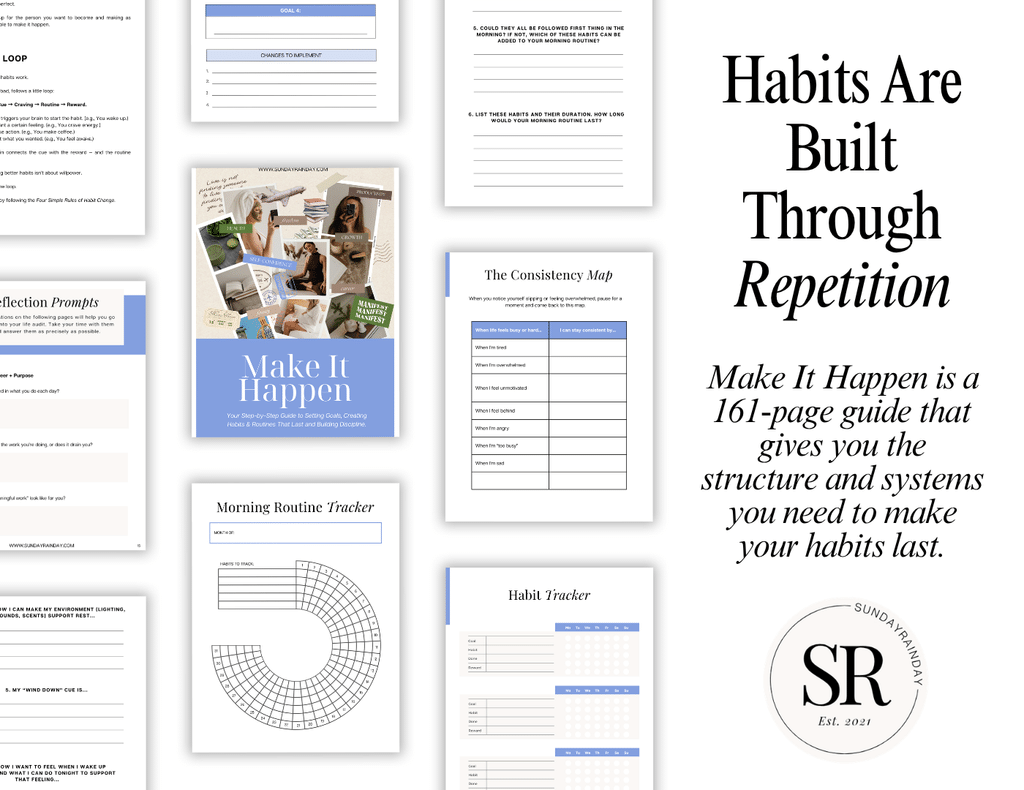
That’s what Make It Happen was created for. It’s a 161-page step-by-step workbook that helps you turn small starts into habits and routines that last.
What is the 2-minute rule?
The 2-minute rule is a way of getting yourself to start, and it comes in two versions. The first, from the productivity writer David Allen, says that if a task will take less than two minutes, you should do it now. The second, from James Clear, says that when you start a new habit, it should take less than two minutes to do.
They share a number and very little else. One is about finishing small things and the other is about beginning big ones, so it’s worth looking at them one at a time.
David Allen’s rule: if it takes less than two minutes, do it now
Allen introduced his rule in Getting Things Done, first published in 2001. His reasoning is practical. If something will take you less than two minutes, then writing it down, filing it and coming back to it later costs more time than doing it straight away. So you reply to the message, book the appointment or hang up the coat, and it never reaches your list.
The rule was designed for a particular moment, which is when you’re working through your inbox or your to-do list and deciding what to do with each item. Allen has said himself that there are no hard and fast rules about it. It’s a guideline for clearing the decks quickly, and you’ll see later why that detail is important.
James Clear’s rule: a new habit should take less than two minutes
Clear’s version appears in Atomic Habits, published in 2018, and it solves a different problem. When a new habit feels too big to begin, you scale it down to its first two minutes. “Read before bed each night” becomes “read one page”. “Do thirty minutes of yoga” becomes “take out my yoga mat”.
You aren’t trying to get fit or well read in two minutes a day. You’re practising the part that almost everyone finds hardest, which is turning up. Clear calls the two-minute version a gateway habit, because it’s the small start that leads you into the larger routine.
| Allen vs Clear | Allen’s rule | Clear’s rule |
|---|---|---|
| The problem it solves | Small tasks pile up and weigh on you | You can’t get started on something bigger |
| What you do | Finish the whole task now | Do only the first two minutes |
| When to use it | While you go through your inbox or your list | At the same point every day |
| Where it goes wrong | It eats the time you needed for focused work | You never move past two minutes |
Why two minutes works: the psychology of getting started
We tend to explain procrastination as laziness or bad time management, and neither explanation holds up for long. Nobody who cleans the entire kitchen to avoid one phone call is lazy. And if time were the problem, the ninety-second email would have been answered on Tuesday.
Psychologists who study procrastination describe it differently, and their explanation makes it much clearer why something as small as two minutes can help.
You’re avoiding a feeling
Fuschia Sirois and Timothy Pychyl, two of the best-known researchers in this field, argue that procrastination is mostly about managing your mood. Some tasks make us feel bored, anxious or unsure of ourselves before we’ve even begun. Putting them off brings quick relief, so we do it, and the cost is passed on to the person we’ll be next week.
This is why the size of a task matters less than how it feels to face it. “Write the report” arrives with a knot in your stomach. “Open the document and type the title” doesn’t, because there’s nothing in it to dread. Two minutes is too short to feel bad about, so there’s nothing left to avoid.
Easy things need very little motivation
BJ Fogg, who founded the Behavior Design Lab at Stanford University, sums up his research in a simple model: a behaviour happens when motivation, ability and a prompt come together at the same moment. If one of the three is missing, nothing happens.
You can’t do much about your motivation at seven o’clock on a wet morning. What you can change is how hard the thing is. Shrink a habit to two minutes and it becomes so easy that the little motivation you do have is enough.
What you’re avoiding is usually the feeling of the first minute, and five minutes is short enough to carry you past it.
How to use the 2-minute rule
Now that you know there are two rules, using them is mostly a matter of matching the rule to the problem. Most of us have both problems at once, a pile of small things we keep stepping over and one or two bigger things we can’t seem to begin. You can work on both, but you’ll use a different rule for each.
The six steps below start with the small tasks, because clearing them is quick and it frees up some attention. The rest are about the bigger thing, which is where the rule can change the most for you.
1. Work out which problem you have
Write down everything you’ve been putting off, without sorting it. Then go through the list and mark each item as either a task you could finish in two minutes or something that needs a habit behind it. “Renew the parking permit” is a task. “Get back into running” needs a habit. The two columns will get different treatment.
Take your time over this, because the two kinds are easy to confuse. Some items look like tasks and behave like habits. “Reply to emails” is never finished, so it belongs with the habits, while “reply to Anna about Saturday” is a task. Others sound small and turn out to be several steps in disguise. “Sort out the car insurance” feels like a two-minute job until you remember that you have to find the renewal letter, compare two quotes and ring someone. When that happens, write down only the first step, which probably does take two minutes.
It also helps to notice how each item makes you feel as you write it. The ones that make your stomach tighten are usually the ones that have been on your mind the longest, so give them a star. You’ll want to deal with one of those early, for the relief of it.
By the end you should have two short lists, a handful of quick tasks and one or two bigger things. If the second list has more than two items on it, choose the one you’d most like to have started a month from now and leave the others for later. One new habit at a time is plenty.
2. Clear the small tasks at set times
Choose two moments a day to go through your messages and your list, for example mid-morning and late afternoon. During those moments, anything that would take less than two minutes gets done on the spot. A useful test is whether writing the task down would take longer than doing it.
In practice, a session looks like this. You set a timer for fifteen or twenty minutes, open your inbox or your list and start at the top, beginning with anything you starred in step one. For each item you ask one question, which is whether you can finish it in two minutes. If you can, you do it there and then. If you can’t, you write down the next step and move on without starting it.
Now and then a task turns out to be longer than it looked. If you’re nearly done, finish it. If you’re not, stop, note where you got to and carry on down the list. The session is for clearing small things, and one long task will swallow it if you let it.
Outside those moments, small tasks go on the list and wait. This is the part of Allen’s rule that tends to get lost, and it’s what stops the rule from breaking your day into two-minute pieces.
For this to work, the tasks that turn up between sessions need one place to go. A note on your phone or a page in a notebook is enough, as long as it’s the only place. Small tasks get lost when they’re spread across three apps, a pile of sticky notes and the back of your hand. The exception is anything urgent, and you’ll know it when you see it.
3. Shrink the habit to its first two minutes
Take the bigger thing and ask yourself what the first two minutes of it look like. You’re looking for the action that begins it, and it should be so small that it feels faintly silly to write down.
- “Run three times a week” becomes “put on my trainers and walk to the end of the street”.
- “Write a book” becomes “open the document and write one sentence”.
- “Meditate every morning” becomes “sit down and take ten slow breaths”.
- “Learn Spanish” becomes “do one screen of a lesson”.
- “Keep the flat tidy” becomes “clear one surface”.
- “Sort out my finances” becomes “open my banking app and read yesterday’s spending”.
A good two-minute version passes three tests. You could do it on your worst day, when you’re tired, busy or in a bad mood. It needs no preparation, so if your trainers are at the back of a cupboard, getting them out and leaving them by the door is tonight’s version. And it’s something you could be seen doing, which rules out “think about my novel” and “plan my workout”.
If you can’t find a version small enough, you’ve probably started in the middle of the habit. Go back one step. Before the run comes getting changed, before the cooking comes taking the vegetables out of the fridge, and before the studying comes sitting down at the desk with the book open.
Related read: 12 High-Impact Habits That Shape Everything Else
4. Give it a time and a place
A two-minute habit still needs something to set it off, which is the prompt in Fogg’s model. The most reliable prompt is something you already do every day. “After I pour my first coffee, I’ll open the document.” “When I get home, I’ll change straight into my running clothes.” Decide it once, so you don’t have to decide it again every day.
A good prompt happens every day, at roughly the same time, and at a moment when you’re free to act. Your first coffee works well. Arriving home works too, unless you walk in to three children who want their dinner. Vague prompts such as “in the evening” or “when I have time” don’t work at all, because there’s no particular moment when they happen.
Then make the place do some of the work for you. Leave the book on your pillow, unroll the mat beside the bed, or keep the document open on your laptop overnight so it’s the first thing you see. Every small obstacle you remove is a little less motivation you’ll need tomorrow.
If the habit still isn’t happening after a week, change the prompt before you blame yourself. The same two minutes that never happen at ten at night often happen quite easily at seven in the morning.
5. Let two minutes be enough
This is the step that makes the rule work or fail. You’ll often carry on once you’ve started, and that’s welcome. But if you treat the two minutes as a trick to make yourself do thirty, some part of you will notice, and the resistance you were trying to get around will come straight back.
So on the days when two minutes is all you have, stop at two minutes and count it as done. You turned up, and turning up is what you’re practising. As Clear puts it, a habit has to be established before it can be improved.
This is harder than it sounds if you’re someone who’s hard on yourself. Two minutes can feel like cheating, and you’ll be tempted to say it doesn’t count. It does count, though for a different reason than a full session does. A long run does more for your fitness than a two-minute walk. But a two-minute walk on a day you wanted to skip does more for the habit, because it’s one more piece of evidence that you turn up even when you don’t feel like it.
A simple way to make this visible is to mark each day on a calendar or a habit tracker, and to mark the two-minute days in exactly the same way as the long ones.
The rule only works if two minutes is allowed to be the whole thing on the days you have nothing more to give.
6. Grow it slowly
Once the two-minute version happens most days without an argument, make it a little longer. One page becomes five, and the walk to the end of the street becomes a ten-minute jog. Add a little, give it a couple of weeks to settle, and add again. If the new version starts to feel heavy, go back to the last one that felt easy.
Here’s how that could look if your habit is running:
- Weeks 1 and 2: put on your trainers and walk to the end of the street.
- Weeks 3 and 4: walk for ten minutes.
- Weeks 5 and 6: go out for ten minutes and jog for one minute in every three.
- Weeks 7 and 8: jog for the ten minutes, or for as much of them as you comfortably can.
Notice that the two-minute version never disappears. It stays as your minimum, the thing you do on the days when the full version is out of reach. A bad week made of seven two-minute days leaves the habit standing, and a bad week of nothing means starting again.
The usual mistake is to grow too fast after one good day. Wait until the current version has felt easy for a couple of weeks, and then add to it.
Where the 2-minute rule stops working
The 2-minute rule is good at one thing, which is getting you over the start. It can’t choose your goals for you, and it won’t fix a week with too much in it. Knowing its limits will save you from blaming yourself when the rule was simply the wrong tool.
These are the four situations where I’d reach for something else, or at least adjust the rule before using it.
When small tasks take over your day. If you apply Allen’s rule to every message the moment it arrives, you’ll spend the day reacting and never reach the work that needs an hour of quiet. Keep it for your set moments.
When two minutes becomes the ceiling. If you’re still reading one page a night six months later, the habit has done its job as a start and now needs to grow. Go back to step six.
When the task isn’t the real problem. Sometimes you’ve avoided something for weeks because it frightens you, or because you no longer want the goal it belongs to. A smaller first step won’t settle that. It helps more to ask what you’re afraid will happen, and whether this is still something you want.
When the task can’t be made smaller. A difficult conversation can’t be had for two minutes. What you can do in two minutes is send the message that sets a time for it, and that is usually the part you were avoiding.
Related read: How to Overcome the Fear of Failure Based on Your Type of Fear
The 2-minute rule vs the 5-minute rule
You may also have come across the 5-minute rule, which sounds like the same idea with a different number. It’s close, but it’s used for something else. With the 5-minute rule, you promise yourself five minutes on a task you’re dreading, and when the five minutes are up you’re free to stop.
It suits one-off jobs that are too big to finish quickly and too unpleasant to begin, like a tax form, a cluttered cupboard or an overdue report. The 2-minute rule is better for things you want to do every day, because two minutes is small enough to repeat without thinking about it. Both rest on the same discovery, which is that beginning is the hard part, so use whichever fits what’s in front of you.
Two minutes is where it starts
The 2-minute rule is two rules, and they do different jobs. David Allen’s clears the small tasks that weigh on you, as long as you keep it to set moments in your day. James Clear’s gets you started on the bigger things by shrinking them to a first step you can’t talk yourself out of.
Both work for the same reason. We put things off to avoid how they make us feel, and two minutes is too short to dread. Once you’ve begun, carrying on asks far less of you than starting did.
So pick one thing today. If it’s a small task, do it the next time you go through your list. If it’s something bigger, write down its first two minutes, tie them to something you already do and let that be enough for now.
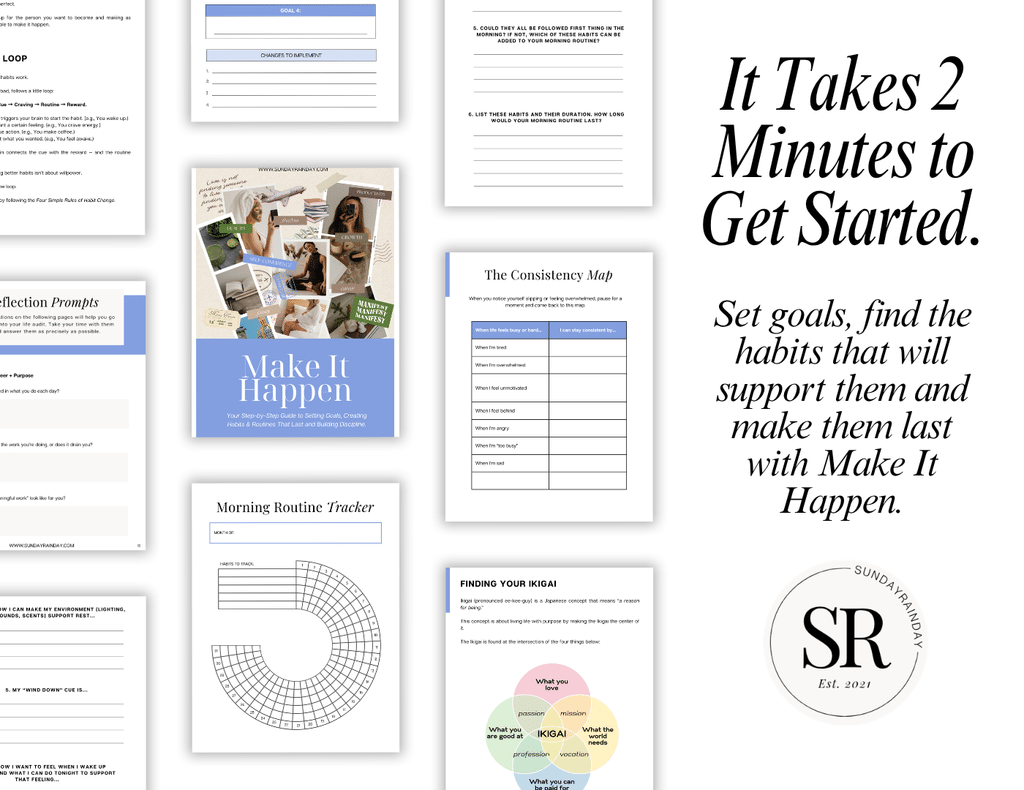
And when you’re ready to turn those two minutes into habits and routines that hold, this is the whole reason Make It Happen exists. It takes you from your goal to your habits and your daily routines, with a habit tracker and a consistency map for the days when your motivation is low.
Frequently asked questions
What is the 2-minute rule?
The 2-minute rule is a way to stop putting things off, and it has two versions. David Allen’s version says that if a task takes less than two minutes, you should do it now. James Clear’s version says that a new habit should take less than two minutes to do when you start it. The first clears small tasks, and the second helps you begin bigger ones.
Who created the 2-minute rule?
David Allen introduced the original rule in his book Getting Things Done in 2001, as a way of dealing with small tasks while clearing an inbox. James Clear adapted the idea for building habits in Atomic Habits, published in 2018. Clear credits Allen for the original version.
Does the 2-minute rule really work?
It works well for getting started, which is where most procrastination happens. Research on procrastination suggests we delay tasks to avoid the unpleasant feelings they bring, and a two-minute step is too small to trigger much of that. It works less well as a complete system, so you still need to grow the habit over time and protect your focused hours from a stream of small tasks.
What are some examples of 2-minute habits?
Read one page, put on your running shoes and step outside, write one sentence, take ten slow breaths, clear one surface, do one screen of a language lesson, or open your banking app and check yesterday’s spending. Each one is the first two minutes of a bigger habit. On most days you’ll carry on, and on the hard days the two minutes still count.
How long should you keep a habit at two minutes?
Keep it at two minutes until it happens most days without any inner argument, which for many people takes two or three weeks. Then add a little, let the new version settle and add again. If the longer version starts to feel like a burden, go back to the last version that felt easy and stay there a while longer.
Can the 2-minute rule help when you feel frozen by a task?
It can, because that frozen feeling, often called task paralysis, usually comes from a task that looks too big or too unclear to begin. Choosing a first step that takes two minutes gives you something definite to do. Open the file, write the first line or put the first three things away. Once you’re moving, the next step is much easier to see.
