

How to Do a Life Audit With the Wheel of Life
You know that feeling when something in your life is a little off, but you can’t quite put your finger on what it is? You’ve got this sense that you could be doing more, or living a bit more on purpose, if you only knew where to start.
That’s exactly what a life audit is for. Instead of carrying around a vague feeling that things could be better, you sit down and get an honest, clear-eyed picture of where you actually stand, and you come away knowing what to change first. And that’s what this guide will walk you through, step by step, using a simple tool called the Wheel of Life, whether you’re closing out the year or just taking stock before you set some big goals.
So by the time you reach the end, you’ll know your weakest areas, what actually deserves your attention first, and exactly where the gaps are between the life you have and the life you want.
Let’s get into it.
Skip the Blank Page
A life audit gives you clarity, but clarity fades fast if you’ve got nowhere to put it.
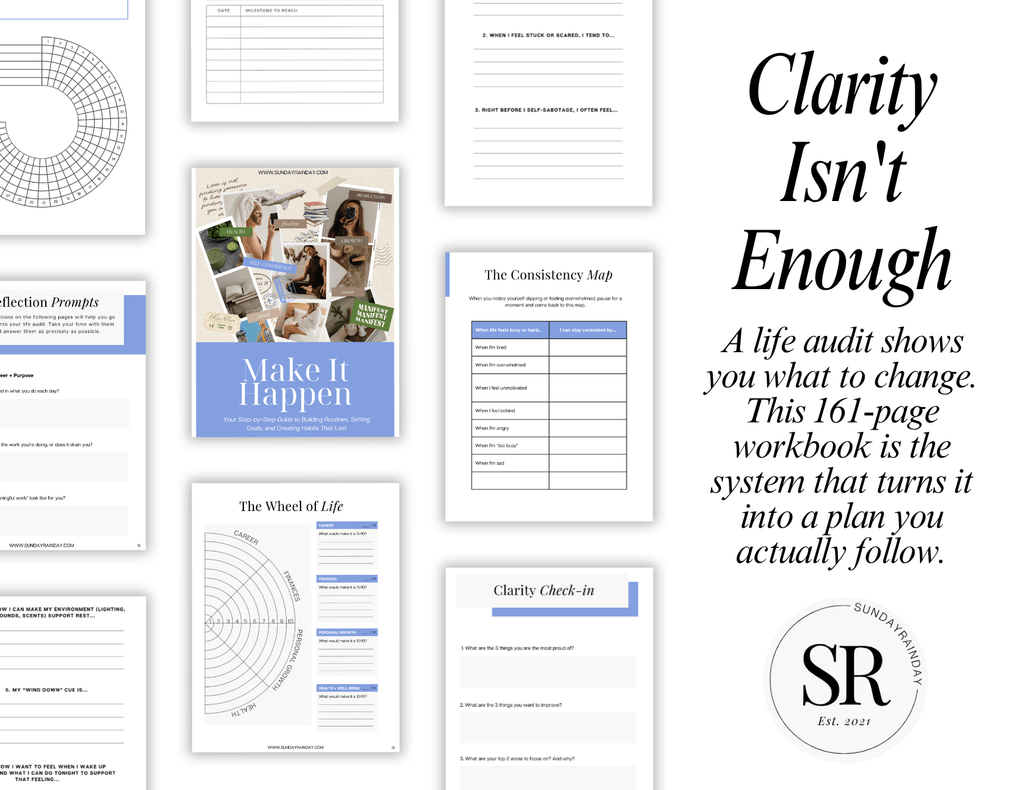
That’s exactly what Make It Happen is for. It’s the complete system that takes you from doing a life audit and the “I know what I want to change” phase to building an actual plan, with the goal-setting, roadmap, and habit-tracking pages already built, so you’re filling in a proven framework instead of starting from scratch.
Save this article

What Is a Life Audit?
A life audit is a structured review of your life across every major area, from your career and finances to your health and relationships. You rate how satisfied you are with each one, reflect on what’s really going on, get clear on what matters most to you, and spot the gaps between where you are and where you want to be.
Think of it the way a business reviews its performance before it sets next year’s strategy. You can’t improve what you’ve never honestly measured, and that’s really what a life audit gives you. It’s the measurement, so any goals you set later come from a clear reading of your life instead of a vague wish for it to be different.
And the easiest way to run one is with a tool called the Wheel of Life.
How to Do a Life Audit, Step by Step
A life audit moves through five steps. You take stock of every area of your life, reflect on what’s really going on in each one, get clear on what actually matters to you, choose where to focus first, and name the gap between where you are and where you want to be.
Here’s how to work through each one.
Step 1: Rate Every Area With the Wheel of Life
The Wheel of Life is a simple assessment that maps how satisfied you are across the different areas of your life onto a single diagram. In one look, it shows you which parts feel full and which ones you’ve been neglecting.
The Wheel is divided into eight areas:
- Career
- Finances
- Personal Growth
- Health
- Family / Friends
- Social Life
- Self-image
- Environment
Here is what it looks like:

Go through and rate each area on a scale of 0 (not satisfied at all) to 10 (completely satisfied). The point here isn’t to beat yourself up about everything you think is not right. It’s to be honest, so the rest of the audit rests on a true picture instead of the one you wish were true.
Then, for each area, ask yourself why you didn’t rate it a 10. What would it actually take to get there? Write down what’s missing in each area to reach full satisfaction, because that list becomes the raw material for everything that follows.
Step 2: Reflect on Each Area
Your ratings tell you where you stand, but a number on its own doesn’t tell you why, and the why is where the real insight lives. So before you move on, go back through each area and actually reflect on it. This is the part most people rush, and it’s the part that makes the whole audit worth doing.
For each area, ask yourself why you landed on that score and what would need to change to move it closer to a 10. A few prompts to get you going:
- What’s working well in this area right now?
- What’s frustrating me, draining me, or quietly stressing me out?
- What would a 10 actually look like here?
- What’s one thing I’ve been avoiding in this area?
And a few that dig a little deeper, depending on the area:
- Career: Does my work energize me or just exhaust me? Am I growing, or coasting?
- Relationships: Who lifts me up, and who leaves me drained? Who have I been neglecting?
- Health: Am I taking care of my body and mind, or running on empty?
- Environment: Does my space support the life I want, or quietly work against it?
Write your answers down. Messy and honest beats neat and polite here, because this is the raw material for everything that follows.
Step 3: Get Clear on What Actually Matters
Here’s something the scores alone won’t tell you: not every low number is a problem worth solving.
You might rate your physical appearance a 4 and genuinely not care, while a 6 in your relationships quietly matters more to you than anything else on the wheel. Satisfaction and importance are two different things, and mixing them up is how people end up pouring energy into areas that were never that important to them.
So go through your areas one more time, and this time ask what actually matters to you, not what you think should matter, and not what other people expect.
What do you value most at this point in your life? Which areas, if you improved them, would change how your whole life feels? The gap between an area’s score and how much you value it is where your real work is.
A low score in an area you deeply care about is your signal. A low score in one you don’t is just noise.
Step 4: Choose Your Priorities
Now you’ve got your ratings, your reflections, and a clear sense of what matters most. Before you do anything else, you need to decide what to focus on first, because you can’t work on all eight areas at once.
Here’s the thing: trying to fix everything at the same time is the fastest way to fix nothing.
Small changes you can stick to will always beat sweeping changes you abandon in a week. So take everything you’ve uncovered and pick your top two or three areas, the ones where a low score meets something you genuinely value. Leave the rest for later. They’re not forgotten, they’re simply next.
That narrowing of focus is exactly what makes the whole thing work.
Step 5: Name Your Gaps
For each of your priority areas, picture your ideal situation clearly, and then name the exact distance between that and where you are right now. That distance is your gap, and naming it precisely is what turns a vague feeling into something you can actually act on.
Take finances as an example. Say you rated it a 5 out of 10, so you ask why. The answer might be “I don’t earn enough,” or “I live paycheck to paycheck and it’s stressing me out.” From there, the gaps pretty much write themselves:
- I want to raise my monthly income to X
- I want to save X so I stop living paycheck to paycheck
Notice you’re still not setting goals yet. You’re just defining exactly what you want to be true. Do this for each priority area, and you’ve finished your audit with a clear, honest map of what needs to change.
From Audit to Action: Turning Your Audit Into Real Change
Your audit is done. You know where you stand, what matters most, and exactly where the gaps are. But an audit that stops at insight is really just a nice afternoon of reflection. The part that actually changes your life is what you do next, so this is where you turn those gaps into goals, a plan, and the daily habits that carry them out.
You don’t have to work through all of this in the same sitting as your audit.
In fact, it’s often better to let your findings breathe for a day or two first. But when you’re ready to turn insight into change, here’s how.
Step 1: Set Your Timeline
Before you set any goals, take a minute to decide what long-term, mid-term, and short-term actually mean for you. There’s no single right answer here, but one principle matters more than the rest: your long-term shouldn’t sit too far away.
And there’s a real reason for that. We’re surprisingly bad at planning for a distant future self. Research by UCLA psychologist Hal Hershfield shows that a lot of us relate to our future self almost like a stranger rather than as ourselves, and the weaker that connection is, the less we act in that future self’s interest. It’s a big part of why saving for retirement or investing in ourselves feels so hard, so the fix is to keep your horizon close enough to feel real.
Give yourself enough time to accomplish something meaningful, but not so much that the finish line stops motivating you. A structure that works well: a 5-year horizon for long-term goals, yearly deadlines for mid-term goals, and quarterly deadlines for the short-term ones. Adjust the numbers to fit your life, as long as they stay coherent with the vision you’re building toward.
Step 2: Set SMART Goals for Each Deadline
The easiest way to set your goals is to work backward. Start from what you want five years out, break that into five yearly goals, and then break those into quarterly goals that keep you on track as the months go by.
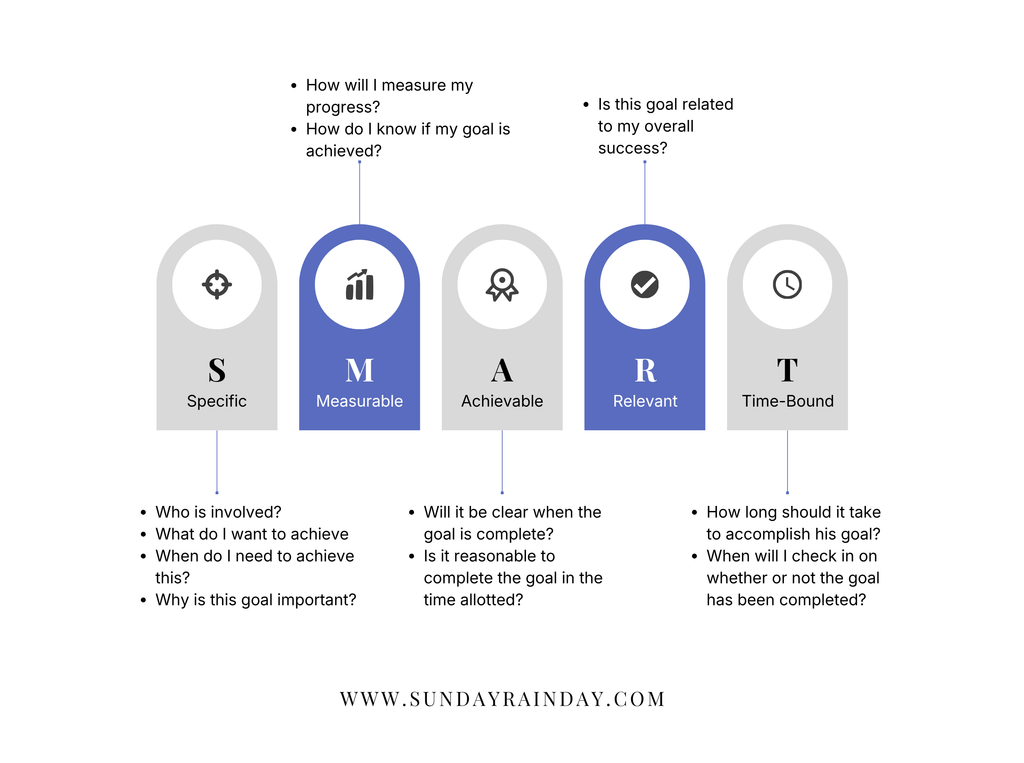
And make each one a SMART goal. The framework, first laid out by George Doran in a 1981 paper on writing objectives, keeps your goals tied to your vision and easy to track:
- Specific: a narrow, well-defined goal is easier to plan around
- Measurable: tie it to evidence so you can see progress
- Achievable: it has to be attainable within your timeframe
- Relevant: it aligns with your values and long-term vision
- Time-bound: give it a clear end date to stay motivated
Here’s what that looks like with the finances example:
“I want to save $50,000 by December 31, 2030. I want to save $10,000 in an emergency fund by December 31.”
Then shrink it down further. Saving $10,000 in a year sounds like a lot, but split by month it’s about $833, and once you break the yearly goal into monthly milestones it stops feeling abstract and starts suggesting a strategy. And if $833 a month feels impossible, that’s useful to know too, because now you might start a side project to bring in an extra $500 and find ways to save the remaining $333.
Breaking goals down like this brings clarity, and clarity is the first step to action. So write your goals down, and revisit them as you go.
Step 3: Build Your Roadmap
Your roadmap is where you turn all those goals and deadlines into something you can actually see.
We stay motivated by what feels concrete, and a plan you can look at is far more concrete than one you’re only holding in your head.
Think about it: “save $50,000 by the end of 2032” isn’t all that motivating on its own, not when you weigh up the five years of choices sitting behind it. But lay that same target out across quarterly steps and it starts to feel possible, because each step is small enough to picture and reach.
Your roadmap can be as simple as a sheet of paper with your yearly, quarterly, and monthly goals written out, or you can use a template. The format really doesn’t matter. What matters is that you can see your journey at a glance and it keeps you moving.
Step 4: Define Your Supporting Habits
Your goals tell you where you’re going, but your habits are how you actually get there, which makes defining them just as important as setting the goals in the first place.
This is also exactly why those short-term goals matter so much. You can’t build meaningful daily habits around a five-year goal, because the path is too far out to be clear. Anchor your habits to your quarterly or monthly goals instead, and they get obvious fast. If your goal is to save an extra $800 a month, the supporting habits almost name themselves:
- Review your budget once a week
- Unsubscribe from your favorite online stores
- Cancel unused subscriptions
- Wait 72 hours before any purchase over $100
- Cook instead of ordering takeout
- Declutter and sell what you no longer use
- Start a side project
Deciding which habits to build and which ones to break is what turns a goal into a real strategy.
Step 5: Track Your Habits and Progress
You can set the perfect goals and build all the right habits, and none of it matters if you’re not consistent. Progress comes from repetition, and repetition is exactly the thing that falls apart when the results are slow to show up. So you track two things.
First, track your habits. Watching the work stack up, even before the results arrive, is what keeps you going through that stretch where the effort and the reward haven’t caught up to each other yet. Use whatever you’ll actually stick with, whether that’s a notebook, a spreadsheet, or a habit-tracking app.
Then, every couple of weeks, track your progress. Your habit tracker tells you whether you’re doing the work; your progress tells you whether the work is paying off. Reviewing it regularly shows you if you’re moving in the right direction and gives you time to adjust if you’re not. If the progress isn’t there, look at your habit tracker first and ask whether you’ve been consistent. If you haven’t, dig into why. Usually it’s one of these:
- You took on too many new habits at once
- You scheduled your habits at the wrong times for your energy
- Old habits worth breaking are getting in the way
- You never built routines strong enough to support the goal
Step 6: Plan Your Rewards
Don’t wait until you’ve hit the goal to think about celebrating. Decide your rewards up front, and tie them to specific milestones along the way.
The reason is simple. Your brain repeats what feels good, so a reward isn’t just a nice bonus at the finish line, it’s part of what keeps the habit going.
And when you know there’s something waiting for you at the three-month mark, or the day you save that first $2,000, you’ve got something concrete pulling you forward on the days your motivation dips. So map out your rewards now, match them to your milestones, and actually take them when you get there. You earned them.
Frequently Asked Questions
What is a life audit?
A life audit is a structured review of how satisfied you are across every major area of your life, from career and finances to health and relationships. You rate each area honestly, identify the gaps between where you are and where you want to be, and use that clarity to set goals that actually matter. Think of it as the personal version of a business reviewing its performance before it sets strategy.
What areas should a life audit cover?
Most life audits use the eight areas of the Wheel of Life: career, finances, personal growth, health, family, relationships, physical appearance, and environment. You can adapt them to fit your life, but these eight give you a complete picture without becoming overwhelming.
How often should you do a life audit?
Once or twice a year works for most people. A year-end or new-year audit is the natural time to reset your goals, and a mid-year check-in lets you review your progress and adjust before the year runs out. The point is to run one often enough to stay intentional, without turning reflection into its own form of procrastination.
How do you do a life audit step by step?
Rate each area of the Wheel of Life from 0 to 10, choose your top two or three priorities, and name the gap between where you are and where you want to be in each one. Then set SMART goals across a long, mid, and short-term timeline, build habits to support those goals, and track both the habits and your progress as you go.
What is the difference between a life audit and setting goals?
Goal-setting decides where you’re going. A life audit decides whether you’re aiming at the right things in the first place. It comes before your goals and gives you an honest reading of your whole life, so the goals you set end up solving your real gaps instead of arbitrary ones.
Give Your Life a New Direction
You’ve got everything you need: the audit, the priorities, the goals, and the habits to back them.
The only thing left is to follow through, and that’s the part Make It Happen was built for. It’s the complete step-by-step system for turning this plan into a life you actually live, so the work you just did becomes real instead of another good intention.

Final Thoughts
A life audit isn’t a one-time fix. It’s a loop. You assess, you set goals, you follow through, and then you come back and do it all again with new goals and a clearer sense of what you want.
And that’s the quiet power of it. Each round builds on the last, and every goal you reach makes the next one feel a little more possible. Over time, the audit stops being an exercise you do and becomes the way you steer your life on purpose.
