

How to Change Your Life: 25 Things to Stop Doing
Most of us try to change our lives by adding things: a new goal, a new routine, a habit tracker with seven columns, a morning that starts an hour earlier. Sometimes adding the right thing does help, but just as often the change you’re looking for begins with doing less.
I learnt this the hard way. I spent ten years in finance being rewarded for how much I could carry, so I kept adding more structure, more responsibility and more output, until my life looked impressive from the outside and felt more and more like it belonged to someone else. What finally changed things wasn’t another habit. It was noticing the patterns I needed to stop, the ones quietly pulling me away from the life I said I wanted.
Those patterns are hard to see because they rarely look like problems. They look like overthinking, saying yes when you mean no, waiting until you feel ready, comparing your life with someone else’s, or filling your days with urgent tasks while the one thing that would move you forward keeps waiting. Repeated for long enough, they start to feel like your personality, when most of them are simply ways of coping you picked up along the way. And what you learnt, you can unlearn.
So if you’re wondering how to change your life in a way that lasts, this article gives you 25 things to stop doing, organised into three levels you can work through one at a time.
Build the structure that replaces old patterns
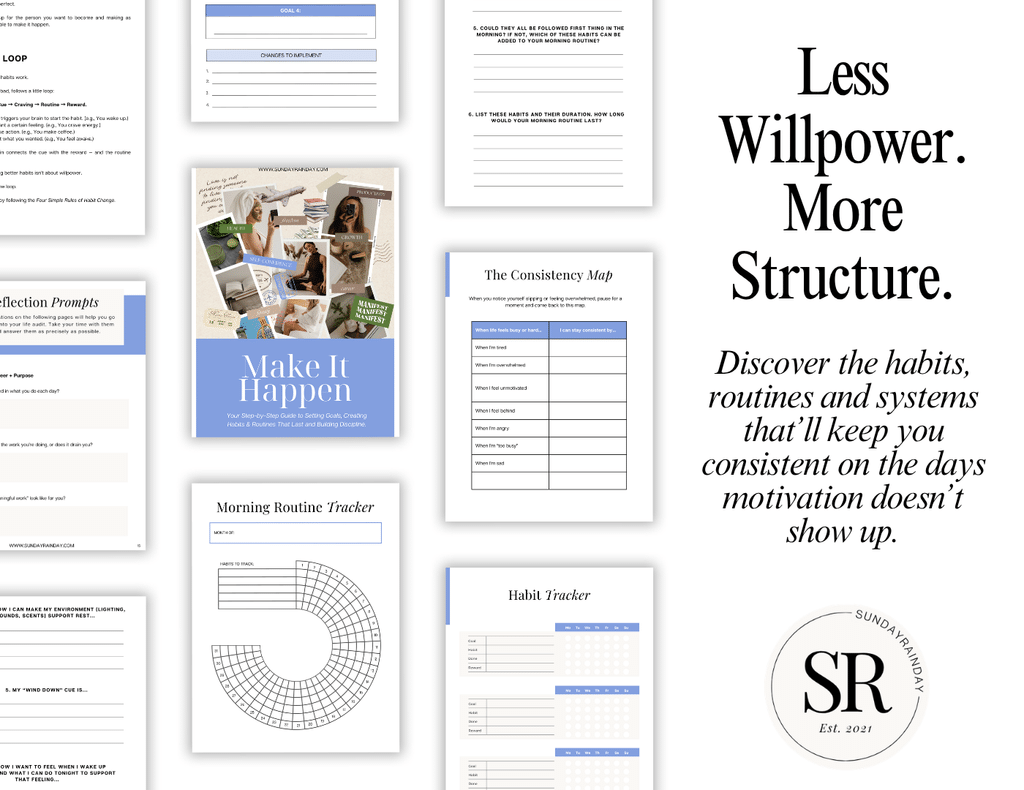
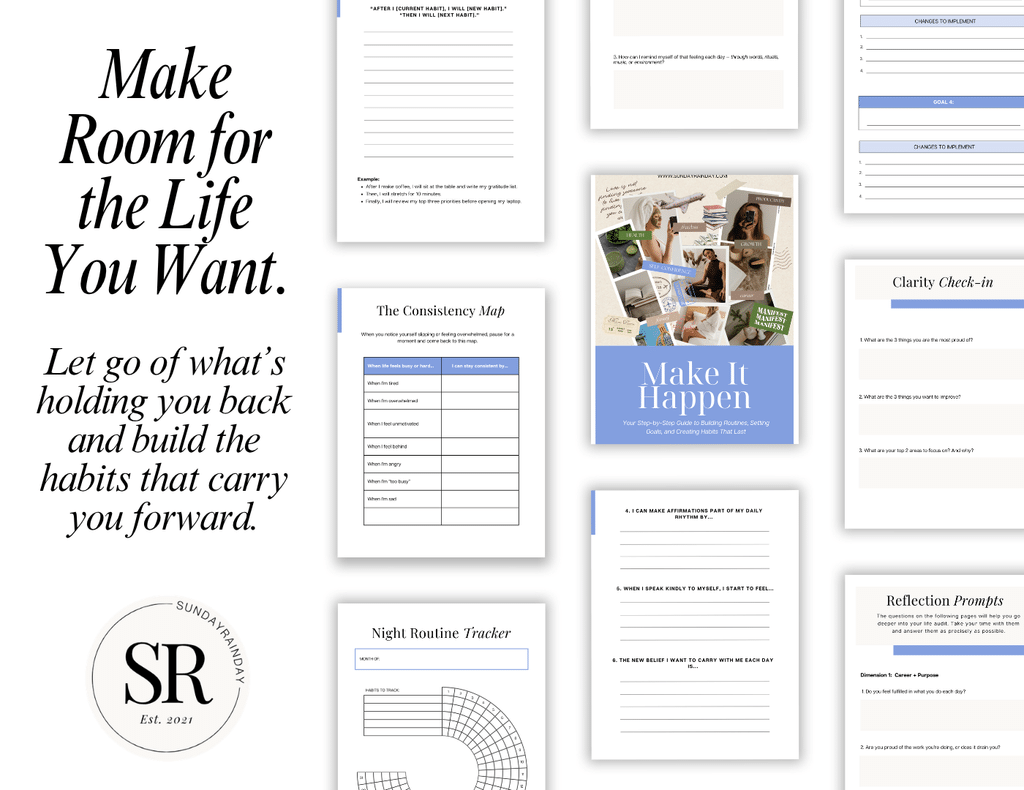
Stopping an old pattern is much easier when something better is ready to take its place. Make It Happen is the 161-page workbook I created for that part of the work. It helps you choose the goals that matter to you, build the habits and routines that carry them, and stay on track with tools like the Consistency Map when life gets busy.
Save this article
The Three Levels of Change
Most self-improvement advice treats everything that holds you back as the same kind of problem, to be fixed with the same kind of effort.
In reality, those things live in three different places. Some are mindsets: the beliefs you carry about time, effort and who you’re allowed to become. Some are habits: the daily behaviours that shape your life whether you choose them or not. And some are emotional patterns: the way you treat yourself when you meet fear, comparison and uncertainty.
Lasting change needs all three, because each level props up the others. A new habit won’t hold for long if the mindset underneath it still says “not yet”, and even the clearest plan struggles to survive an inner voice that punishes you every time you fall short.
That’s why the 25 things below are arranged in three parts, in the order change tends to happen: mindsets first, then habits, then emotional patterns. You don’t need to work through them all. Read each part, notice the points that feel uncomfortably familiar, and keep those in mind for the section at the end on where to begin.
Part 1: The Mindsets to Let Go of
Everything starts with how you think. The beliefs below rarely feel like beliefs, because they sound like common sense or simply the way things are. Yet they quietly decide what feels possible, and once they shift, the habits and emotions further down become much easier to change.
1. Waiting for the perfect time
One of the most common ways to delay change is to wait for a better moment. You’ll start when work calms down, when you have more time, when life feels more organised or when you finally know exactly what to do. It sounds sensible, even responsible, but that moment rarely arrives, because there’s almost always another reason to wait.
Waiting can become a quiet way of avoiding discomfort. You never say no to what you want, only “not yet”, and repeated often enough, “not yet” turns into years. Most meaningful change begins before you feel ready, with one honest step small enough to take this week. Pick the thing you keep postponing, work out what the smallest version of starting would look like, and do that before the week is out.
Related read: Letting Go of Expectations: 15 Beliefs That Quietly Run Your Life
2. Confusing maximum output with your full potential
Many of us are praised for how much we can carry. We’re reliable, quick to answer and always available, and we keep going when we’re running on empty. From the outside that looks like success. But how much you can produce when you push yourself to the edge says very little about what becomes possible when your energy, your values and your attention are working together.
You can be very productive and still feel disconnected from yourself, achieving a lot while the life you’re building doesn’t quite feel like yours. If that sounds familiar, start treating your energy as something to direct instead of something to use up. Look back at where your best hours went last week, and ask how many of them went to what you actually care about.
3. Mistaking busyness for progress
Busyness feels productive. A full calendar suggests things are happening, a long to-do list proves you’re trying, and constant movement looks a lot like progress. It’s also comfortable, because a day full of small tasks leaves no room for the one decision you’ve been avoiding.
You can tick off a hundred things and still feel that nothing meaningful has moved, and the difference usually comes down to whether any of those tasks were connected to where you want your life to go. At the end of each day this week, ask yourself what you did that the person you’re becoming would thank you for. If the honest answer is often “nothing”, you don’t need more effort, just a clearer sense of direction.
Related read: Busy But Not Productive? How Attention Residue Drains Your Focus
4. Relying on willpower instead of building systems
Most attempts to change begin with a promise to try harder: to be more disciplined, to resist the snack, to get up when the alarm goes. Willpower can carry you for a few days, but it tends to be at its weakest exactly when you need it most, when you’re tired, stressed or discouraged, which is why so many changes collapse after the first busy week.
The psychologist Wendy Wood, who has studied habits for decades, has found that people who seem to have great self-control rely less on willpower than on habits and surroundings that make the right choice the easy one.
So design your days the same way. Put the book on your pillow instead of promising to read, lay out your gym clothes the night before, and move the distraction out of reach instead of resisting it a hundred times a day. Systems like these keep going when motivation doesn’t, and they’re the foundation of making new habits stick.
5. Blaming your circumstances without choosing your next step
Your circumstances matter. Not everyone has the same time, support, money, energy or safety, and some seasons genuinely limit what you can do. Pretending otherwise would be neither honest nor kind. But when your circumstances become the whole story, it’s easy to lose sight of the choices you still have, and to stop looking for the small openings that exist even in a hard season.
You may not be responsible for everything that has happened to you, but you are still the one who chooses your next step. Agency doesn’t require believing that you control everything, only that your choices still count within the life you’re actually living. Name one constraint you can’t change right now, then write down one small thing you can still do around it.
6. Waiting for permission that is never coming
Many of us quietly wait to be chosen. We wait for someone to notice our potential, approve of our plan or tell us we’re finally ready, because moving with someone else’s blessing feels safer. If it goes wrong, the risk was shared, and if it goes right, someone believed in us first.
The trouble is that this permission rarely arrives. Most people are far too busy with their own lives to authorise yours, and the longer you wait to be chosen, the longer your life stays on hold. You don’t need everyone to understand your direction, or a guarantee that you’re right, before you begin. Think of one thing you’ve been waiting for someone else to approve, and decide whether your own yes is enough to take the first step.
7. Waiting to become someone else before you begin again
Another version of waiting is the belief that you need to become a different person first: more disciplined, more confident, more organised, more healed. Until then, starting feels like setting yourself up to fail.
Yet those qualities are built by beginning. Discipline grows from keeping small promises, confidence from acting while you’re still unsure, and self-trust from coming back after you’ve slipped. Nobody becomes that future version of themselves first and starts afterwards. Choose one area where you’ve been waiting to feel different before you act, and ask yourself what you’d do today if you stopped waiting to be ready.
Related read: 11 Self-Sabotaging Behaviors and How to Stop Them
Discipline is built from the small promises you keep, long before you feel like a disciplined person.
8. Keeping what you actually want vague
It’s hard to change your life when you’ve never described what you’d like it to become. Many of us live with a blurry sense that something is off. We want more, or less, or something different, but the feeling never comes into focus, so it never turns into a direction.
Vagueness is comfortable for a reason: if you never name what you want, you can’t fail at it, and nobody sees you wanting something you don’t have yet. A life you can’t describe, though, is very hard to build, and clarity tends to come from asking better questions, not from waiting for an answer to appear. If yours still feels blurry, these self-discovery questions will help you turn a vague feeling into something you can work towards.
Part 2: The Daily Habits to Stop
Mindsets set the direction, and habits decide whether you actually go there. The eleven below are everyday behaviours that shape your life one repetition at a time, usually without you noticing, and each one comes with a small way to start doing it differently.
9. Living on autopilot
Autopilot is hard to notice because it feels natural.
You wake up, check your phone, move through your responsibilities, answer what’s urgent, end the day tired and repeat it all tomorrow. Nothing is visibly wrong, but very little is being consciously chosen either. Your days are shaped by habit, pressure, expectation and convenience, and you can do everything you’re supposed to do while still feeling disconnected from your own life.
The way out starts with noticing, without judging yourself for what you find. Once a week, take ten minutes to ask what felt aligned, what felt heavy, what you did only because you always have, and what you’re tolerating that you no longer want to treat as normal. Those answers are where intention starts to come back into your days.
Related read: How to Stop Living on Autopilot and Get Your Life Back
10. Wasting your best energy on things that do not matter
Not all hours are equal. At certain times of the day your mind is clearer, your focus is stronger and ideas come more easily, and those are the hours that deserve your most meaningful work.
Yet many of us spend them on email, messages, small admin and other people’s priorities, and by the time we reach what actually matters, we’re already tired.
It’s one of the quietest reasons people stay stuck. They care about their goals, but those goals only ever get the energy left over at the end of the day. Work out when your best hours usually fall, and protect one of them, even just three mornings a week, for the thing that would move your life forward. The inbox can wait until afterwards.
11. Breaking promises to yourself
Self-trust is built through follow-through. Every time you tell yourself you’ll do something and then let it slide, your belief in your own word gets a little weaker: you skip the workout, postpone the project, stay up too late again. Each moment feels small, but together they form a pattern, and slowly you start to expect, before you even begin, that you won’t keep the promise you’re making.
The answer usually isn’t to become stricter with yourself. More often, the promises are too big, too vague or disconnected from the life you’re actually living. Make them smaller, small enough to keep on your worst day, and then keep them. Ten minutes of reading every evening, kept, will do more for your self-trust than an hour you planned and skipped.
Related read: How to Have Self-Confidence: The 4 Sources It’s Built From
12. Postponing your life through procrastination
Procrastination is rarely laziness. Sometimes it’s fear, sometimes overwhelm or unclear priorities, and often it’s a task that has grown so big in your mind that you can’t see where to begin. The reasons are understandable, but the cost is real: the longer you postpone something important, the heavier it becomes, until a small task turns into a constant hum of anxiety.
The way through is to make the beginning smaller. Instead of waiting until you feel motivated enough to do the whole thing, decide on the first visible action and do only that. “Get healthy” becomes putting on your walking shoes, “write the article” becomes opening the document, and “organise my life” becomes clearing the desk. Once you’ve started, carrying on is usually far easier than you expected.
13. Trying to do everything at once
Doing several things at the same time can feel efficient, but in practice it usually means doing all of them less well while feeling twice as tired. Every time you switch between tasks, part of your mind stays behind on the last one, a hidden cost called attention residue that quietly drains your focus. You’re busy all day, yet your attention is spread across so many things that none of them really moves.
The work that changes your life tends to need you fully present. So give it a block of time with one task and nothing else open: close the other tabs, put your phone in another room and decide what you’ll work on before you start. Even an hour of focused work a day can move something important further than a week of scattered effort.
14. Checking your phone before you check in with yourself
The first thing you give your attention to in the morning sets the tone for everything that follows, and for many of us that first thing is a screen. Before you’ve had a single thought of your own, you’re already taking in other people’s news, opinions and lives, and stepping straight into a world that wants something from you.
It seems like a small habit, but it teaches your mind to start each day reacting instead of choosing, and the early morning is one of the few moments when your attention still belongs to you. You don’t need a complicated routine to protect it. Charge your phone outside the bedroom, and keep the first ten minutes of the day for something of your own: a coffee by the window, a few lines in a notebook, or simply deciding what today is for.
15. Saying yes when you really mean no
Every time you agree to something you didn’t want to do, you hand a small piece of your life to someone else. It usually comes from a good place. You don’t want to disappoint anyone, you like being helpful and generous, and in the moment yes feels kinder than no.
But every yes is also a no to something else: the rest you needed, the work that mattered, the evening you meant to protect. The cost is invisible at first, and then one day you realise your calendar is full of things you never really chose. Boundaries are how you protect the energy your own life needs, and they can start with a pause. “Let me check and come back to you” gives you time to decide whether this is something you’d choose if saying no felt easy.
16. Ignoring your physical and mental energy
It’s very hard to build a meaningful life when you’re constantly exhausted, and yet many of us treat our energy as an afterthought. We cut sleep, skip rest and push through stress, and still expect ourselves to be focused, motivated and patient, then blame ourselves when we can’t follow through.
Your energy affects almost everything else on this list: your clarity, your focus, your confidence and your ability to make good decisions. So make it part of the plan instead of a reward for finishing it. Protect a regular bedtime, build a few minutes of rest into your working day, and notice which activities leave you drained and which leave you restored. Small changes here make every other change easier to keep.
17. Staying in spaces that keep you small
Your environment shapes what feels normal. That includes the rooms you live and work in, and also your relationships, routines, conversations and everything you read and watch. Some environments make growth easier. Others keep you attached to an older version of yourself, because they reward over-giving, normalise negativity or make your goals seem unrealistic.
This doesn’t mean cutting out every difficult person or leaving every imperfect situation. It means becoming aware of what your surroundings are reinforcing, and adjusting what you can. Spend a little more time with the people around whom you feel most like yourself, unfollow the accounts that leave you feeling behind, and look for one class, community or circle of friends where the life you want already feels normal.
18. Consuming endlessly instead of creating
It’s easy to spend years absorbing other people’s work. You read articles like this one, watch the videos, save the ideas and collect advice about the very life you keep postponing. It feels productive, because you’re learning, but consuming without acting can become a sophisticated form of avoidance: a way of gathering more information so that you never have to do anything with it.
At some point you already know enough to begin, and the next book won’t give you the permission the last ten didn’t. What’s missing is rarely more input. It’s the willingness to make something with what you already have, even if it’s imperfect and unfinished. Try a simple rule for the next month: for every hour you spend reading or watching advice, spend one acting on it.
At some point you already know enough to begin, and the next book won’t give you the permission the last ten didn’t.
19. Not finishing what you begin
Starting is exciting. The beginning of a goal comes with energy and possibility, and you can already picture the person you’re about to become. Finishing asks for something different: to keep going once the excitement has gone, through repetition, boredom, doubt and slow progress. This is where many of us stop, beginning the routine and then abandoning it, or starting the project and moving on to the next idea.
Sometimes stopping is the right decision, because some plans genuinely stop fitting. The difference lies between letting something go on purpose and drifting away from things again and again. Before you start anything new, decide what “finished” means for what you’re already doing, and give yourself a date to either complete it or close it deliberately.
Part 3: The Emotional Patterns to Release
You can hold the right mindset and build the right habits and still be held back from the inside. The last six are emotional patterns: the way you relate to yourself, to fear and to other people. They decide whether change feels sustainable or exhausting, and they tend to soften once you notice them.
20. Letting perfectionism delay your life
Perfectionism often looks like high standards, but it usually works as protection. It shields you from criticism, from uncertainty and from the discomfort of being seen trying. So you wait until the idea is clearer, the plan is better, the timing is right and you feel more confident, and the waiting can go on for years.
Confidence comes from evidence, though, and evidence only comes from doing. You need the imperfect first attempt and the messy beginning, because they’re what show you what to improve. Pick one thing you’ve been polishing in your head, give it a deadline for a first version you’d rate at seventy per cent, then share it, use it or send it, and let the next version be better.
21. Comparing your choices to someone else’s
Comparison is one of the fastest ways to lose touch with your own path. It makes you question your timing, play down your progress and feel behind in a life that was never meant to be measured against anyone else’s.
It also gives you incomplete information. You see someone’s result but not the private cost, the achievement but not the uncertainty, the beautiful moment but not the ordinary days before it. The bigger risk is that it pulls you away from your own values, until you’re chasing goals that belong to someone else. When you catch yourself comparing, ask what that person has that you actually want, and whether it fits the life you’re building. If it doesn’t, let it go. If it does, turn it into a goal of your own.
22. Speaking to yourself like someone you do not love
The way you speak to yourself shapes the way you experience your life. If your inner voice is constantly harsh, impatient or critical, your own mind becomes an exhausting place to live, where every mistake is proof that something is wrong with you and every delay turns into a flaw in your character.
Many of us believe we need that harshness to stay disciplined, but shame makes change harder to sustain, while self-compassion tends to make it easier. You can be honest without being cruel, and hold yourself accountable without attacking who you are. Next time you notice that harsh voice, ask what you’d say to a friend who had done the same thing, and say that to yourself instead.
23. Holding onto who you used to be
Sometimes what keeps you stuck is an identity more than a habit. You describe yourself in fixed terms: you’re always late, you never finish things, you’re bad with money, you’re just not a morning person. These stories may once have been true, but repeated often enough, they start to set the limits of what you’ll even try.
We rarely act against who we believe we are. If you’re convinced you’re inconsistent, you’ll read every stumble as proof and every effort as temporary. Growth asks you to let an older version of yourself go, even when she feels familiar and safe. Choose one label you’ve been carrying, write down a sentence you’d like to be true instead, and look for one small way to act on it this week. You’re allowed to outgrow the labels other people gave you, and the ones you gave yourself.
24. Letting the fear of failure make your decisions
Everyone feels fear. The problem starts when it quietly becomes the thing making your choices for you. You pick the smaller option, stay with what’s comfortable, avoid the risk that might expose you and talk yourself out of what you want, and you call it being realistic.
A life organised around avoiding failure is also a life organised around avoiding growth, because everything meaningful carries the possibility that it won’t work out, and every skill you admire in someone else was built on attempts that didn’t go well. You probably won’t get rid of the fear before you act, so the aim is to feel it and move anyway. Start with something where failing would be uncomfortable but survivable, and notice how much smaller the fear feels afterwards.
Related read: How to Overcome the Fear of Failure Based on Your Type of Fear
25. Rehearsing the worst before it happens
Some of us relive the past, and others spend their time in a future that hasn’t happened and probably never will. You imagine the conversation going badly, picture the plan falling apart and run through every way things could go wrong, as if preparing for disaster might prevent it. Your mind believes it’s protecting you, but it’s making you live through pain that hasn’t happened.
Worry also tends to be wrong. In a 2020 study at Penn State, people with generalised anxiety disorder recorded their worries for ten days and then checked what actually happened: 91 per cent of their worried predictions didn’t come true. None of this means ignoring real risks or refusing to plan, only noticing when your mind is solving problems that don’t exist yet. Try writing your worries down for a week and checking back on them afterwards. Seeing how few came true makes the next one much easier to put down.
How to Start Changing These Patterns
After reading a list like this, it’s tempting to want to fix everything at once. That usually ends in overwhelm, and overwhelm is one of the fastest routes back to the old patterns. Change works better when it’s focused, so choose one pattern to start with: the one that feels most costly right now, the one that keeps showing up in your days and quietly affects your energy, your confidence or your sense of direction. It doesn’t matter which of the three parts it comes from. Start where it hurts most.
Then give that pattern your attention for the next 30 days. Begin by answering four questions in writing:
- What is this pattern protecting me from?
- What is it costing me?
- What would change if I interrupted it for the next 30 days?
- What is one small thing I can practise instead?
The small thing is what turns insight into change. If you keep waiting for the perfect time, practise taking one step before you feel ready. If your best energy goes to things that don’t matter, protect your first focused hour of the day. If you keep breaking promises to yourself, make one tiny promise and keep it every day. And if comparison keeps pulling you off course, cut back on whatever sets it off, whether that’s an app, an account or a certain kind of conversation.
You’re not aiming to become perfect in 30 days, only to interrupt the pattern often enough to see that it can be interrupted. Each time you do, you collect a little evidence that your life can be different, and that evidence makes the next change easier to believe in.
Choosing what to stop
Learning how to change your life is rarely about doing more. More often it starts with an honest look at what you’re repeating: where your attention goes, which patterns cost you more than they give, and whether the life you’re living each week is one you’d choose to keep building. That kind of honesty can be uncomfortable, but it’s also a relief, because it shows you exactly where to begin.
A more intentional life is rarely built through one dramatic decision. It grows from the repeated choice to stop abandoning your own direction: you wait a little less, hide behind busyness a little less, give your best energy away a little less, and stop letting old patterns decide what your future gets to be. Slowly, your life starts to feel less like something you’re getting through and more like something you’re creating on purpose.
If you’d like a structure for that work, Make It Happen is where I’d start. It walks you through naming the patterns that hold you back, choosing goals that are truly yours and building the habits and routines that replace the old ones, with prompts on the moments you tend to self-sabotage and tools like the Consistency Map for the weeks when motivation fades.
Frequently asked questions
How do I actually start changing my life?
Start by choosing one pattern to interrupt instead of trying to fix everything at once. Pick the mindset, habit or emotional pattern that costs you most right now, and work on it for 30 days. Ask what the pattern protects you from, what it costs you and what one small thing you could practise instead. Lasting change is built from repeated small choices far more often than from one dramatic decision.
What should I stop doing to be happier?
The things that quietly drain your happiness are often subtle: waiting for the perfect time, comparing your life with other people’s, breaking promises to yourself, saying yes when you mean no and speaking to yourself harshly. You don’t have to stop all of them at once. Interrupting even one tends to free up the energy, clarity and self-trust that a happier life is built on.
How long does it take to change your life?
There’s no fixed timeline, but working consistently on one pattern for around 30 days is usually enough to feel a real difference. Deeper change unfolds over months, as new habits settle and your sense of who you are catches up. Speed matters less than direction: each time you interrupt an old pattern, you collect evidence that your life can be different, and that evidence builds on itself.
Why is it so hard to change your life?
Because many of the patterns holding you back don’t look like flaws. They’re ways of coping and protecting yourself that you learnt along the way, and they’ve become so familiar that they can feel like your personality. Change often means letting go of an old identity too, which feels unsafe even when that identity is limiting you. It gets easier when you rely less on willpower and more on changing your surroundings and routines, so that the better choice takes less effort.
