
The Ladder Method: How to Get Out of Your Comfort Zone and Make the Scary Thing Ordinary
You already know which thing this article is about. It came to mind somewhere between the title and this sentence: the conversation you keep rehearsing in the shower, the application that has been sitting in your drafts since spring, the class you have looked up three times and never booked.
Most advice on how to get out of your comfort zone treats this form of procrastination as a courage problem. Be braver, feel the fear and do it anyway, take the leap. But if one burst of courage were enough, you would have done it by now, because you have almost certainly had brave days since you first started avoiding it.
What usually goes wrong is the size of the step. We picture leaving the comfort zone as one bold move and clear exit, so we either never make it, or we make it once, find it awful, and retreat with fresh proof that we were right to stay put. This article takes the slower route, which also happens to be the only one that works. It covers what your comfort zone is for, why stepping out of it feels worse than it should, and how to stretch it in small steps you can repeat until the frightening thing becomes ordinary.
Save this article

What your comfort zone is, and what it is for
Your comfort zone is the set of places, people, routines and roles in which you know what will happen next. Inside it you feel competent and in control, your stress stays low, and very little of your attention goes on managing yourself.
That makes staying in your comfort zone far more useful than it suggests. It is where you rest, where you recover from hard weeks, and where skills you once found terrifying (driving, presenting, living alone) now sit quietly in the background. Everything in your comfort zone today was outside it at some point, which is the most encouraging fact about this whole subject.
The trouble starts when the things you want are on the other side of its edge. A comfort zone has no opinion about your goals. It only tracks what is familiar, so it will keep you away from a promotion, a friendship or a move with the same loyalty it shows in keeping you away from real danger. To get out of your comfort zone is to do something on purpose where the outcome is uncertain and habit can’t carry you, because you have decided that what sits on the other side is worth taking the risk to fail.
Why stepping out of your comfort zone feels so hard
Two things are working against you, and neither of them are part of your personality.
The first is the way avoidance teaches. Each time you back away from something that scares you, the anxiety drops, and that drop feels like relief. Your mind files the relief as proof that backing away was the right call. Clinicians see the same loop in its stronger forms: Cleveland Clinic’s guide to exposure therapy explains that avoiding what we fear can help in the short term, but over time it can make the fear worse. So the cancelled plan and the unsent email cost you more than the opportunity itself, because they also make it harder to try again.
The second is timing. Discomfort is immediate and impossible to miss, while progress is slow and hard to see. On the first day of anything new you get the full dose of awkwardness and almost no evidence that you are improving, so it’s natural to read the awkwardness as a verdict: this is not for me.
The researchers Kaitlin Woolley and Ayelet Fishbach tested what happens when people read that feeling differently. Across five studies involving 2,163 adults, they asked some participants to treat discomfort as a sign that the activity was working.
In one of those studies, 557 students in improvisation classes were given that instruction before an exercise. They took more risks, stayed in the spotlight for longer and came away with a stronger sense of achievement than classmates who were told only to feel themselves developing skills. Both groups did exactly the same exercise, and the only thing that differed was the meaning they had been given for feeling awkward.
This matters for you because the discomfort you feel at the edge of your comfort zone is mostly information about novelty. It tells you that you are somewhere unfamiliar, and it says very little about whether you are any good at what you’re trying to do.
Related read: 15 uncomfortable feelings that indicate you’re on the right path.
The relief you feel when you cancel is what makes the same thing harder next month.
The four zones: comfort, fear, learning and growth
You may have seen the diagram that maps all of this as four zones. It is a popular teaching model and you shouldn’t mistake it for a law of psychology, but it is useful, because it tells you what to expect and in what order.
You start in the comfort zone, where things feel safe and under control. The first thing you meet on the way out is the fear zone, where self-doubt gets louder, other people’s opinions seem to matter more, and excuses come easily. Most attempts end here, since nobody mentions that the fear zone is the entrance and that everyone has to walk through it.
Keep going and you reach the learning zone. You pick up new skills, deal with problems you haven’t met before, and start collecting evidence that you can handle more than you thought. Confidence tends to arrive at this point, after the evidence, and rarely before it.
Then comes the growth zone, where what used to frighten you has become part of your normal life and you find yourself setting goals you wouldn’t have dared write down a year earlier. The growth zone is, in other words, your new and larger comfort zone, and the same four stages will be waiting at its edge.
What the diagram leaves out is that nobody moves through it in a straight line. You will step into the learning zone on Tuesday and find yourself back in the fear zone by Thursday, and that back-and-forth is how a comfort zone grows.

How to get out of your comfort zone in seven small steps
The approach below borrows its logic from graded exposure, the method therapists use to treat fear: begin with something mildly uncomfortable, repeat it until it bores you, then move up a level. You don’t need a therapist to apply that logic to a job application or a dance class.
1. Choose one edge
Your comfort zone has many edges (social, professional, physical, creative, financial), and trying to push on all of them at once is a reliable way to push on none. Pick the thing from the first paragraph of this article, the one that came to mind before you had time to argue with yourself.
If several things came to mind, resist the urge to pick the most frightening one. Choose the one you would most regret leaving untouched a year from now. Fear is a poor way to rank your options, because it rates an awkward phone call and a change of career at roughly the same volume, whereas regret tends to know which of the two matters to you.
It’s also worth checking that the edge is really yours. Most of us carry around a few stretches we think we ought to want: the networking evenings, the marathon, the side business everyone else seems to be starting. A simple test is to ask whether you would still want to do it if nobody ever found out that you had. If the answer is no, you are looking at somebody else’s edge, and crossing it won’t give you much.
Then write your choice down as something another person could watch you do: “apply for the team lead role”, “go to the Thursday life-drawing class”, “tell my sister I can’t host this year”. An aim like “be more confident” gives you nothing to act on and nothing to measure.
Related read: How to overcome the fear of failure based on your type of fear
2. Build a ladder underneath it
Between where you are now and that goal, there are smaller versions of the same discomfort. List five or six of them and give each a score from one to ten for how uneasy it makes you.
Say the goal is to speak up in senior meetings. Your ladder might run from asking one question in your own team meeting (a three), to giving a two-minute update (a five), to disagreeing with someone out loud (a seven), to presenting to the leadership group (a nine).
If you struggle to find the rungs, there are three things you can turn down to make any step smaller: how many people are watching, how long it lasts, and how hard it would be to undo. Speaking for thirty seconds is easier than speaking for ten minutes, three colleagues are easier than thirty, and a trial class is easier than a paid twelve-week course. Change one of these at a time and you will usually find a version of the goal that makes you nervous without making you want to run.
Be a little strict about what counts as a rung, though. Each one should be a smaller dose of the thing you are afraid of, which means that reading three books on public speaking or spending a month researching dance schools doesn’t qualify. Preparation feels like progress, and it is also where avoidance most likes to hide.
Start around a three or a four. A one teaches you nothing, and a nine is how people end up telling the story of the time they tried once and never went back. Your scores will also turn out to be wrong in places, with a five that feels like a two once you are in it and a four that feels like an eight, so expect to redraw the ladder after the first couple of attempts.
3. Decide what the discomfort means before you feel it
This is the Woolley and Fishbach finding turned into a habit. Before each step, tell yourself in plain words what you expect: this will feel awkward for the first ten minutes, and the awkwardness means I’m in the right place. It sounds too simple to matter. But a meaning you choose in advance holds far better than one you try to attach in the middle of the moment, when your heart is already racing and every instinct is telling you to leave.
Be specific about what the discomfort will feel like in your body, too. For most people it is some combination of a warm face, a fast heartbeat, a dry mouth and a mind that goes briefly blank. When you have named those in advance, they arrive as things you were expecting, and they lose most of their power to convince you that something has gone wrong.
It also helps to rehearse the hard part in your head and skip the triumphant ending. Picture yourself walking into the room, not knowing where to sit, saying the first clumsy sentence and carrying on anyway. Imagining yourself coping tends to be better preparation than imagining the applause.
Finally, decide before you go what will count as success, and make it something you do, never the way it lands. “I asked one question” is within your control. “I asked a good question and people nodded” depends on a room full of other people, and if you measure yourself that way, a perfectly good attempt can still feel like a failure on the walk home.
4. Stay a little longer than you want to
The urge to leave is strongest early on. If you go at that point, you teach yourself the old lesson again, that escape brings relief, so the aim of every step is to stay until the feeling has had time to come down on its own, even slightly.
The easiest way to manage this is to set your leaving time before you arrive. “I’ll stay until half past eight” is a decision made by the calm version of you at home, and all the nervous version has to do is keep to it. Without that, the choice gets made in the moment by the part of you that most wants to be somewhere else.
Watch for the quieter ways of leaving as well, because you can walk out of a situation without moving your feet. Scrolling your phone at the edge of the room, standing next to the one person you already know all evening, letting a colleague make your point for you, sitting through the whole meeting with the question still in your notebook: each of these keeps your body in the room while you avoid the part that was the point of coming. Therapists call them safety behaviours, and they explain why some people do frightening things for years without the things ever getting easier.
While you are there, slow your breathing, unclench your hands, and pay attention to what is happening in the room instead of the commentary in your head. Ten more minutes is often enough to leave with a different memory of the whole event. And if you do go early, skip the post-mortem. Note how long you managed, and add five minutes next time.
5. Go back before the fear resets
One brave evening rarely changes anything, because a single visit can’t make a place familiar. Repeat the same rung soon, while the first attempt is still fresh, and then again, until it starts to bore you.
The practical trick is to book the second attempt before you have made the first. Once the first one is over, your mind will offer you a very reasonable bargain: you’ve proved you can do it, so there’s no need to do it again. A second class already paid for, or a second meeting already in the diary, takes that negotiation off the table.
Be ready for the second and third attempts to feel flat. The first time comes with adrenaline and a rush of pride afterwards. The repeats come with neither, and it’s easy to conclude that they aren’t doing anything. In fact that flatness is the result you came for, since it means the thing is on its way to becoming ordinary.
Your comfort zone grows on the second and third step, which is why the dramatic one-off leap changes so little.
You are ready for the next rung when you notice that you have stopped thinking about this one beforehand. The dread in advance is usually the last thing to go, long after the activity itself has become manageable, so it is a more honest signal than how well the last attempt went. And when an attempt does go badly, as some will, it still counts as a visit. Repeat the same rung once more before you decide anything about it.
6. Keep a small daily dose of the unfamiliar
Alongside the ladder, it helps to stay in practice with not knowing what happens next. Take a different route home, order the dish you can’t pronounce, sit with a colleague you’ve never spoken to, say yes to the invitation you would normally turn down on reflex.
The only rule is that it should cost you nothing if it goes wrong. A disappointing lunch or a dull conversation is a small price, and the smallness is what makes it work: you get to practise being slightly out of your depth on a day when nothing depends on it.
The most useful version of this habit is to catch your automatic no. Most of us decline things within a second or two, long before we have considered them, and then find a sensible reason afterwards. When you notice that reflex, wait a moment and ask whether the no is a preference or a habit. Sometimes you really don’t want to go, and that is a fine answer. But quite often you will find that the only objection is that you have never done it before.
None of this replaces the ladder. What it does is stop novelty from feeling like an emergency, so the bigger steps come with less shock. And saying yes more often doesn’t mean saying yes to everything: the test is whether the thing serves a life you want, or only fills somebody else’s diary.
7. Come back and rest on purpose
Stretching only works if you recover in between. Plan the quiet evening after the difficult conversation and the ordinary week after the big presentation, and enjoy them without guilt, because rest is what a comfort zone is for.
There is a difference between resting and retreating, and it comes down to whether the next step exists. When you are resting, the next rung is already in your diary and the pause has an end. When you are retreating, the pause is open-ended, and “I’ll get back to it when things calm down” gradually turns into never. So if you need a longer break, which will happen in a hard month, take it, and put a date on your return before you start.
Pay attention to the direction things are moving in as well. If a step leaves you dreading the next one more each time, treat it as a sizing error and go down a rung. The feeling you are aiming for is the uneasy, exposed feeling of being a beginner, and a step that produces panic is too big to learn from.
Once a month or so, take out the ladder and cross off whatever has become ordinary. We forget how frightening things used to be almost as soon as they stop being frightening, and without a record it can seem as though you have made no progress at all. A list of things that no longer scare you is the best evidence you will ever have that the next one won’t scare you for long either.
Everyday examples of stepping out of your comfort zone
What counts depends entirely on where your own edge is, so take from this list only what makes your stomach tighten a little.
- At work: ask the question you assume everyone else knows the answer to, volunteer for the project nobody on the team has done before, or ask your manager for specific feedback on one piece of work.
- With other people: go to an event alone and stay for an hour, tell a friend something true that you would normally smooth over, or invite someone you’d like to know better for coffee.
- On your own: take a beginner’s class in something you expect to be bad at, spend a day somewhere new without planning it, or share one thing you have made with people who didn’t ask to see it.
Frequently asked questions
What does it mean to step out of your comfort zone?
It means choosing to do something where you can’t predict the outcome or rely on habit, because what you want lies beyond what is familiar. The comfort zone itself is the range of situations in which you feel competent and in control. Stepping out of it can be as small as asking a question in a meeting or as large as changing career, and the size matters less than the fact that you chose it deliberately.
Why is it so hard to get out of your comfort zone?
Because avoiding something frightening brings instant relief, and that relief teaches you to avoid it again. At the same time, discomfort arrives straight away while progress takes weeks to show, so early attempts feel like all cost and no reward. Both effects fade with repetition, which is why small steps you can repeat work better than one big leap.
What are some examples of stepping out of your comfort zone?
Common ones include speaking up in a meeting, going to an event on your own, starting a class as a complete beginner, asking for feedback or a pay rise, travelling alone, and sharing creative work publicly. A good example for you is anything that produces a mild, manageable unease, roughly a three or four out of ten. If it causes no reaction at all, it is already inside your comfort zone, and if it causes panic, it is too big for a first step.
Is it bad to stay in your comfort zone?
No. Your comfort zone is where you rest and recover, and there are seasons of life (a new baby, a bereavement, a demanding stretch at work) when staying inside it is the sensible choice. It becomes a problem only when something you want sits outside it and you keep choosing familiarity over that thing. If the feeling is wider than one avoided step, and your whole life has started to seem too small, you may be outgrowing your life.
How long does it take to get comfortable with something new?
There is no fixed number, because it depends on how big the step is and how often you repeat it. What you can usually count on is the pattern: the first attempt tends to be the worst, the next ones get easier, and after a handful of repetitions the activity stops demanding your full attention. Long gaps between attempts slow this down, because the unfamiliarity has time to return.
How can I get out of my comfort zone at work?
Start with low-risk visibility: ask one question in each meeting, share an idea in writing before you say it aloud, or offer to present a small part of a larger update. Once those feel routine, move on to things with more exposure, such as leading a meeting, asking for feedback on a specific piece of work, or putting yourself forward for a project that would stretch you. Tell your manager what you are trying to develop, since people can only offer you the opportunities they know you want.
Turning one stretch into a plan
Being brave will get you out of your comfort zone once. To keep going for long enough to change your life, you need some structure as well: a clear idea of what you are working towards, what this week’s rung is, and what you will do on the days when your energy is low.
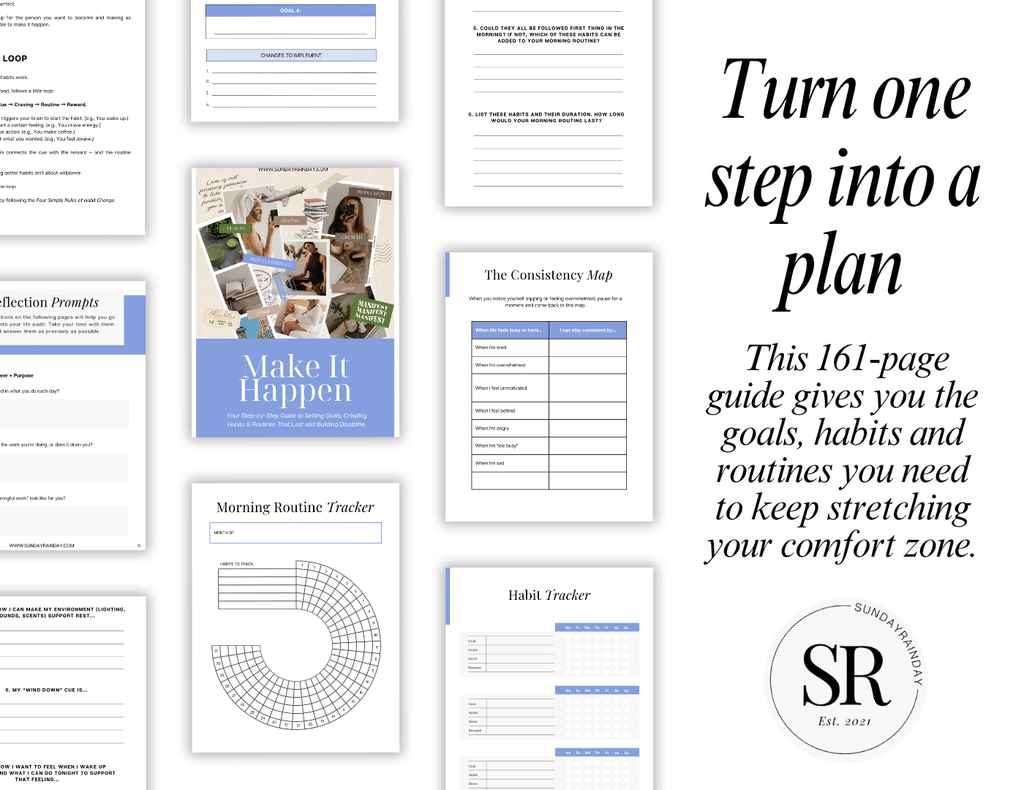
That is the gap Make It Happen was written to close. It is a 161-page workbook that takes you from a life audit to goals you care about, and on to the habits and routines that keep you moving, with a full chapter on the self-sabotage patterns that tend to appear just as you get close to an edge. If the ladder in this article made sense to you, the workbook is where you build the rest of the plan around it.