

Why Am I So Lazy? The Motivation Equation That Explains It
Lazy is one of the few labels we give ourselves without asking for any evidence. A task sits untouched for a week, the evening disappears into scrolling, the plan you were so excited about on Sunday is still a plan on Thursday, and the verdict arrives almost automatically: I’m just lazy.
It feels like an explanation, but “lazy” only describes what happened. It says nothing about why, and so it gives you nothing to work with except guilt.
Psychologists who study motivation have a far more useful answer. When you put something off, your brain is running a quiet calculation about whether the task is worth doing right now, and the result of that calculation can be predicted by four factors. Change any one of them, and your motivation changes with it. In this article, you’ll learn what that calculation is, how to spot which part of it is working against you and what to do about each one.
Save this article

Build a life you don’t have to force yourself through
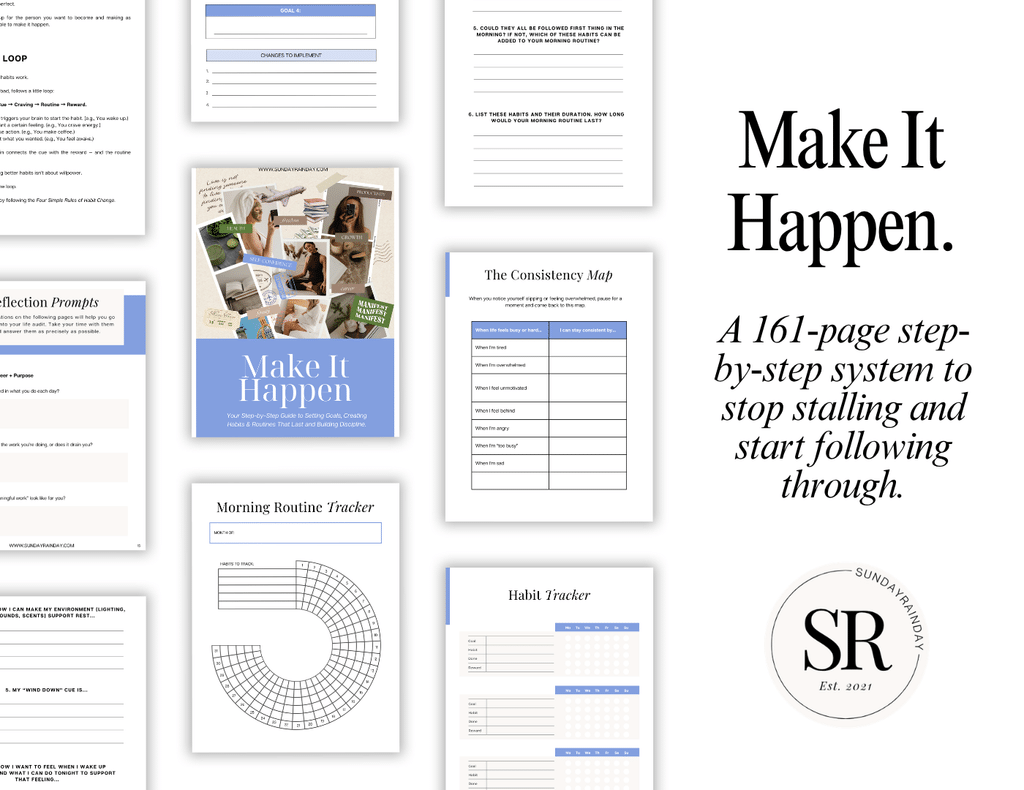
If you keep starting things and stalling, what usually helps most is a plan that works with the way motivation really behaves. Make It Happen is a 161-page workbook that helps you set goals that matter to you, break them into steps you can believe in, build the habits and routines that carry them and work through the patterns of self-sabotage that keep pulling you back.
Why “lazy” is the wrong word
When we call ourselves lazy, we’re describing a character trait: a fixed flaw that makes us less willing to try than other people. But the research on procrastination and motivation rarely finds a lack of effort at the root of it. People who put things off often care a great deal about the outcome. They lie awake thinking about the unfinished task, feel guilty about it all day and still don’t start. That pattern looks much less like laziness and much more like a motivation problem with a specific cause.
Avoiding a task is often about how it feels
The psychologists Fuschia Sirois and Timothy Pychyl have described procrastination as a way of managing our mood in the short term, at the expense of our future selves. When a task feels boring, confusing or threatening, putting it off brings immediate relief. That relief is real, which is why the habit is so hard to break. The cost arrives later, usually as stress, guilt and an even less appealing task.
Seen this way, the question changes. Instead of “what’s wrong with me?”, it becomes “what is it about this task, right now, that makes avoiding it feel better than doing it?”
That question has an answer. And the most useful version of it comes in the form of an equation.
“Lazy” describes what happened. It never explains why.
The procrastination equation: how motivation really works
In 2007, the psychologist Piers Steel of the University of Calgary published one of the most comprehensive reviews of procrastination ever carried out. His meta-analysis in Psychological Bulletin brought together 691 findings from decades of research to answer a simple question: what really predicts whether someone puts a task off? The answer fitted neatly into a model Steel called temporal motivation theory, which combines two long-standing ideas in psychology: that we’re motivated by what we expect to gain, and that we value rewards less the further away they are. It’s now better known by a simpler name. The procrastination equation.
The equation
Here it is in its simplest form:
Motivation = (Expectancy × Value) ÷ (Impulsiveness × Delay)
The top half of the equation raises your motivation. Expectancy is how confident you are that you can succeed. Value is how rewarding or meaningful the task feels to you. The bottom half lowers it. Impulsiveness is how easily you’re pulled towards something more immediately appealing. Delay is how far away the reward for your effort is.
Because the parts multiply and divide, a problem in any one of them can bring the whole result down. You can care deeply about a goal, but if you don’t believe you can do it, motivation stays low. You can be confident and excited, but if your phone is within reach and the payoff is a year away, the easier option keeps winning.
What the research found
Steel’s analysis found that some of the traits we often blame for procrastination, such as a general tendency towards anxiety or rebelliousness, had only weak links to it. The strongest and most consistent predictors were how unpleasant the task felt, how far away its reward or deadline was, how confident people were in their ability, how impulsive or easily distracted they were, and how organised and self-controlled they tended to be.
One finding stands out. Low confidence turned out to be a stronger driver of procrastination than perfectionism. In fact, people with perfectionist tendencies procrastinated slightly less on average, even though they worried more. If you’ve always assumed you put things off because you want them to be perfect, it’s worth asking whether the real issue is that part of you doesn’t believe they’ll go well.
Why this explains what feels like laziness
Think about how differently you approach different tasks. You might spend hours happily reorganising your kitchen while a work report sits untouched, or train for a race with total commitment while your tax return waits for months. If laziness were a character trait, it would show up everywhere. Instead, it shows up around specific tasks, at specific moments.
That’s exactly what the equation predicts. Motivation is less a fixed quantity you either have or lack, and more the result of a calculation that changes with every task and every situation. And because it’s a calculation, it can be changed.
The equation at a glance
| Part | The question it asks | When it’s working against you, it sounds like |
|---|---|---|
| Expectancy | Do I believe I can do this? | “I don’t even know where to start.” |
| Value | Does this feel worth doing? | “This is so boring. What’s the point?” |
| Impulsiveness | How easily am I pulled elsewhere? | “I’ll just check one thing first.” |
| Delay | How soon will I see the reward? | “I’ve got plenty of time.” |
The four parts of the equation, and how to work with each one
Each part of the equation points to a different reason you might be stuck, and each one calls for a different response. That’s why so much generic advice about laziness doesn’t work: a stricter routine won’t help if the real problem is that you don’t believe you can succeed, and a motivational quote won’t help if your phone is the real competition. Read through the four parts below and notice which one sounds most like you. Most of the time, one or two will stand out. Those are the ones to work on first.
1. Expectancy: when you don’t believe you can do it
Expectancy is your confidence that you can complete a task and that your effort will pay off. When it’s low, a task feels like a wall rather than a path. You may not even notice it as doubt. More often, it shows up as feeling overwhelmed, confused or strangely tired whenever you think about starting.
Signs expectancy is the problem:
- You don’t know where to start, so you don’t.
- The task feels too big, too vague or too far beyond your skills.
- You’ve tried something similar before and it didn’t go well.
- You spend more time planning and researching than doing.
What helps: The psychologist Albert Bandura found that the most powerful source of confidence is experience: small, real successes that show you what you can do. So shrink the first step until you’re certain you can do it. “Write the report” becomes “open the document and write three bullet points”. Define exactly what “done” looks like, because vague tasks feel harder than they are. And if the task really is beyond your current skills, the answer is information or help, rather than more effort. Asking someone, watching a tutorial or finding an example can raise your expectancy faster than anything else.
2. Value: when the task doesn’t feel worth it
Value is how rewarding, interesting or meaningful a task feels. Steel found that how unpleasant a task feels is one of the strongest predictors of putting it off. Boring, tedious or frustrating tasks lose to almost anything else, even when we know they matter.
Signs value is the problem:
- The task feels boring, pointless or draining.
- You can’t remember why you wanted to do it in the first place.
- You’d rather do almost anything else, including tasks you’d normally avoid.
- It’s someone else’s goal more than your own.
What helps: Reconnect the task to something you care about. Ask what it makes possible: the freedom, the security, the version of yourself it builds towards. Then make the task itself more appealing. The behavioural scientist Katherine Milkman calls one approach temptation bundling: pairing something you should do with something you enjoy, like listening to a favourite podcast only while you clean or go to the gym. You can also add a sense of challenge to a dull task by setting a timer and seeing how much you can finish before it rings.
And sometimes, low value is a signal worth listening to. If a goal has felt meaningless for months, it may be time to ask whether it still belongs on your list at all.
3. Impulsiveness: when something easier always wins
Impulsiveness is how strongly you’re pulled towards whatever is most immediately rewarding. It’s the part of the equation that makes a notification more compelling than a project, even when you’d much rather finish the project. Steel found that impulsiveness and distractibility were among the most consistent predictors of procrastination, and modern life gives them endless material.
Signs impulsiveness is the problem:
- You start working, then find yourself somewhere else without remembering deciding to go.
- You check your phone, email or messages “just quickly” many times an hour.
- You work better in a library or café than at home.
- You often switch to an easier task halfway through a harder one.
What helps: Distance. Make the distraction physically or digitally harder to reach: put your phone in another room, close every tab you don’t need, use an app blocker during focused hours. Decide in advance what you’ll do when the pull arrives, using a simple if-then plan: “If I feel the urge to check my phone, I’ll write one more sentence first.” Short, defined blocks of focus also help, because “for the next 25 minutes” is far easier to protect than “all afternoon”.
4. Delay: when the reward feels too far away
Delay is the distance between your effort and its reward. The further away the reward, the less it seems to count today, which is why “I’ve got plenty of time” is one of the most dangerous thoughts in the world of motivation. It also explains why so many of us suddenly become remarkably productive the night before a deadline.
Signs delay is the problem:
- You only seem to work well under pressure.
- Your goal is months or years away, with nothing in between.
- You start strong after a deadline is set, then drift until it’s close.
- You struggle to see your progress, so it doesn’t feel like progress at all.
What helps: Bring the reward closer. Break a distant goal into milestones with dates attached, so there’s always something within a week or two. Research by Dan Ariely and Klaus Wertenbroch found that people who set themselves deadlines performed better than those who had none, so give yourself deadlines even when nobody else does. Track your progress where you can see it, because a visible streak or a filled-in chart turns distant results into something you can feel today.
How to understand what feels like laziness in five minutes
The next time you catch yourself thinking “I’m so lazy”, try this instead. It takes five minutes, and it turns a judgement into a plan.
- Name the task. Be specific: “finish the first draft of my portfolio”, rather than “work on my career”.
- Score each part from 1 to 5. How confident am I that I can do this (expectancy)? How worthwhile does it feel (value)? How strong are the distractions around me (impulsiveness)? How far away is the reward (delay)?
- Find the weakest link. Look for the lowest score on the top half, or the highest score on the bottom half. That’s where your motivation is leaking.
- Choose one change. Use the strategies above for that part only. One targeted change usually does more than five general ones.
- Start with the smallest version. Whatever you choose, take the first step today, while the diagnosis is fresh.
Find the one part of the equation that’s working against you, and your motivation will usually follow.
What feels like laziness has a cause
What feels like laziness is usually the result of a calculation your brain makes about every task: how confident you feel, how much the task matters to you, how strong the distractions around you are and how far away the reward is. Piers Steel’s research shows that these four factors, captured in the procrastination equation, predict when we put things off far better than any label we give ourselves. When one of them is working against you, motivation drops. When you find it and change it, motivation tends to return on its own.
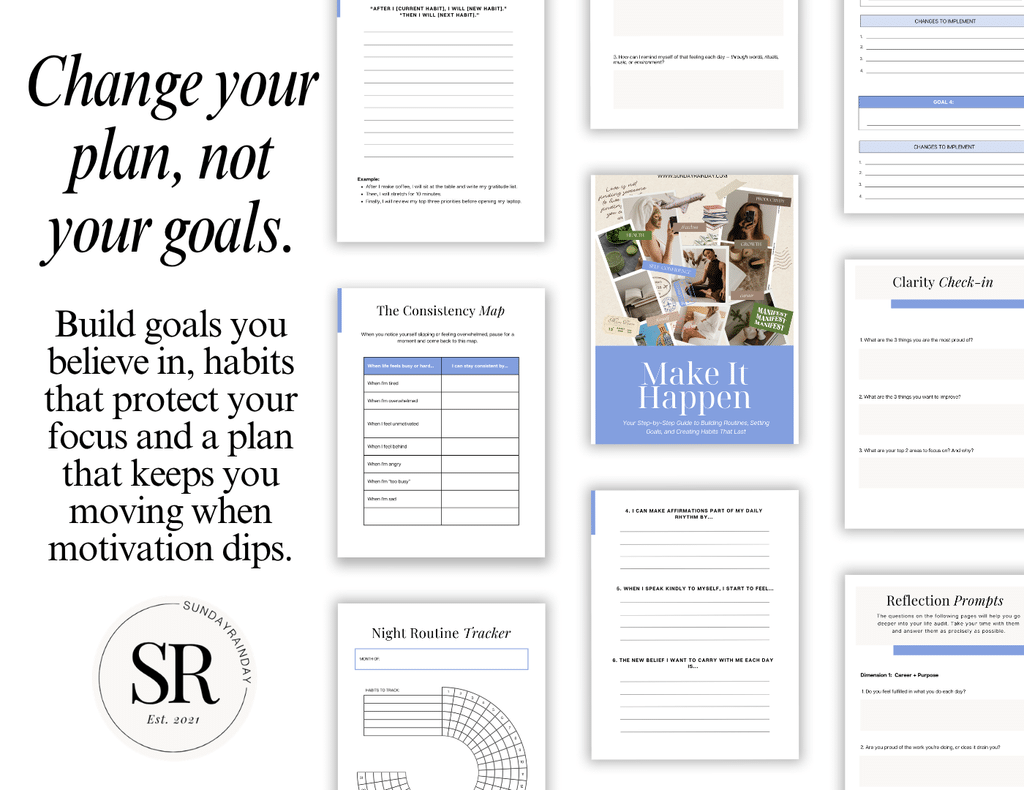
If you’d like to work through this in a more structured way, Make It Happen was designed to help. It takes you from a life audit and goals that reflect what you really want, which raises their value, through action plans broken into steps you can believe in, which raises your expectancy, to habits, routines and an environment that protect you from distraction. Its chapter on self-sabotage helps you understand the patterns that keep pulling you back, so the next time you feel stuck, you’ll know exactly where to look.
Frequently asked questions
Why am I so lazy?
What feels like laziness is usually a drop in motivation with a specific cause. According to the procrastination equation, motivation falls when you doubt you can succeed, when a task feels unrewarding, when distractions are close at hand or when the reward is far away. Identifying which of these applies to you is the first step to changing it.
What is the procrastination equation?
The procrastination equation, developed by the psychologist Piers Steel, describes motivation as (Expectancy × Value) ÷ (Impulsiveness × Delay). It’s based on temporal motivation theory and Steel’s 2007 meta-analysis of procrastination research.
Is laziness a personality trait?
Research on procrastination suggests that what we call laziness depends heavily on the task and the situation. Most people are highly motivated by some tasks and avoid others, which points to the task and its circumstances rather than a fixed trait.
Is procrastination the same as laziness?
No. Laziness implies not caring or not wanting to make an effort. Procrastination often involves caring a great deal and still delaying, frequently to avoid the unpleasant feelings a task brings up in the moment.
How do I stop being lazy?
Start by identifying which part of the equation is working against you. Break tasks into small steps to build confidence, connect them to something you care about, remove distractions and bring rewards closer with milestones and deadlines.
What if I’m tired or unmotivated all the time?
If low energy or low mood lasts for weeks and affects most areas of your life, it’s worth talking to a doctor or another health professional, as it can have causes that motivation strategies won’t address.
