

Discipline vs Motivation: Why the Most Disciplined People Don’t Rely on Willpower
In 2012, a team of psychologists gave 205 adults in Germany a smartphone that buzzed seven times a day for a week. Each time it did, they had to report what they wanted in that moment, whether it clashed with their goals and whether they were trying to resist it. Across nearly 7,800 reports, you’d expect the most self-disciplined people to be the ones resisting temptation most often.
But they weren’t.
The people with the most self-control reported fewer temptations, weaker desires and less resisting overall. Their discipline showed up long before any battle of willpower began: in the way they’d set up their days.
That finding changes how we think about discipline vs motivation. Most of us treat motivation as the fuel and discipline as the effort we fall back on when the fuel runs out. It’s why discipline so often feels like pushing, and why pushing so often ends in exhaustion. In this article, you’ll see what motivation and discipline really are, why relying on willpower and pressure wears you down, and what the research says the most disciplined people do instead.
Save this article
Build discipline into your days
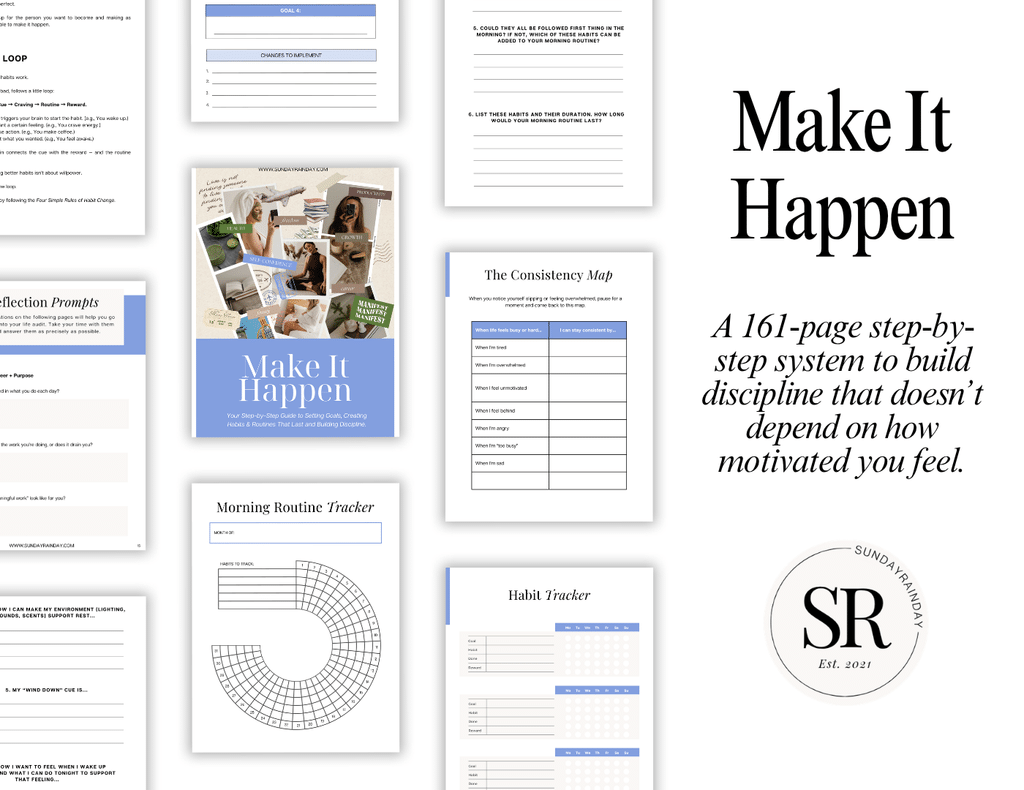
If you’re tired of starting strong and drifting by the third week, the missing piece is usually structure. Make It Happen is a 161-page workbook that helps you build that structure step by step: from a life audit and aligned goals to habits, routines, environment design and a personal consistency map. It’s designed for the days your motivation doesn’t show up, so your progress doesn’t depend on it.
What’s the difference between discipline and motivation?
Motivation is the desire to act: a feeling that rises and falls with your energy, your mood and what’s happening around you. Discipline is the ability to act in line with your goals whether or not you feel like it. Motivation tends to arrive at the start of something new and fade as the novelty wears off. Discipline is what keeps the behaviour going once it has. We need both, but they do very different jobs, and most of the frustration people feel about discipline comes from expecting one to do the other’s work.
Motivation: the spark that gets you started
Motivation is real, and it’s useful. It’s what makes you sign up for the course, buy the running shoes or open a blank page on a Sunday night. It points you towards what you want and gives you the energy to begin.
But motivation is a feeling, and feelings move. It drops when you’ve slept badly, when work gets busy, when the results aren’t showing yet or when the idea simply stops feeling new. If you only act when you feel motivated, you’ll only act on your good days. And most days aren’t the good days.
Discipline: what carries you when the feeling fades
The common picture of discipline is someone gritting their teeth and forcing themselves through. Read that way, discipline becomes a test of strength, and every time you fall short, it feels like proof you don’t have enough of it.
There’s a more useful way to see it. Discipline is less about how hard you can push and more about how little you need to. It’s the structure you build around a goal, so that the right action becomes the easy, obvious, default one. That’s the kind of discipline the research points to, and the kind that doesn’t burn you out.
Discipline vs motivation at a glance
| Motivation | Discipline | |
|---|---|---|
| What it is | A feeling: the desire to act | A practice: acting in line with your goals |
| Where it comes from | Novelty, emotion, inspiration, energy | Habits, routines, environment and clear decisions |
| How long it lasts | Rises and falls, often within days | Grows stronger the more you repeat it |
| What it depends on | Your mood and circumstances | Structure you build in advance |
| What it’s best for | Starting something new | Keeping it going |
Why the most disciplined people rely less on willpower
If discipline were mainly about resisting temptation, the most disciplined people would be the ones resisting most often. Over the past fifteen years, psychologists have found that this simply isn’t how it works. People with strong self-control tend to face fewer battles in the first place, because their habits and surroundings make the right choice the easy one. At the same time, the popular idea that willpower is a tank you drain through the day has turned out to be much shakier than it once seemed. Put together, these findings point to a calmer kind of discipline, and one that doesn’t depend on pushing yourself to exhaustion.
The everyday temptations study: less resisting, not more
The smartphone study from the introduction was led by the psychologist Wilhelm Hofmann and published in 2012 in the Journal of Personality and Social Psychology. Over seven days and nearly 7,800 reports, participants felt a desire at about half of the moments they were asked, from food and sleep to social media and a break from work. Around 47% of those desires clashed at least somewhat with their goals, and people actively tried to resist them about 42% of the time.
The surprise came when the researchers compared people with high and low self-control. Those with high self-control didn’t resist more. They reported weaker desires, fewer conflicts and less resisting overall. The authors concluded that self-control seems to work more by avoiding temptations in the first place than by fighting them in the moment.
In other words, the most disciplined people in the study weren’t winning more battles. They were simply in fewer of them.
Habits: the engine behind self-control
So what were they doing instead? In 2015, the psychologists Brian Galla and Angela Duckworth set out to answer that question across six studies with more than 2,200 participants, from students to adults on a meditation retreat. They looked at habits like healthy snacking, regular exercise, consistent sleep and studying.
Again and again, the answer was habits. People with more self-control had stronger beneficial habits, and those habits explained a large part of why self-control led to better results, from completing homework to keeping up meditation practice months later. People with more self-control also reported using less effortful inhibition in daily life. Their good behaviour had become more automatic, so it needed less willpower to keep going.
Think of habits as the scaffolding around a goal. Once it’s in place, the goal no longer has to hold itself up.
Motivation helps you start. Structure is what keeps you going once the feeling fades.
The willpower myth: why the “limited resource” idea is shaky
For years, one of the most popular ideas in psychology was ego depletion: the theory that willpower is a limited resource, used up by every decision and act of self-control, until there’s nothing left by the evening. It shaped a great deal of the discipline advice you’ll still read today.
The idea has struggled under closer scrutiny. In 2016, a preregistered replication across 23 laboratories and more than 2,100 participants found an effect so small it was statistically indistinguishable from zero. Researchers still debate exactly how self-control and mental fatigue work, but the simple picture of a draining willpower tank no longer holds up the way it once did.
What stays true either way is the lesson of the Hofmann and Galla studies. A life built around constantly resisting is tiring and unreliable, whatever the mechanism behind it.
Why pressure leads to burnout
When discipline means constant self-pressure, every difficult day becomes a test you can fail. Urgency and self-criticism can produce short bursts of effort, which is why they feel effective. But they turn each missed workout or unfinished task into evidence against you, and after enough of that evidence, stopping starts to feel like relief.
The research on self-compassion points the other way. In a set of four experiments published in 2012, the psychologists Juliana Breines and Serena Chen found that people who responded to a failure or weakness with self-compassion were more motivated to improve than those who didn’t. After a difficult test, the self-compassionate group was more motivated to study for the next one.
Being kind to yourself after a slip doesn’t weaken your discipline. It’s what lets you come back the next day.
How to build discipline that doesn’t depend on motivation
If the research is right, the goal is to need less willpower, rather than to find more of it. That means shifting your attention away from the moment of temptation and towards everything that happens before it: the way your days are set up, the habits you repeat, the reasons behind your goals and the way you treat yourself when things go wrong. The principles below are the foundations. For twenty specific tactics you can apply this week, you’ll find them in how to be more disciplined. Start here, though, because tactics only hold when the foundations underneath them are sound.
Signs your discipline is running on pressure
Before changing anything, it helps to notice what kind of discipline you’re using now. The signal to watch for is how your effort feels from the inside. Discipline that runs on pressure tends to look like this:
- You rely on guilt or fear to get started.
- You treat your goals as all or nothing, so one missed day feels like failure.
- You negotiate with yourself several times a day about the same decision.
- You feel a wave of relief when you finally give up.
- Your progress comes in intense bursts, followed by long gaps.
If several of these sound familiar, the answer is a different kind of structure, rather than more effort.
1. Fewer battles: change the situation, not your resolve
The Hofmann study showed that disciplined people encounter fewer temptations. You can do the same on purpose. Look at the moments when your discipline usually breaks, and ask what you could change about the situation rather than about yourself. If you always scroll instead of reading at night, the decision that matters happens when you choose where your phone sleeps, not at 11pm. If you skip the gym after work, the decision that matters might be packing your bag the night before or choosing a gym on your way home.
Every temptation you design out of your day is a battle you never have to fight.
2. Habits: let repetition do the heavy lifting
Galla and Duckworth found that habits explain much of why self-control works. A habit forms when you repeat the same behaviour in the same context, until the context itself starts to trigger it. So the most useful question is rarely “how do I make myself do this?” It’s “when and where will I do this, every time?”
Tie the behaviour to a fixed moment in your day, keep it small enough to repeat on your busiest days and protect the repetition above everything else. Early on, it will take effort. With time, it takes less, and that drop in effort is your discipline turning into something sturdier than willpower.
3. Meaning: connect your discipline to what matters to you
Discipline feels very different when it serves a goal you’ve chosen for your own reasons. Psychologists Kennon Sheldon and Andrew Elliot have shown that people put more sustained effort into goals that reflect their real interests and values, compared with goals they pursue out of pressure or a sense of obligation.
So before you push harder on a goal, check where it came from. Does it reflect what you want for your life, or what you think you should want? A life audit and a clear picture of where you’re heading in the next few years make this much easier to answer. When the reason is yours, discipline stops feeling like a punishment and starts feeling like a choice you keep making.
4. Self-compassion: make it easy to come back
Everyone misses days. What separates lasting discipline from the burnout kind is how quickly you return. As the self-compassion research shows, treating a slip with understanding makes you more likely to try again, while harsh self-criticism makes quitting feel like relief.
When you miss a day, name what got in the way, adjust the plan if you need to and pick it back up at the next opportunity. No catching up, no doubling the effort to compensate. Just return.
5. Rest: build recovery into the plan
Sustainable discipline includes rest by design. A plan with no room for recovery only works until your energy runs out, and then the whole structure collapses at once. Schedule your demanding work for the hours you’re usually sharpest, keep lighter tasks for the hours you’re not and treat time off as part of the system rather than a break from it.
Rest is one of the things that keeps you disciplined, rather than a reward you have to earn.
Discipline is built in structure, not pressure
Motivation is the feeling that gets you started, and it will always come and go. Discipline is what carries a goal through the days it doesn’t show up. The research on self-control shows that the most disciplined people don’t spend their days resisting temptation. They meet fewer temptations, because their habits and surroundings make the right action the default, and they rely less on willpower, an idea that has proved far less solid than it once seemed. The discipline that lasts is calm, structured and kind: it changes the situation instead of fighting it, lets repetition do the work, serves goals that matter to you, makes room for rest and makes it easy to come back after a slip.
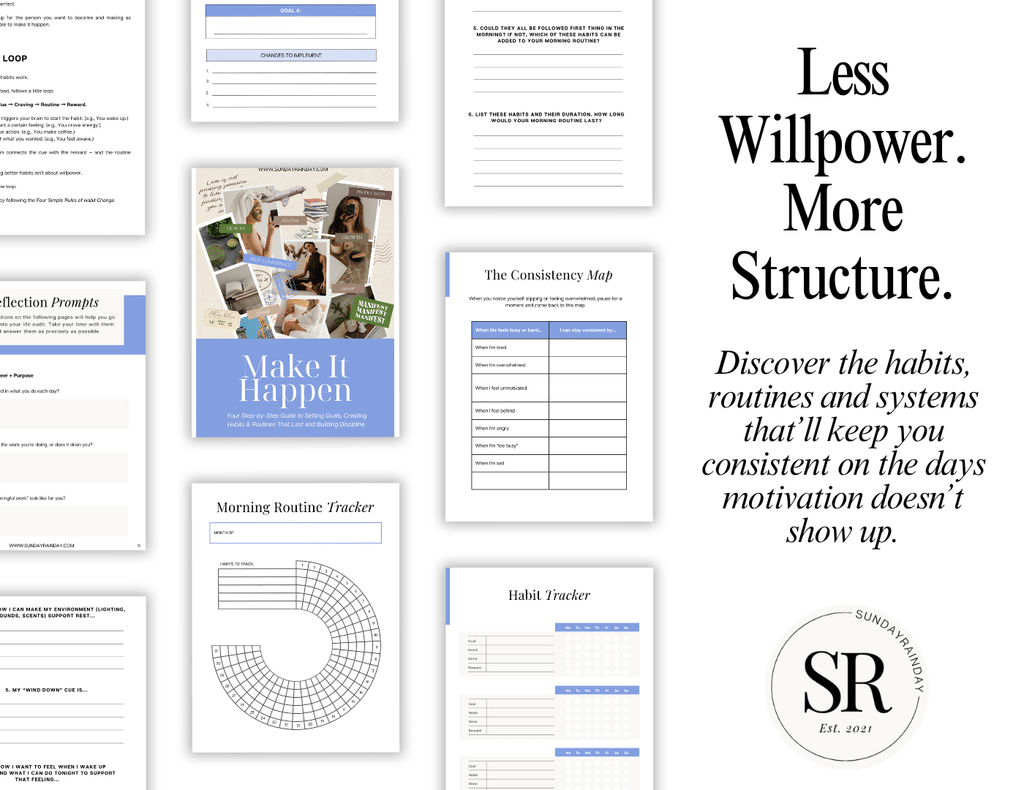
If you’d like to build that kind of discipline step by step, Make It Happen was created for exactly this. Its nine sections take you from a life audit and goals that reflect what you really want, through habits, routines and environment design, to working through self-sabotage and a personal consistency map. It gives your goals the structure they need, so your progress no longer depends on how motivated you feel on any given day.
Frequently asked questions
What is the difference between discipline and motivation?
Motivation is the desire to act, a feeling that rises and falls with your mood and energy. Discipline is the ability to act in line with your goals whether or not you feel like it, usually supported by habits, routines and a well-designed environment.
Which is more important, discipline or motivation?
Both play a role. Motivation is most useful for starting something new, while discipline is what keeps it going once the initial excitement fades. For long-term goals, discipline matters more, because motivation rarely lasts.
Can you have discipline without motivation?
Yes. Disciplined behaviour often runs on habits and structure rather than feelings, which is why disciplined people can keep going on days they don’t feel motivated.
Is willpower a limited resource?
The popular theory that willpower runs out like fuel, known as ego depletion, has been hard to replicate. A 2016 study across 23 laboratories found an effect close to zero, although researchers still debate how self-control and mental fatigue work.
Why do disciplined people find it easier?
Research suggests people with high self-control experience fewer and weaker temptations, largely because they’ve built habits and routines that make good choices automatic. They rely less on resisting in the moment.
How do you build discipline without burning out?
Change your environment to reduce temptations, build habits through repetition, connect your goals to what matters to you, plan rest into your schedule and respond to missed days with self-compassion rather than self-criticism.
