

How to Make a Vision Board That Actually Works (Step-by-Step)
If you have already created a vision board at least once, you know how it works. You spend a couple of hours on Pinterest, save pictures of a beautiful house, a fit woman exercising, a model wearing a trendy outfit and a clean, organised desk, arrange them into something pretty, and feel motivated for about a week. Then the board goes on a wall or into a folder, and a few weeks later you can’t even remember the last time you looked at it. That’s when you realise your vision board didn’t change a thing in your life.
If that sounds familiar, you didn’t do anything wrong. You just started at the end. A vision board is the last step of a longer piece of work, and when you go straight to the pictures, you end up with a collage of things that look nice, which is very different from a picture of the life you want.
So this guide starts earlier. We’ll look at what psychologists have learned about picturing your future, because it changes what belongs on a board, and then we’ll make a vision board together, step by step, on paper or on a screen. The last part covers something most guides skip, which is what to do with your board once it’s on the wall.
Save this article
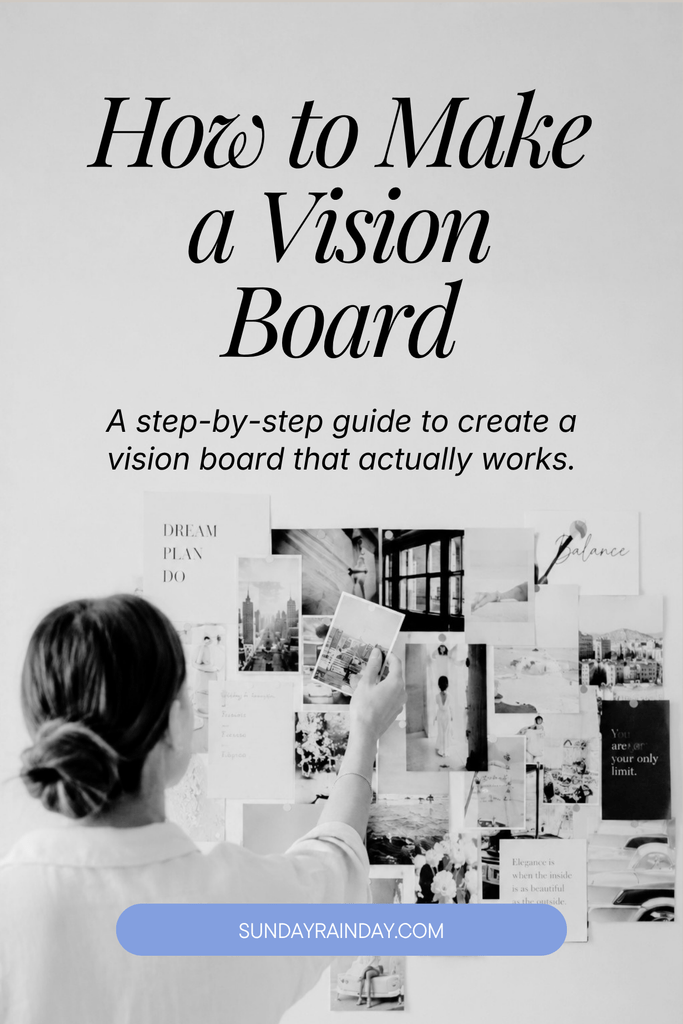
Why most vision boards don’t create real change
Most vision boards fail because they’re built without clarity or follow-through. The images get chosen without much intention, the goals stay abstract, and the board slowly turns into decoration instead of direction.
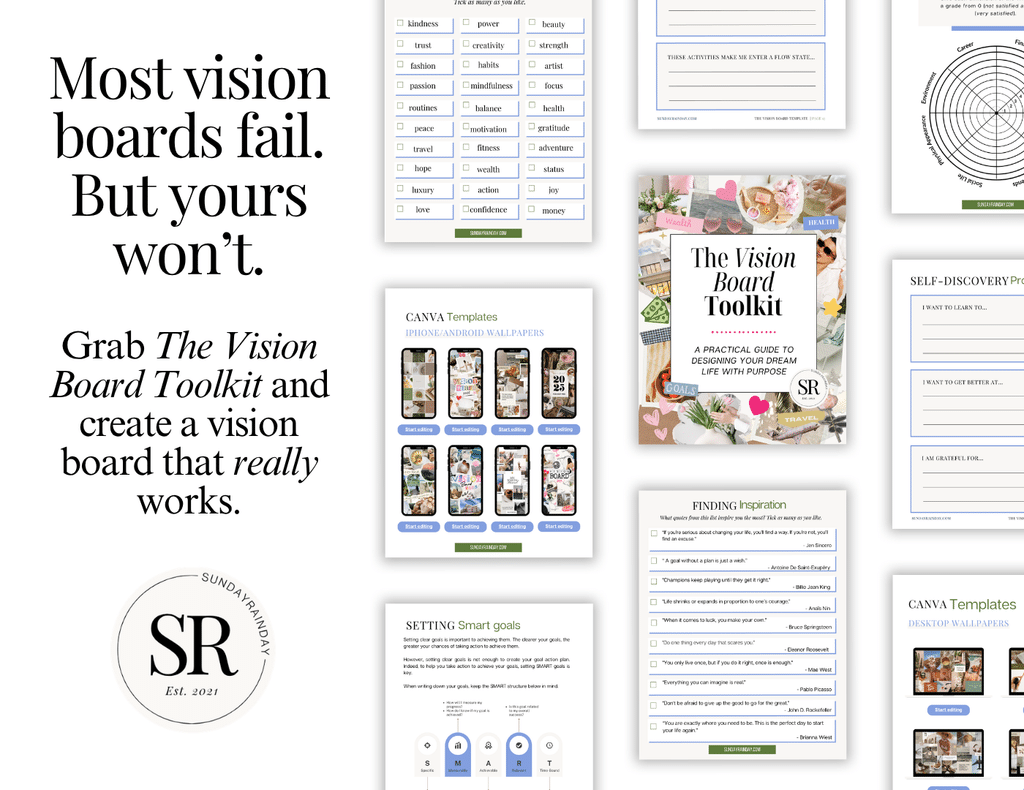
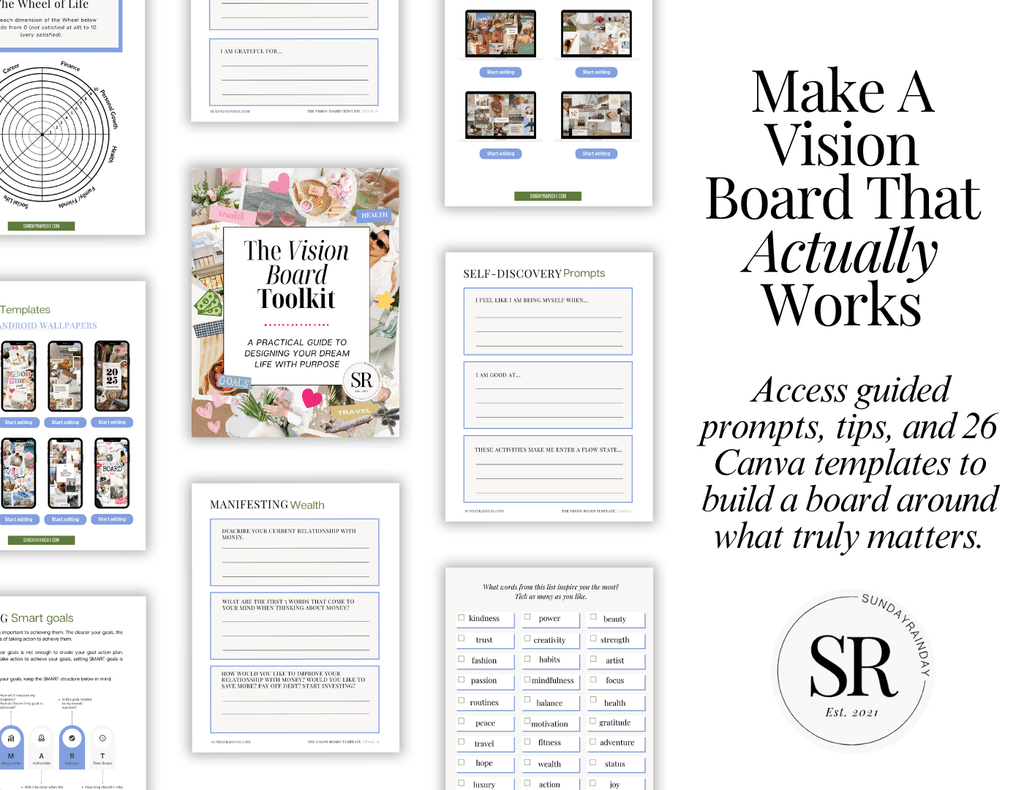
The Vision Board Toolkit is designed to keep that from happening. It gives you prompts and exercises to clarify what you want before you build anything, helps you align your board with your real goals and priorities, and leaves you with something that supports action instead of just looking nice on a shelf. If you want your vision board to actually move your life forward, structure is what makes the difference.
What is a vision board?
A vision board is a collection of images, words and quotes that represent your goals and the life you’re working towards, gathered in one place where you’ll see them every day. Some people call it a dream board or a goal board. It can be a cork board above your desk, a poster on the back of a door, or a digital collage you set as the wallpaper on your phone.
That sounds simple, and it is. But building a life you love takes a long time, and the hardest part comes long after you’ve chosen the goal: still caring about it on a random Tuesday in March, when work is busy, you’re tired and nobody would notice if you let it slide. A vision board is there for those days. It keeps what you want in front of you when your motivation is nowhere to be found.
Do vision boards actually work? What the research says
They can, and whether yours does depends mostly on what you put on it. There’s very little research on vision boards themselves, so anyone who tells you they’re scientifically proven is stretching things. What psychologists have studied for decades is what happens to people when they picture their future, and that’s close enough to be useful.
Three findings matter here. Picturing only the result can work against you, picturing yourself doing the work helps, and a reminder is only useful in a place where you’ll see it. Once you know them, you’ll make a different board from the one you made last time.
Picturing only the result can slow you down
Gabriele Oettingen, a psychologist at New York University, has spent much of her career studying positive fantasies, and what she found surprises most people. In a set of experiments with Heather Barry Kappes, people who were asked to imagine the coming week going beautifully felt less energised afterwards, and got less done that week, than people who simply thought about the week ahead.
It makes sense once you think about how it feels. When you picture the finished thing in detail, the beach house or the book with your name on it, part of you enjoys it as though it had already happened. You get some of the relief and the pleasure now, and the urge to go and earn them fades a little. A board made only of finished results gives you that feeling every time you look at it.
Picturing yourself doing the work helps
In the late 1990s, Lien Pham and Shelley Taylor at the University of California asked students to spend a few minutes a day, in the week before an exam, picturing one of two things. Some pictured the moment of getting a high grade. Others pictured themselves studying: sitting at their desk, going through the chapters, switching off the television. The students who pictured the studying did more of it, and they got better grades than the ones who pictured the result.
For your board, that means making room for the unglamorous pictures too. Next to the finish line, the trainers by the front door. Next to the published book, a desk at seven in the morning.
Oettingen’s later work adds one more piece. In her studies, people followed through more often when they pictured the result and then the obstacle most likely to get in their way, and decided in advance what they’d do about it. She calls this mental contrasting, and we’ll use it in step three.
A reminder only works where you’ll see it
The third finding is about reminders, which is what a vision board is once it’s finished. Todd Rogers at Harvard and Katherine Milkman at Wharton found that people are much better at following through on an intention when something distinctive is waiting for them at the moment they need to act. As they put it, “a reminder cannot work if it is not noticed.”
That explains why a board in a drawer does nothing for you. It also explains why a board that has hung in the same spot for a year slowly turns into part of the wall.
You’ll often read that vision boards work by programming your reticular activating system, the part of your brain that supposedly filters the world for whatever you focus on. The reticular activating system is real. It’s a network in your brainstem that wakes you up and keeps you alert. But there’s no solid research showing that a collage can train it to spot opportunities for you, so I’d rather give you the explanation that holds up: we act on what we’re reminded of, at the moment we’re reminded.
Related read: 30 Journal Prompts to Help You Create a Vision Board
The vision boards that work show the life you want and the work that leads to it, in a place you can’t avoid looking.
How to make a vision board, step by step
There are seven steps here, and the first three don’t involve a single picture. I’ve put them first on purpose. They’re the part most guides leave out, and they’re what separates a board you’ll still be looking at in a year from one you’ll have forgotten by spring.
I’d give it two sittings: one evening for the thinking and another for the making. If you already know what you want and your goals are written down, you can start at step four. If you’re not sure, start at the top.
1. Do a life audit with the Wheel of Life
Before you gather a single image, take an honest look at where you stand. It’s tempting to skip this and go straight to the life you want, but a board built on a vague wish for things to be different will only ever show you a vague, different life.
A life audit fixes that. With a tool called the Wheel of Life, you rate how satisfied you are in each of the main areas of your life, and the gaps between where you are and where you’d like to be become very easy to see. It looks at eight areas:
- Career
- Finances
- Personal growth
- Health
- Family and friends
- Social life
- Self-image
- Environment
Go through them one at a time and be honest with your scores, because nobody else will see them. The two or three areas that score lowest, or that bother you most, are what your vision board should be built from.
Related read: How to Do a Life Audit With the Wheel of Life
2. Turn the gaps into specific goals
Now you turn those gaps into goals, and how you word them matters more than you’d think. Edwin Locke and Gary Latham spent thirty-five years studying goal setting, and their most consistent finding was that specific, challenging goals lead to better results than vague ones like “do your best”. This is what the SMART framework is for: you write each goal so that it’s specific, measurable, attainable, realistic and tied to a date.
For a vision board there’s a second reason to be specific. A goal like “be healthier” gives you nothing to picture. “Run 5 km without stopping by June” gives you the shoes, the route and the morning light.
Keep it to three or four goals for the year ahead. With fifteen, nothing on the board stands out, and you won’t know which one to start on when Monday comes.
Related read: How to Set Goals You Will Achieve
3. Break each goal into milestones, and name what could get in the way
A five-year goal is too far away to do anything about today, so the next step is to break each goal into smaller milestones with dates. A milestone is small enough to reach in a few weeks, which means there’s always one clear step in front of you. Reaching it also gives you the feeling of getting somewhere, and you’ll need that feeling on goals that take years.
Then, for each goal, write down the one thing most likely to get in your way and what you’ll do when it shows up. It might be how tired you are after work, or your habit of saying yes to everyone. This takes five minutes, and of everything in the research it’s the part people skip most often.
Your milestones and obstacles also give you more to put on your board. Alongside the distant result, you can now picture the stages on the way to it.
4. Choose your format and gather your supplies
Now that you know your goals and milestones, you can start building, and the first decision is whether your board will be physical or digital.
There’s no right answer here. Some people love making a board the old-fashioned way, with a glue stick, magazine clippings and an evening at the kitchen table. Others prefer a digital board they can set as the wallpaper on their phone and laptop. Go with the one you’ll enjoy making, because that’s the one you’ll finish.
For a digital vision board, all you need is a free Canva account and a folder on your computer or phone to collect your images in.
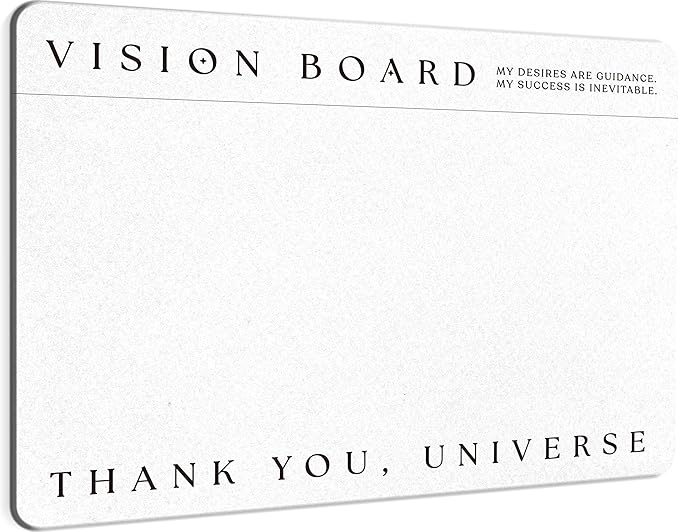
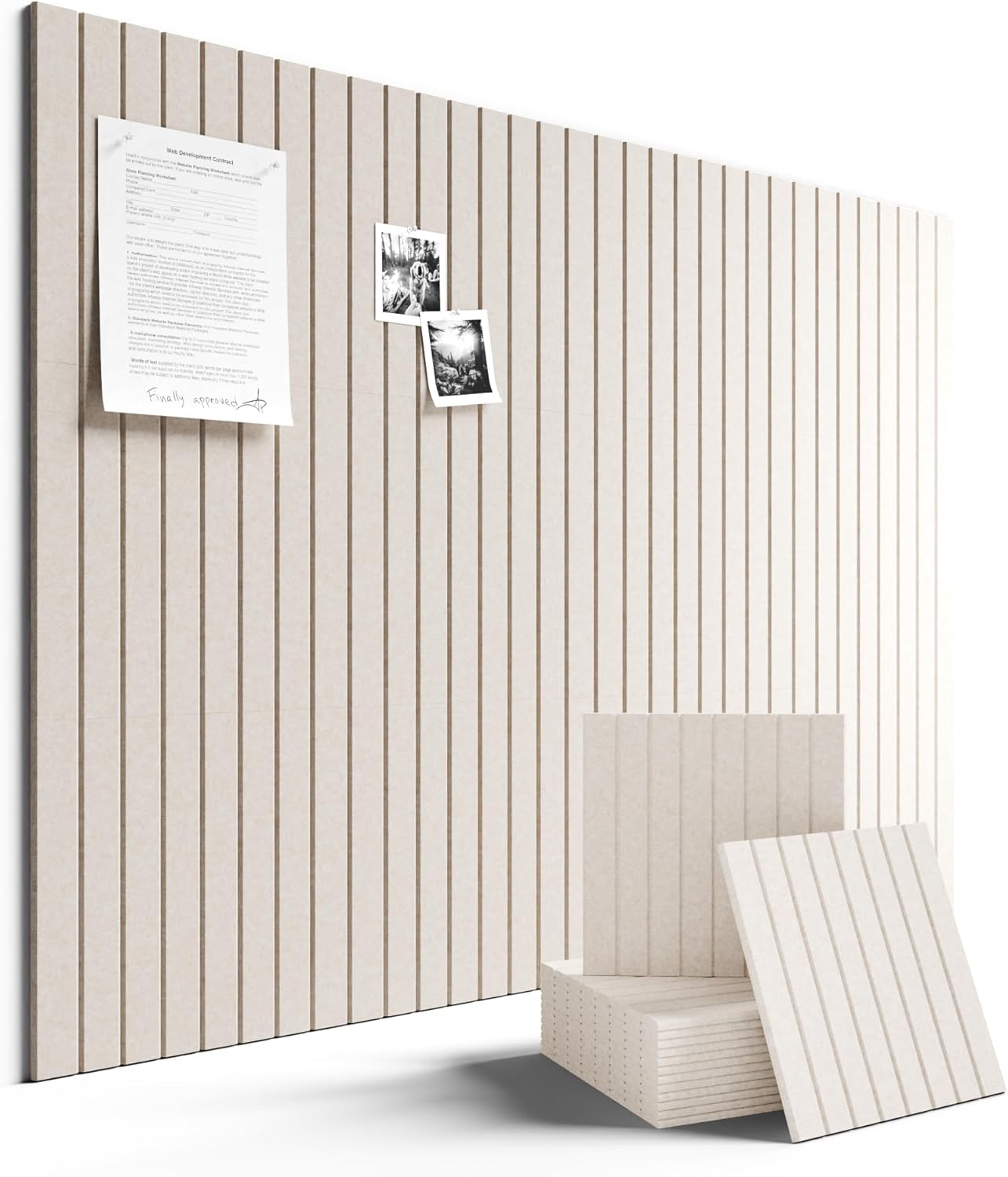
For a physical vision board, here are the supplies you need:
- A base: a cork board, a foam board or a large sheet of card
- Old magazines, printed pictures and a few of your own photos
- Scissors and a glue stick, or pins and washi tape if you’d like to move things around later
- A pen, or printed words, for your goals and their dates
If you’re missing something, here are some highly rated options on Amazon:
5. Choose what to put on your vision board
This is the fun part, and it’s also where the research from earlier comes in. For each of your goals, look for three things:
- The result. One picture of where you’re going, as close to your own version of it as you can find.
- The work. One or two pictures of what you’ll be doing on an ordinary day to get there.
- A few words. The goal in your own words with its date, or a short quote that still means something to you the tenth time you read it.
If you’re stuck, here are some vision board ideas for each area of the Wheel of Life:
| Area of life | The result | The work |
|---|---|---|
| Career | The studio or office you’d like to work in, a job title, a book cover with your name on it | Your desk early in the morning, the course you’re taking, a page of your portfolio |
| Finances | The flat the deposit is for, a debt at zero, the trip you’re saving towards | A savings tracker, the date of your monthly transfer, a packed lunch |
| Personal growth | A graduation, a city where you’d speak the language | This year’s pile of books, a weekly class, a notebook open on a table |
| Health | A 10 km finish line, a body doing something it enjoys | Trainers by the front door, a meal you’d cook, a bedtime |
| Family and friends | A long table with the people you love around it | A standing Sunday phone call, an evening blocked in the diary |
| Social life | A dinner you’re hosting, a trip with friends | The club or class where you’d meet people, an invitation you send first |
| Self-image | An outfit that feels like you, a word for how you’d like to feel | A slow morning, a journal and half an hour to yourself |
| Environment | A calm bedroom, a garden, a new city | One cleared shelf, a Saturday spent viewing flats |
One thing makes a big difference here: don’t choose an image because it’s pretty. Choose it because it makes you feel something, and because it shows your own goal in detail. “A home office with natural light and a door that closes” will pull at you far more than a stock photo of a “dream job”.
For a physical board, go through old magazines or print the pictures you find online. For a digital one, Pexels and Kaboompics have free photos, and Pinterest is good for ideas. Don’t overlook your own camera roll either. A photo of your own kitchen table, your running route or the people you love will mean more to you than anything from a stock site.
As for the look of it, two fonts and two or three colours are plenty. You’re making something you’ll want to look at every day for a year, so calm usually ages better than busy.
Related read: 100 Inspiring Quotes to Add to Your Vision Board
6. Put your vision board together
Now you bring it all together, and this is meant to be a pleasant evening, so put some music on.
If your board is physical, lay everything out before you glue anything down. Put the result for each goal where your eye lands first, keep the pictures for the same goal close to each other, and leave a little empty space so the board doesn’t feel crowded.
If you’re making a digital vision board in Canva, it takes five short steps:
- Create a new design. Choose “Phone wallpaper” or “Desktop wallpaper” if your board will live on a screen, or a poster size if you plan to print it.
- Open Elements and search for “grids” to add a collage layout with as many frames as you have images.
- Upload your images and drag each one into a frame.
- Add your words with the Text tool, and keep to your two fonts and your colours.
- Download the board as a PNG for a wallpaper, or as a PDF if you’d like to print it.
If you’d rather not start from a blank page, the Vision Board Toolkit includes 26 Canva vision board templates, so the assembling part takes minutes.
7. Put it where you’ll see it every day
A board you never see can’t do anything for you, so the last step is deciding where it lives. Choose a place you pass every day, and if you can, a place close to where the work happens: above your desk for a career goal, by the front door for a running one.
This is why a digital board works so well as a wallpaper. You’ll look at it dozens of times a day without trying. If you’ve made a physical board, your bedroom wall is a good choice too, because seeing it first thing in the morning is a small way to remember what the day is for.
How to use your vision board once it’s made
Making the board is the enjoyable part, and for most people it’s also where the story ends. The board goes up, it looks lovely, and within a few weeks it has become one more thing in the room. That’s normal. We stop noticing anything that never changes, which is the same reason you no longer see the picture that’s been hanging in your hallway for years.
So a vision board needs a little attention to keep doing its job. None of this takes long, and you don’t have to do it perfectly. Four small habits are enough to keep your board working for you all year.
Look at it on purpose once a day. Ten seconds in the morning is enough. Let your eyes go to the pictures of the work as well as the results, and ask yourself what today’s version of that work looks like.
Ask it one question a week. On Sunday evening or Monday morning, look at the board and choose one thing you can do this week for one of your goals. Then put it in your diary with a day and a time, because a board can remind you but it can’t book the hour for you.
Refresh it when you stop seeing it. Every few months, move the board, swap a few pictures, or replace a milestone you’ve reached with the next one. Crossing off what you’ve done is one of the nicest parts of having a board at all.
Change it when you change. If a goal stops feeling like yours, take it off. A vision board is a picture of what you want now, and it’s allowed to be different from what you wanted in January. Sometimes that’s a sign you’re outgrowing the life the board was made for.
Your next step
A vision board can change how you spend your year, or it can be a nice collage. The difference is in the thinking you do before you choose a single picture, and in how often you look at the board afterwards.
If you’d like a guide for that thinking, the Vision Board Toolkit brings together the prompts, exercises and templates to take you from a life audit to a finished board that’s clear, honest and built on what you want.
Frequently asked questions
How do you make a vision board?
Start by deciding what you want: rate the main areas of your life, choose three or four specific goals and break each one into milestones. Then choose a physical or digital format, gather images of both the results and the work that leads to them, add a few words and arrange everything on a board or in Canva. Finish by putting it somewhere you’ll see it every day.
Do vision boards really work?
They can, when they show more than the finished result. Research on positive fantasies suggests that picturing only the outcome can leave you less motivated, while picturing the steps makes you more likely to take them. A vision board that includes the work, sits where you’ll see it and is paired with a plan gives you a daily reminder of what you decided to do. It doesn’t replace the doing.
What should you put on a vision board?
For each goal, put one image of the result, one or two images of the work it takes and a few words with a date. Build it from the two or three areas of your life you most want to change, such as your career, your health or your finances. Choose pictures that make you feel something and show your own goal in detail, because generic stock images are easy to stop seeing.
How do you make a digital vision board?
Collect your images in a folder, then open a free tool like Canva and create a design in the size of your phone or laptop wallpaper. Add a grid, drag your images into the frames, add your words and download it as an image. The big advantage of a digital vision board is that you can set it as your wallpaper, so your goals stay in front of you all day.
Can a vision board help you manifest your goals?
It depends on what you mean by manifesting. A vision board can’t bring anything to you while you wait. What it can do is help you decide what you want, keep it in front of you and nudge you to act on it, and for most people that’s what manifesting looks like in practice. The board holds your attention on the goal, and what you do with that attention is what changes your life.
When should you make a vision board, and how often should you update it?
Any time works, but the start of a new year is the most natural moment, and making one fits well into a New Year life reset. After that, look it over every three months. Replace the milestones you’ve reached, take off anything that no longer feels like yours, and make a new board once a year.
