

How to Have Self-Confidence: The 4 Sources It’s Really Built From
Think of one thing you’re quietly sure you can do well. Cooking dinner for friends, perhaps, finding your way around a city you know or explaining your work to a new colleague. Now ask yourself where that certainty came from. You probably didn’t repeat an affirmation until you believed it, and you didn’t wake up one morning feeling sure of yourself. You did it, again and again, until the evidence was impossible to ignore.
That’s how self-confidence is built, and it’s why so much confidence advice falls flat. We’re told to stand tall, think positively and fake it until we make it, as though confidence were a mood we could switch on. Psychology tells a different story. Confidence grows from a handful of specific sources, and once you know what they are, you can build it on purpose.
In this article, you’ll learn what self-confidence really is, how it differs from self-esteem, how to have self-confidence and what one of the most influential psychologists of the last century discovered about where it comes from. You’ll then find the four sources of self-confidence, the signs that each one is working for or against you and practical ways to use each of them in your own life.
Save this article
Build the evidence you need to believe in yourself
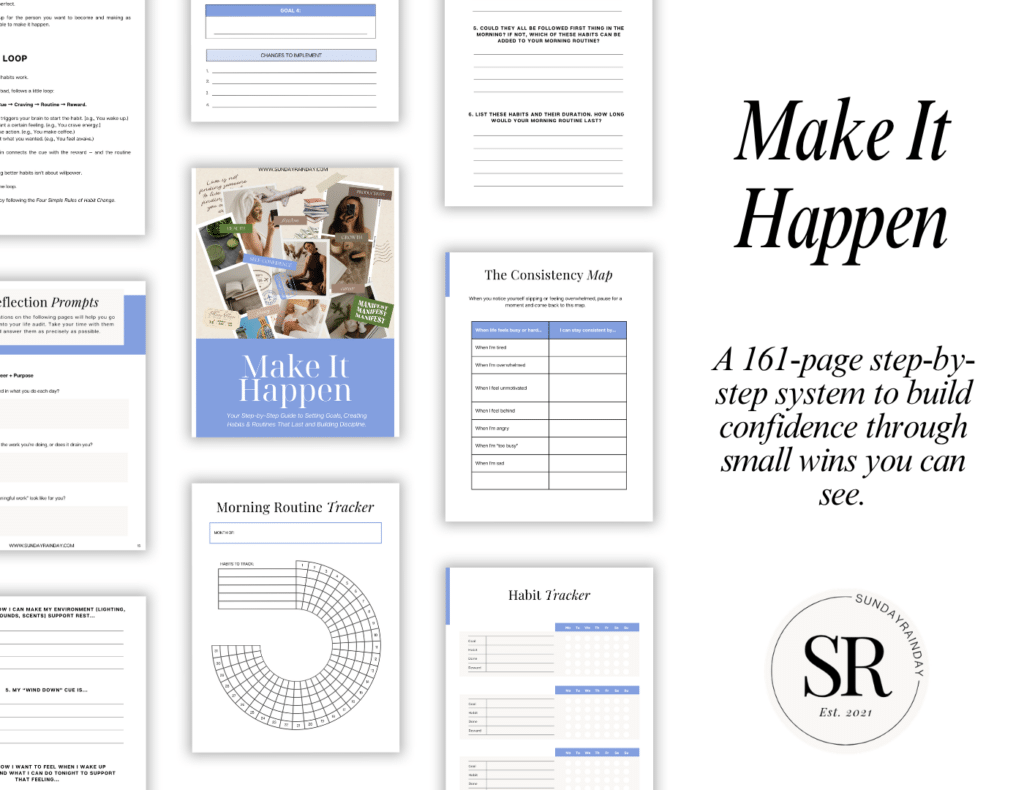
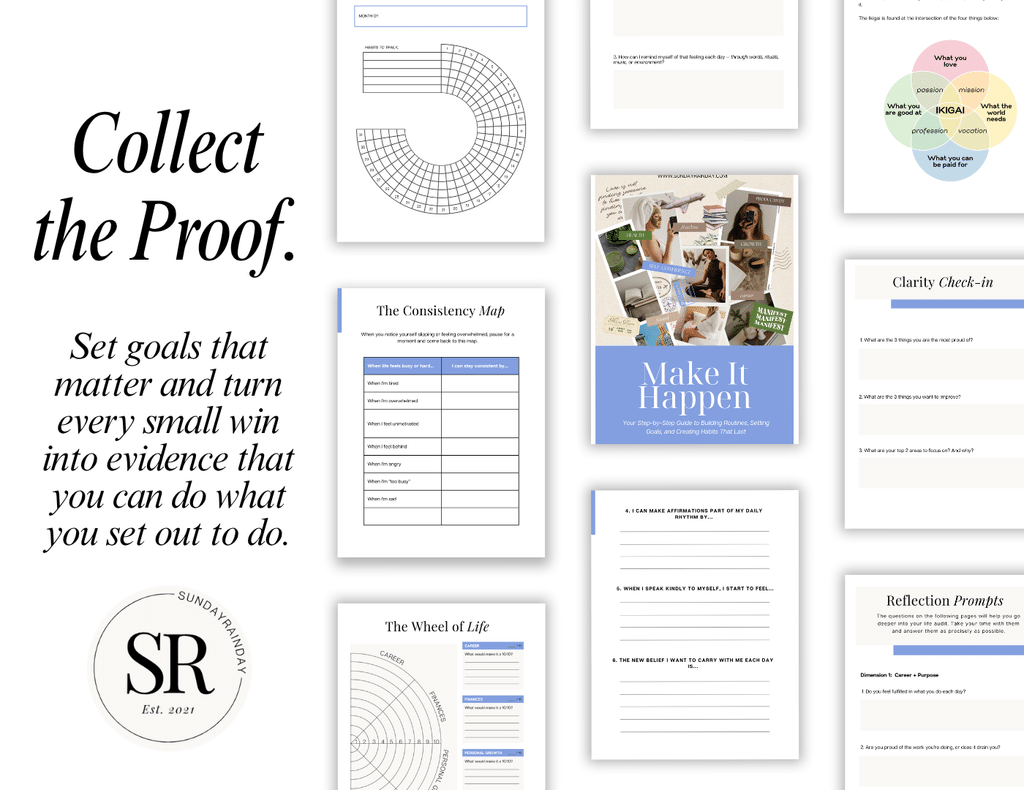
Confidence comes from proof, and proof comes from small, repeated wins. Make It Happen is a 161-page workbook that helps you set goals that matter to you, break them into steps you can complete, build the habits that carry them and work through the self-doubt and self-sabotage that hold you back. It includes a dedicated chapter on self-confidence, so every small step forward becomes evidence you can build on.
What is self-confidence?
Self-confidence is your belief in your ability to do something: to handle a situation, learn a skill or reach a goal. It’s practical and specific. You can feel very confident giving a presentation and much less confident on a dance floor, and both can be true at once. Psychologists often use the term self-efficacy for this kind of belief, and most of the research on how confidence grows has been carried out under that name. Understanding that confidence is tied to specific abilities, rather than to who you are as a whole, is the first step to building more of it.
Self-confidence vs self-esteem
The two are often used as though they mean the same thing, but they describe different parts of how we see ourselves. Self-esteem is your overall sense of your own worth: whether you feel you’re a valuable, likeable person. Self-confidence is your belief in what you can do.
The distinction matters, because the two can move independently. Someone can have healthy self-esteem and still feel unsure about public speaking. Someone else can be highly confident at work while quietly doubting their worth. When you search for ways to feel more confident, much of the advice you’ll find is really about self-esteem: being kinder to yourself, accepting your flaws, valuing who you are. That’s important work. But if you want to feel more capable in a particular area of your life, you need something more specific: evidence.
Self-esteem is how you value yourself. Self-confidence is what you believe you can do.
Where self-confidence comes from: Bandura’s self-efficacy theory
In 1977, the Stanford psychologist Albert Bandura published a paper that would become one of the most cited in the history of psychology. In Self-Efficacy: Toward a Unifying Theory of Behavior Change, he argued that our belief in our own ability to succeed shapes what we attempt, how much effort we put in and how long we keep going when things get hard. More importantly for anyone who wants to feel more confident, he set out where that belief comes from. Far from being fixed at birth or set by personality, it’s built, piece by piece, from information we gather about ourselves, and some kinds of information are far more powerful than others.
What the snake studies showed
Some of Bandura’s early research involved people with an intense fear of snakes. In one approach, participants watched a therapist handle a snake calmly. In another, they were guided step by step to approach and handle the snake themselves, starting with the smallest possible action and moving forward only when they felt ready.
Both approaches helped, but they didn’t help equally. People who did the tasks themselves gained more belief in their ability to cope than people who only watched. The difference was evidence. Watching someone else succeed suggested it might be possible. Doing it yourself proved it.
That insight runs through everything Bandura went on to write. He later described these personal experiences of success, which he called mastery experiences, as the most influential source of self-efficacy, because they offer the most authentic proof that you can do something.
Why confidence follows action
Most of us assume confidence comes first: once we feel confident enough, we’ll apply for the job, speak up in the meeting or start the business. Bandura’s work suggests the order usually runs the other way. Action produces evidence, evidence produces belief and belief makes the next action easier.
This is why waiting to feel ready so rarely works. Confidence is something you collect as you go, one small proof at a time.
Why affirmations alone don’t build confidence
If confidence comes from evidence, it also explains why simply telling yourself you’re capable can fall flat. In a 2009 study published in Psychological Science, the psychologists Joanne Wood, Elaine Perunovic and John Lee asked participants to repeat the statement “I’m a lovable person”. People who already felt good about themselves felt slightly better afterwards. People with low self-esteem felt worse.
The researchers suggested that when a positive statement clashes too strongly with what we believe about ourselves, it can remind us of everything that seems to contradict it. Words can support confidence, as you’ll see below, but they work best when they point to something real.
The 4 sources of self-confidence and how to use them
Bandura identified four sources from which we build our belief in what we can do. They aren’t equally powerful, and they work best together. Your own successes carry the most weight, followed by seeing people like you succeed, encouragement from people you trust and the way you interpret the signals your body sends you. As you read through them, notice which ones are already working for you and which ones might be quietly working against you. That’s usually where the fastest change is waiting.
1. Mastery experiences: proof from your own wins
Mastery experiences are the moments when you try something and succeed. They’re the most powerful source of confidence because they’re the hardest to argue with. You don’t have to believe anyone else’s opinion of you. You were there, and you saw it happen.
The key is to arrange for those moments on purpose. Choose goals small enough that you’re likely to succeed, then raise the bar gradually, the same way Bandura’s participants approached their fear one step at a time. If you want to feel confident speaking in meetings, start by asking one question in a smaller meeting before you present to the whole team.
Bandura also noticed something important about the kind of success that builds lasting confidence. Easy wins can create a fragile sense of ability that collapses at the first setback. Confidence becomes resilient when you succeed at things that took real effort, especially after a difficulty or two. So when something goes wrong, look at what you did next. Recovering from a setback is itself a mastery experience.
Finally, keep a record. Most of us remember our failures in vivid detail and forget our successes within days. A simple evidence file, a note on your phone or a page in your journal where you write down what you did well, gives you something real to return to on the days your confidence dips.
2. Vicarious experience: seeing people like you succeed
The second source is watching other people succeed, especially people you see as similar to you. When someone with a background, situation or starting point like yours achieves something, it quietly tells you that it might be possible for you too.
Similarity is what makes this work. A world-class expert can inspire you, but their success says little about your own chances. Someone a few steps ahead of you, who started where you are, says much more. So look for role models who are close to your situation: a colleague who recently made the career change you’re considering, a friend who started running in their forties, a writer who published their first book alongside a full-time job.
The same source can also work against you. Comparing yourself with carefully curated highlights on social media can make your own progress look small. If scrolling leaves you feeling less capable, that’s a sign this source is draining your confidence rather than building it, and it’s worth choosing more carefully whose stories you consume.
3. Verbal persuasion: encouragement that rings true
The third source is what other people tell us about our abilities, and what we tell ourselves. Encouragement from someone you trust can give you the push to try something you’d otherwise avoid. On its own, it’s weaker than experience, but it can be what gets you to the starting line.
Its power depends on credibility. Praise from someone who knows your work well, and who you know will be honest, carries far more weight than general reassurance. So instead of asking “was that good?”, ask the people you trust for specific feedback: what worked, and what one thing would make it better next time.
The same principle applies to the way you talk to yourself. As the research on affirmations shows, broad statements you don’t believe can backfire. Self-talk works better when it points to evidence: “I’ve prepared for this”, “I’ve handled harder conversations than this one” or “I didn’t know how to do this last year, and now I do.”
4. Emotional and physical states: how you read your body’s signals
The fourth source is the way you interpret what you feel. A racing heart, tight chest or restless energy before a big moment can feel like proof that you’re not ready. But those sensations don’t come with a label, and the label you give them matters.
The Harvard Business School researcher Alison Wood Brooks tested this in a series of experiments published in 2014. Before singing karaoke, giving a speech or solving difficult maths problems, participants were asked to say a simple sentence, such as “I am excited” or “I am calm”. Those who described their nerves as excitement performed better across the board. In the karaoke experiment, people who said they were excited scored an average of 80% on pitch, rhythm and volume, compared with 53% for those who said they were anxious.
Brooks suggested that because anxiety and excitement are both states of high energy, it’s easier to reframe one as the other than to calm down completely. So the next time your heart races before something that matters, try telling yourself you’re excited. Your body is preparing you to perform, and that’s a very different story from the one fear tells.
Your general energy plays a part too. The same task can feel far more daunting when you’re exhausted, which is one reason confidence often seems to vanish at the end of a long week. Noticing that pattern can stop you from mistaking tiredness for inability.
The 4 sources at a glance
| Source | What it is | How to use it |
|---|---|---|
| Mastery experiences | Proof from your own successes | Set small, progressive goals and keep a record of your wins |
| Vicarious experience | Seeing people like you succeed | Choose role models close to your situation and limit draining comparisons |
| Verbal persuasion | Encouragement from credible people and yourself | Ask for specific feedback and use self-talk that points to evidence |
| Emotional and physical states | How you interpret your body’s signals | Reframe nerves as excitement and notice when tiredness is talking |
Building self-confidence, one proof at a time
Self-confidence is your belief in what you can do so the best way to feel more confident is to collect evidence: set goals small enough to reach, raise the bar gradually, keep a record of what you’ve done and treat every recovery from a setback as proof of what you’re capable of.
That’s exactly what Make It Happen is designed to help you do. It guides you from a life audit and goals that matter to you, through action plans broken into steps you can complete, to the habits and routines that turn those steps into steady progress. Its chapters on self-confidence and self-sabotage help you recognise the patterns that hold you back, so that every small win becomes another piece of evidence that you can do what you set out to do.
Frequently asked questions
How do you have self-confidence?
Self-confidence grows from evidence. According to Albert Bandura’s research, it’s built from four sources: your own successes, seeing people like you succeed, encouragement from people you trust and the way you interpret your emotional and physical signals. Your own successes are the most powerful of the four.
What is the difference between self-confidence and self-esteem?
Self-esteem is your overall sense of your own worth. Self-confidence is your belief in your ability to do specific things. You can have healthy self-esteem and still lack confidence in a particular area, or the other way round.
What is self-efficacy?
Self-efficacy is the term psychologists use for your belief in your ability to succeed at a specific task or in a specific situation. The concept was introduced by the psychologist Albert Bandura in 1977.
What is the most important source of self-confidence?
Bandura considered mastery experiences, the evidence that comes from your own successes, to be the most influential source of self-confidence, because they offer the most authentic proof of what you can do.
Do positive affirmations build self-confidence?
Not on their own. Research suggests that positive statements can make people with low self-esteem feel worse when the statements feel untrue. Self-talk works better when it points to real evidence, such as preparation you’ve done or challenges you’ve already handled.
How long does it take to build self-confidence?
There’s no fixed timeline, because confidence is specific to each area of life. Small, regular successes in one area can build confidence there within weeks, especially when you keep a record of your progress.
