

The Sunday Routine That Closes Your Week Before You Plan the Next
Friday evening rarely closes anything. The laptop shuts and the work week officially ends, but the reply you still owe, the task you’ve moved to “next week” for the third time and the decision you keep circling all come home with you. By Sunday night, they’re still there, quietly taking up room.
We tend to read that Sunday-night weight as a planning problem. So we open the planner, write a fresh list and lay next week’s intentions on top of everything last week left undone. A new plan can’t settle an old week, though.
What helps is a Sunday routine that works more like a threshold than a to-do list: one deliberate pause where you close the week behind you before you step into the next one. Below, you’ll find why unfinished tasks follow you around the way they do, why Sunday makes such a good checkpoint, and a seven-step routine that closes one week and opens the next in under an hour.
Save this article

Why your week doesn’t end when Friday does
Your mind keeps a running tab of everything you’ve started and haven’t finished. Each open task leaves a small marker in your attention, a reminder that something still needs you. That’s useful when you can act on it straight away. It’s far less useful on a Sunday afternoon, when the marker keeps tapping you on the shoulder and nothing can be done until Monday. Multiply it by a full week of loose ends, and that background hum becomes the restlessness so many of us mistake for dread about the week ahead.
In a series of experiments published in 2011, psychologists E.J. Masicampo and Roy Baumeister asked people to think about an important goal they hadn’t yet completed. Afterwards, those people had more intrusive thoughts during an unrelated reading task and performed worse on a set of anagrams than people whose goals were already done. Then the researchers added a single step. Before the second task, some participants wrote down a specific plan for how and when they would finish their goal.
The intrusions disappeared, and their performance recovered, even though the goal itself was exactly as unfinished as before.
That detail changes how we think about the end of a week. What your mind wants from an open loop is a decision about it. Finishing the task is one way to give it that decision. Making a clear plan is another, and on a Sunday, it’s usually the only one available.
A task that keep running like an open loop in your mind doesn’t need to be completed to stop pulling at you. It needs a decision.
Why Sunday works as the week’s checkpoint
Whatever you call it, a Sunday reset, a weekly review or simply your Sunday routine, the ritual matters because of where it sits. A week is a natural unit of life: most of it is repeated in sequence, long enough to make real progress, short enough to notice early when something starts to drift. Sunday falls right on the seam between two of them, at a moment when most of us are, for once, a little removed from the noise. That makes it the one point in the week where you can see both sides at the same time. Used well, it becomes a checkpoint, a place to pause between one week and the next.
A checkpoint has two jobs. First, it shows you where you actually are, rather than where you assumed you’d be by now. Then it sets the direction for the next stretch, based on what you’ve just experienced instead of what you hoped would happen.
Most Sunday routines jump straight to the second job, and often to the home: clean sheets, a full fridge, outfits ready for Monday. None of that is wasted, and a calm space does make the morning much easier. But when the week behind you is still open, the new plan lands on top of everything it left unfinished, and the restlessness stays exactly where it was.
That’s why the routine below begins with closing and only then moves on to planning. The chores can still have their place in your Sunday; they simply come after the part that settles your mind.
Make every week a week you fully chose
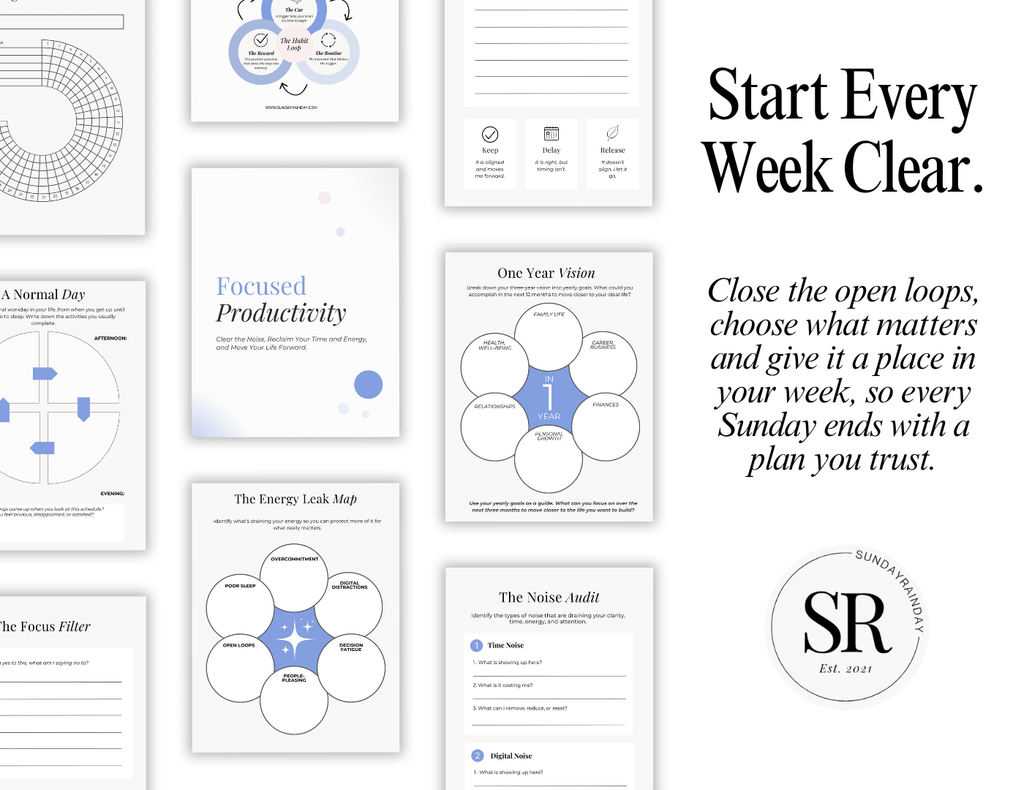
A Sunday routine only works when you know what deserves a place in your week. The Focused Productivity Framework is a 176-page workbook that helps you see where your time and energy really go, close the open loops that quietly drain your attention and build a weekly schedule that keeps your priorities visible, so every week carries your goals and every Sunday ends with a plan you believe in.
The closing Sunday routine in 7 steps
The routine has two halves, and the order between them is what makes it work. The first four steps close the week behind you: you look back, gather everything still open and give each loose end a decision. Only then do the last three steps open the new week, choosing what matters and giving it a place to live. Most planning habits skip straight to the second half, which is why a fresh plan can feel crowded before Monday has even begun. Give yourself a notebook or a single page in your notes app, your calendar and about forty-five minutes.
Part one: close the week
1. Look back before you look ahead: what happened, what moved and what didn’t
Start with the week as it actually was, not as you planned it. Open your calendar and walk through the days, then answer three questions in a few lines each: what moved forward, what took more time or energy than expected, and what gave you energy back.
Keep it curious rather than critical, because there’s no grade at the end. This is the step that turns a week you lived through into a week you can learn from. In one study by researchers at HEC Paris and Harvard Business School, trainees who spent the last fifteen minutes of each day writing about what they’d learned scored around 23% higher on their final assessment than colleagues who used those minutes to keep working. A few minutes of looking back tends to do more for the next stretch than the same minutes spent pushing on.
2. Empty your head: write down every open loop
Now gather everything that’s still open. Tasks you didn’t finish, replies you owe, promises you made in passing, things you keep meaning to look into, and the small worries that have no task attached yet. Go through your inbox, your messages, your notes and the corners of your mind until the list stops growing.
Aim for completeness rather than neatness. A loop that stays in your head keeps pulling at you; a loop written on the page is something you can finally look at and deal with. If the list feels long, that’s useful information too, and it often explains the restlessness on its own.
Related read: How attention residue impacts your focus
3. Decide, don’t carry: finish it, schedule it or drop it
This is the step that does the real closing. Go through your list and give every item one of three endings.
- Finish it: if it takes five minutes or less, do it now and cross it off.
- Schedule it: if it matters but can’t be done today, give it a specific day and time, not a vague “this week”.
- Drop it: if you’ve been carrying it out of guilt rather than intention, let it go on purpose, and tell anyone who needs to know.
The second ending is where Masicampo and Baumeister’s research earns its place. A plan only quiets a loop when it’s concrete enough to trust, so “call the dentist” becomes “call the dentist on Tuesday at 12:30”. The third ending matters just as much, because a loop you keep postponing without deciding is still a loop.
4. Close it on paper: one line to end the week
Before you turn the page, write a single sentence that sums up what this week taught you. It might be about your energy, your work, a conversation or simply that you needed more rest than you gave yourself.
That one line acts like a full stop. It marks the week as finished, gives the lesson somewhere to live, and makes the move into next week feel like crossing a threshold rather than carrying the same bags into a new room.
Related read: How to get your life together by closing your open loops
Part two: open the new week
5. Choose the week’s three priorities: what would make it count
With a clear page, ask a different question from the usual “what do I need to get done?”. Ask what would make this week feel worthwhile when you look back on it next Sunday. Choose three things at most.
Three is enough to make progress and few enough to protect. Everything else on your list still exists, but it moves into the background, where it supports the week instead of competing with what matters.
6. Give them a place: put each priority in your calendar
A priority without a time slot is still a wish. Open your calendar and give each of your three priorities a specific block, ideally in the hours when you tend to think most clearly. If you’ve never worked this way, our guide to time blocking shows how to protect those hours so they survive the week.
This is also the moment to check the week’s shape as a whole. If your calendar is already full before you add a single priority, it’s better to know that on Sunday than to find out on Wednesday.
7. Decide Monday’s first move tonight
The last step is the smallest, and it changes how the whole week starts. Decide exactly what you’ll do first on Monday morning, write it down and, if you can, prepare it: the document open, the notes ready, the first sentence drafted.
That way, Monday begins with something you chose in a calm moment rather than with whatever your inbox decides is urgent. It’s a small bridge between the two weeks, and it’s often the difference between starting the week on purpose and starting it on reaction.
The order matters. Planning a new week on top of one you haven’t closed only gives you more to carry.
How to keep it under an hour
A Sunday routine only works if you keep coming back to it, and you’ll keep coming back to it only if it fits comfortably into your weekend. The first few attempts usually take longer, because a month of loose ends tends to surface at once. After two or three weeks, the open-loop list shrinks, the decisions get quicker and the whole routine settles at around forty-five minutes. A few choices make that easier.
Give it a fixed slot. Late Sunday afternoon works well for most people: far enough from bedtime that the week ahead doesn’t keep you awake, close enough to Monday that the plan still feels fresh.
Split the time roughly in two. About twenty-five minutes for closing the week and twenty for opening the next. If the first half runs over, shorten the second rather than skipping the closing steps.
Keep everything in one place. One notebook or one note, the same each week, so you can glance back at last Sunday’s priorities and see whether they made it into the week.
Have a short version for busy weekends. When Sunday disappears, do steps 2, 3 and 7 on Monday morning. Ten minutes of gathering, deciding and choosing your first move is enough to keep the habit alive until the following week.
Signs your Sunday routine needs adjusting
A routine that fits one season of your life won’t always fit the next. Your work changes, your energy shifts, and a structure that once felt freeing can start to feel like one more obligation. When that happens, the routine is still doing its job: showing you how your weeks really run and asking to be adjusted. These are the signals worth paying attention to.
The same loops come back every week. If an item keeps reappearing on your list, scheduled and rescheduled, the signal to watch for is avoidance rather than a lack of time. Either the task is too big and needs breaking into a first step you can actually take, or it’s something you no longer want and haven’t let yourself drop.
Your priorities outnumber your free hours. When three priorities won’t fit into the week you’ve got, the problem sits upstream of planning. It’s a sign your commitments have grown faster than your time, and the most useful Sunday decision may be what to say no to.
The routine takes two hours. That usually means too much is waiting for Sunday. Capture loose ends as they appear during the week, so Sunday becomes a review rather than an excavation.
You’ve started to dread it. A routine that feels heavy has often grown too detailed. Strip it back to the three steps of the short version for a few weeks and add the rest back only when you miss it.
Perfect the bridge between two weeks
Sunday sits between two weeks, and how you cross it shapes both. Rushed, it becomes the place where last week’s loose ends pile up against next week’s plans. Taken slowly and in the right order, it becomes a bridge: one side settled, the other chosen.
You don’t need a perfect system to start. A notebook, your calendar and the willingness to make a few small decisions are enough for the first Sunday. Over time, the routine stops being something you do and becomes the place where your weeks make sense.
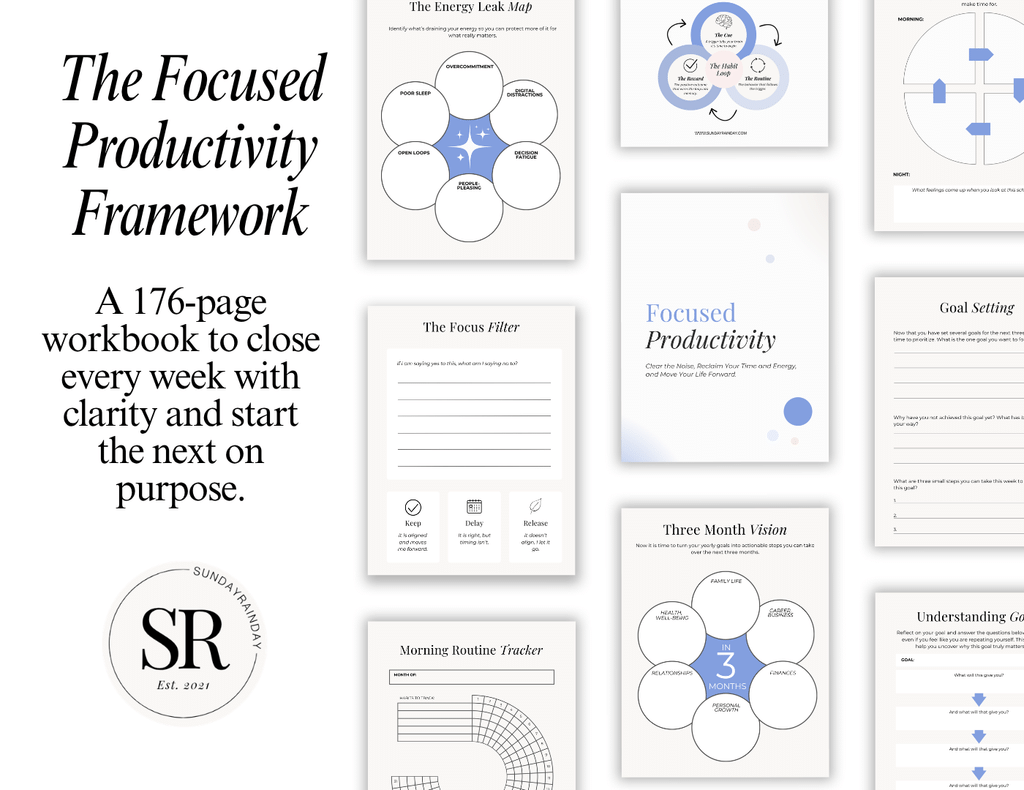
If you’d like a fuller structure around it, the Focused Productivity Framework builds this kind of thinking into a complete system. Its Weekly Reflections give your Sunday look-back a shape, the Energy Leak Map helps you spot the open loops and commitments that quietly drain your week, and the Return Rule shows you how to come back after a week that went off track. Across 176 pages of worksheets and exercises, the Focused Productivity Framework helps you protect your time, your energy and the work that matters most, one week at a time.
Frequently asked questions
What should a Sunday routine include?
A good Sunday routine has two parts: closing the week that’s ending and opening the one ahead. Look back at what happened, write down every open loop, decide what to do with each one, then choose up to three priorities and give them a place in your calendar.
How long should a Sunday routine take?
Around forty-five minutes once it’s established. The first few weeks often take longer, because older loose ends come to the surface. If it regularly runs past an hour, try capturing tasks during the week so less waits for Sunday.
Is a Sunday routine the same as a Sunday reset?
Most people use the two terms interchangeably. What matters is what the ritual includes: tidying and meal prep get your home ready, while closing open loops and choosing priorities get your week ready. A good Sunday routine does the second part first.
What if I work on weekends?
The day matters less than the rhythm. Choose the evening before your week begins, whichever day that is, and keep it consistent so the routine becomes your natural threshold between one week and the next.
Why do I feel anxious on Sunday evenings?
Often it’s the weight of unfinished tasks rather than Monday itself. Research on open loops shows that unfinished goals keep pulling at your attention until you make a specific plan for them, which is why closing the week tends to ease that Sunday-evening feeling.
