

The Morning Routine Checklist You Write Yourself
Most morning routine checklists were written for someone else’s life. They list what a founder, an athlete or a movie star does before breakfast, and they leave out the part that made those things worth doing for that person, which was the goal sitting behind them. Copy the list without the goal and you inherit forty-five minutes of tasks with no reason of your own to get up for them.
That is usually why a new routine feels inspiring for a week and has disappeared by the end of the month. Discipline has very little to do with it, because a checklist that answers someone else’s question gives you nothing to come back for once the excitement of trying something new has worn off.
This article works the other way round. It starts with what you want from the next three months, measures the time your mornings really allow, and builds the checklist from there, one line at a time. By the end of this article, you will have a realistic list in your own handwriting, along with a smaller version for the mornings when nothing goes to plan.
Save this article
Why copying someone else’s morning routine rarely lasts
A routine only starts paying you back once it runs without much thought, and getting there takes longer than most checklists admit. When Phillippa Lally and her colleagues at University College London followed 96 volunteers who were each trying to build one new daily habit, the behaviour took an average of 66 days to feel automatic, and for some people the estimate ran as high as 254. So whatever you put on your checklist has to be something you are willing to repeat for roughly ten weeks before it becomes easy. A step you chose because it photographs well won’t survive that long, and neither will one you chose because a stranger swears by it.
The steps that do survive tend to be the ones attached to something you want. Ten minutes of writing is easy to skip when it is simply “journalling”, and much harder to skip when it is the only time this week you will move your book forward. The action is the same in both cases, and what changes is whether it has a job to do.
This is also why length is such a poor measure of a good routine. A twelve-step morning looks impressive on paper, yet every extra step is one more thing to keep alive through those ten weeks. Two steps with a purpose will outlast twelve without one.
What a morning is good for
Before you decide what goes on the list, it helps to know what mornings do well, because they don’t do everything well. The research points to two things in particular. Mornings are a good place to plant a habit you want to keep, and they have an outsized influence on the mood you carry through the rest of the day. Almost everything else people squeeze in before 8 a.m. could happen at lunch or in the evening with no loss at all.
The first finding comes from a small French study in which 48 students were asked to do a short hip stretch every day for three months, half of them straight after waking and half before bed. The morning group was on course to make the stretch automatic in about 106 days, compared with 154 for the evening group, and the researchers linked the difference to cortisol, which is naturally at its highest after waking. It was one simple behaviour in one small group, so the exact numbers shouldn’t be leaned on. What the study does suggest is that if there is a single habit you most want to stick, the morning is a sensible home for it.
The second comes from Nancy Rothbard and Steffanie Wilk, who tracked the moods of call-centre staff at an insurance company for three weeks. The mood people arrived in coloured how they read their customers for the rest of the day, and it showed in their work as well, since those who started low took fewer calls and needed more breaks. A morning that leaves you rushed and irritable has a cost that outlasts the morning.
Taken together, the two findings give your routine a much shorter job description than most checklists imply. It needs to house one habit that matters to you, and it needs to deliver you to the start of your day in a reasonable frame of mind.
A habit that keeps failing in the morning is often telling you about the time slot and very little about you.
How to create a morning routine from your goals
A checklist built this way comes out of four decisions, and the order matters. You choose the goal first, then find out how much time you have, then decide what deserves a place, and only at the end arrange it into a sequence. Most people do it the other way round, starting with a list of appealing activities and looking for the time and the reason afterwards. Taking the decisions in order is what keeps the finished list short. Give yourself twenty minutes with a pen for this, ideally at a weekend, when no particular morning is looming.
1. Choose your goal for the next three months
Pick one thing you want to have moved forward three months from now. It might be a finished draft, a stronger back, a calmer start with your children, or a side project that finally has regular hours. Three months is long enough for a morning habit to settle and short enough that you can still picture the result.
Then turn the goal into the smallest daily action that would move it. “Get fit” becomes fifteen minutes of strength work, and “write the book” becomes two hundred words. This single action is the centre of your routine, and I’ll call it the lead habit from here on. If you can’t yet tell which daily action would make the most difference, these high-impact habits are a good place to look. And if you are tempted to choose two goals, choose one anyway and promise the second the three months after.
2. Count the minutes you really have
Work backwards from the moment you have to be somewhere, whether that is your desk, the school gate or the 7.42 train. Subtract everything that is already fixed, such as showering, dressing, breakfast and getting other people out of the door. Whatever is left is your budget, and for many people on a working day it is closer to fifteen minutes than sixty.
Resist the urge to enlarge the budget by setting the alarm earlier without changing your bedtime. The American Academy of Sleep Medicine and the Sleep Research Society recommend seven or more hours a night for adults, and a routine paid for with lost sleep tends to cost more than it gives back. If you do want more room in the morning, move your whole night earlier in small steps, which is a project of its own and the subject of how to become a morning person.
3. Decide what earns a place
Every line on the finished checklist should be able to say what it is for, and in practice that leaves room for three kinds of line. The first is the essentials you would do anyway, which belong on the list only so that the timing is honest. The second is your lead habit. The third is one steadying thing, whatever reliably puts you in a better mood. For some people that is ten quiet minutes with coffee before anyone else is up, and for others it is a walk round the block or a made bed.
Anything that fits none of the three can wait. Gratitude lists, cold showers, language apps and lemon water are all fine things to do, and you are free to add one later if it turns out to serve the goal. What they shouldn’t do is ride along by default, because each addition makes the whole routine a little easier to abandon.
4. Put it in order and tie each step to the one before
A routine holds together best when each step is triggered by the one before it and the clock plays a supporting role. The psychologist Peter Gollwitzer calls these if-then plans, and an analysis of 94 tests that he carried out with Paschal Sheeran found they made people noticeably more likely to follow through on what they intended. In a morning routine the plan sounds like “after I pour my coffee, I open the manuscript”, or “when I’ve brushed my teeth, I roll out the mat”.
Put the lead habit as early in the sequence as you can manage, before email and before your phone has had the chance to hand you somebody else’s priorities. Then write the list as a chain of events, so that a late start shifts everything along without breaking it.
Related read: How to Make Habits Stick: A Framework for Lasting Change
Your morning routine checklist, written out
By now you have everything the checklist needs, and writing it down takes a couple of minutes. Keep it to a single index card or a note you can see without unlocking your phone, since a list you have to go looking for won’t be read at 6.30. The structure is the same whatever your goal, and it has five lines. Seeing a few finished versions helps, so three examples follow, each built for a different goal and a different amount of time. Treat them as illustrations of the method, because the whole point is that yours will look different.
- My goal for these three months:
- The time I have: ___ minutes, from ___ to ___
- Essentials that already happen:
- My lead habit and its trigger: after ___, I ___ for ___ minutes
- One steadying thing:
Fifteen minutes, for a calmer start
The goal here is to stop beginning every day in a rush, so the lead habit and the steadying thing turn out to be the same ten minutes.
- Up at 6.45, and the phone stays on its charger in the hall
- Kettle on, and while it boils, open the curtains and put out what the day needs (bag, keys, lunch)
- Coffee sitting down for ten minutes, with nothing to read or answer
- Shower, dress and breakfast from 7.00
Forty minutes, for a creative project
The goal is a finished first draft, and the lead habit is twenty-five minutes of writing before anything else has a claim on the day.
- Up at 6.15, glass of water
- Coffee made, then straight to the desk for 25 minutes on the draft, starting from a note left the night before
- Five minutes to write tomorrow’s starting note
- Shower, dress and breakfast from 6.55
An hour, for getting stronger
The goal is three months of consistent strength training, with a few minutes of planning as the steadying thing.
- Up at 6.00 and into the kit laid out the night before
- 30 minutes of strength work in the living room
- Shower, then breakfast eaten at the table
- Ten minutes with the day’s plan and the three things that matter most
- Out of the door at 7.15
None of the three runs to more than five lines, and each could be explained to a friend in a sentence, which is a reasonable test to apply to your own.
The short version, for mornings that go wrong
Some mornings will not cooperate. A child is ill, the alarm fails, or you slept badly and the full routine is plainly out of reach. What you do on those mornings matters more than it seems, because a routine with only one setting tends to be dropped altogether the first time that setting isn’t available. The answer is to give your checklist a sixth line, a reduced version of the routine that you can complete on the worst morning you can reasonably imagine.
The short version is your lead habit shrunk to about two minutes, which might be one paragraph, one set of squats or one page. It will feel almost too small to bother with, and that is the idea behind the two-minute rule, since the aim on these days is only to keep the run of mornings unbroken. Lally’s study offers some comfort here as well, because missing a single day made little difference to how the habit formed in the end. People ran into trouble only when the gaps became frequent.
Write the short version on a good day. On a bad morning you will bargain it down to nothing, whereas a line you wrote last Sunday has already made the decision for you.
Review it the way you would review a plan
A checklist written this way is a small plan, and plans need looking at. Two weeks in, read down the list and notice which lines happened most days and which were skipped. A line you keep skipping is in the wrong place, too long, or not connected to anything you want, and each of those has its own fix. You can move it, shrink it or cross it out. Then leave the list alone for a while, because a routine that is redesigned every Sunday never gets the repetition it needs.
The bigger review comes when the three months are up or the goal is reached, whichever happens first. By then the lead habit has either become one of the essentials, something you now simply do, or it is ready to give way to the next goal’s habit. In both cases the checklist is rewritten from the top, starting once more with what you want.
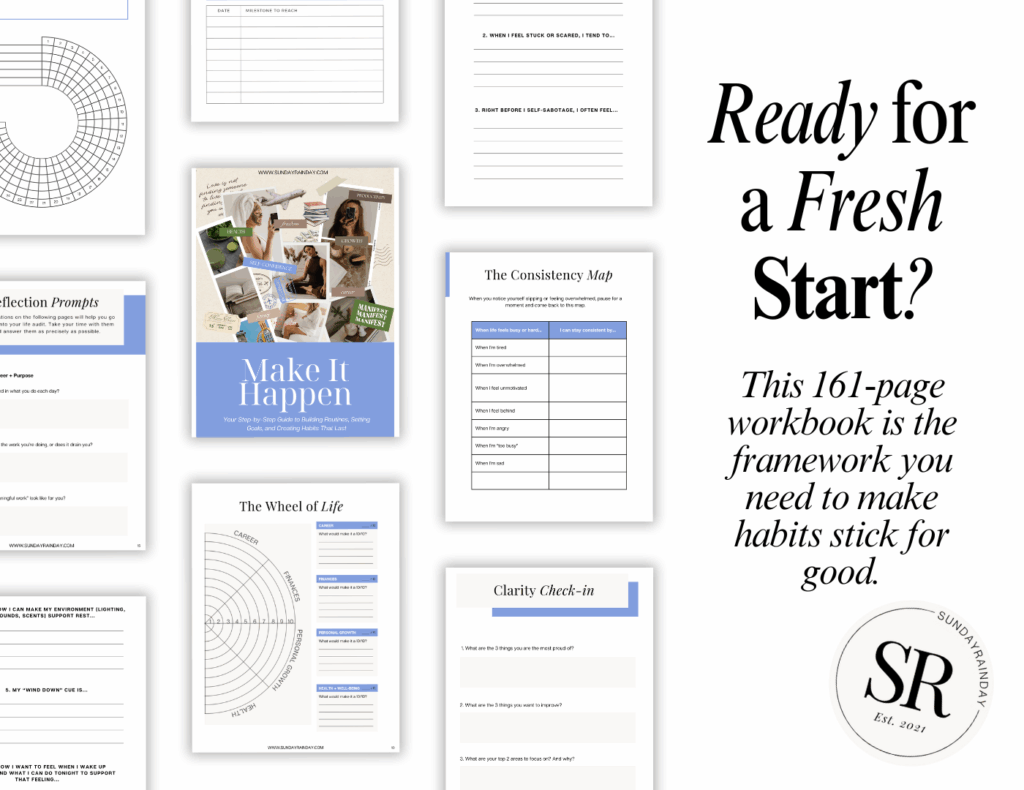
If you would like the whole process laid out with space to write, Make It Happen is a 161-page workbook built around it. It moves from a life audit to goals, habits and routines, and its three-month routine trackers give that fortnightly review something to look at.
Frequently asked questions
What should a morning routine checklist include?
Three kinds of line are enough: the essentials you already do, one lead habit tied to a goal you care about, and one thing that reliably steadies your mood. Add the time each takes and the event that triggers it, so the list reads as a sequence and not as a set of wishes. Most useful checklists come to four or five lines. If yours runs past seven, look for the lines that serve no particular goal and take them off, because length is one of the most common reasons a routine is abandoned.
How long should a morning routine be?
It should be as long as the time between waking and your first fixed commitment, minus the essentials, and no longer. For many people that leaves fifteen to thirty minutes on a working day, which is plenty for one lead habit and a few quiet minutes. Hour-long routines suit people whose mornings are their own, and they are no more effective for being long. A short routine you keep for three months will do far more for you than an ambitious one you keep for nine days.
Do I need to wake up at 5 a.m. for a morning routine to work?
No. Nothing in the research on habits depends on a particular hour, and adults need at least seven hours of sleep whatever time they get up. What helps is doing your lead habit soon after waking and in the same order each day, and that works as well at 7.30 as it does at 5.00. If you would like earlier mornings for their own sake, shift your bedtime and your wake time together by around fifteen minutes a week, so that the extra time comes from the evening.
How long does it take for a morning routine to become a habit?
Longer than the twenty-one days that often gets quoted. In the best-known study on the question, the average was 66 days, and individual results ranged from 18 days to an estimated 254. A reasonable expectation is two to three months of fairly consistent repetition before the routine feels like something you simply do. Missing the odd day doesn’t reset the clock, so there is no need to start again from zero after a bad morning.
Should my weekend morning routine be different?
It can be gentler, and for most people it should be. Try to keep your wake time within an hour or so of the weekday one, since a large swing makes Monday harder, and keep the lead habit if your goal benefits from daily practice. Everything else can loosen. Some people use the extra time for a longer version of the same habit, an hour on the draft where a weekday allows twenty-five minutes, while others drop to the short version and enjoy a slow breakfast. Both keep the thread going.
