

Not a Morning Person? How to Reset Your Body Clock for Earlier Mornings
Most people who say they’re not a morning person have tried to become one at least once. They set the alarm an hour earlier, pushed through a few foggy mornings on willpower alone, and slid back into the old rhythm by the second weekend. Each attempt that fades quietly confirms the story we tell ourselves: I’m just not built for mornings.
There’s some truth in that story. Your preference for mornings or evenings is partly written into your genes, and no amount of effort will turn a natural night owl into someone who springs out of bed at five.
The part we usually blame on ourselves is far more flexible, though.
Your body clock resets itself every day, and it takes its cues from light much more than from your alarm. Once you understand how that works, becoming a morning person turns into something practical: changing the right signals, and holding steady long enough for your body to catch up. Below, you’ll find what being “not a morning person” really means, whether earlier mornings are worth the effort, and six steps that help them feel natural.
Save this article
What it really means to not be a morning person
Scientists call your natural leaning towards mornings or evenings your chronotype. It sits on a spectrum, with early larks at one end, night owls at the other and most of us somewhere in the middle, leaning one way without being extreme. Your chronotype also moves across your life: teenagers tend to drift later, and most people grow earlier again as they age. So “I’m not a morning person” is rarely a fixed category. More often, it describes where you sit on that spectrum right now.
Genes do play a part. A study of nearly 700,000 people identified 351 regions of the genome linked to being a morning person. Yet when the researchers compared the 5% of people with the most “morning” variants against the 5% with the fewest, the difference in average sleep timing was about 25 minutes.
That’s a real difference, though a much smaller one than most night owls feel between themselves and the people who seem to wake up effortlessly at six. Genes set a leaning, and they rarely account for the whole distance.
Much of the rest comes from your current body clock: the timing your body has settled into because of how you live. When we say we’re not morning people, we usually bundle the two together. Your chronotype sets a leaning. Your daily signals decide how far you’ve drifted from it, and those signals are something you can change.
Turn earlier mornings into a habit that lasts
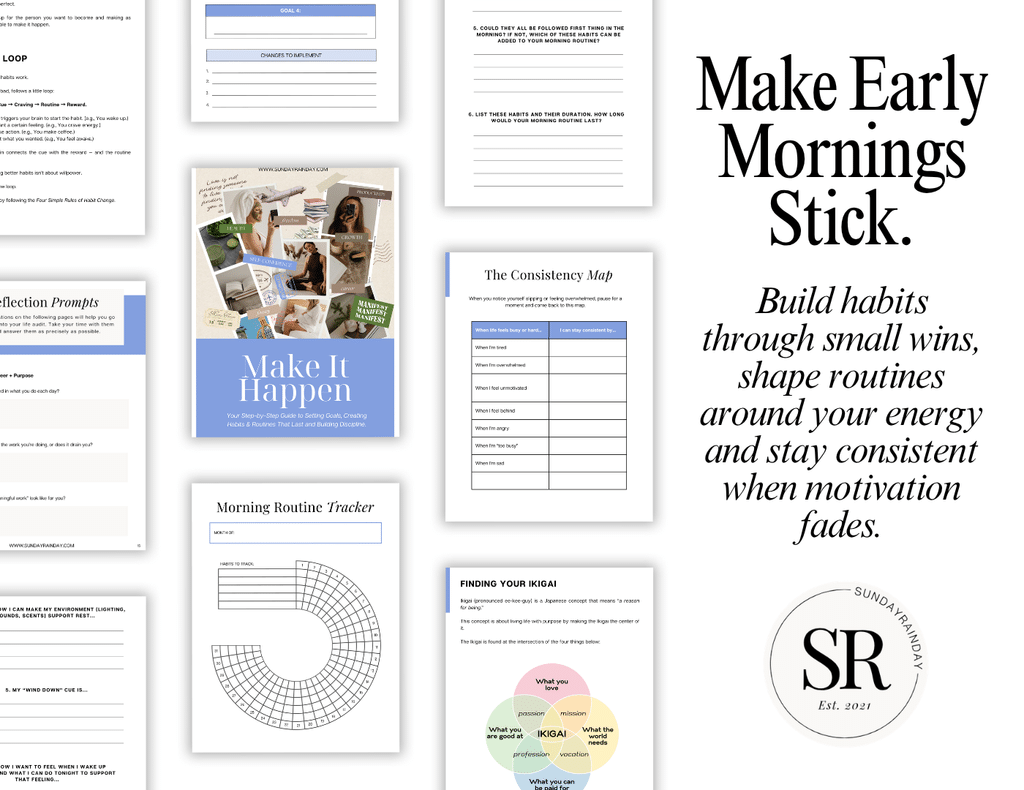
Becoming a morning person is a habit change, and habits need more than a good intention to stick. Make It Happen is a 161-page workbook that helps you build habits through small wins, design morning and evening routines around your energy, shape an environment that makes them easier and stay consistent when motivation fades, so your new rhythm keeps going long after the first week.
Why your body clock follows light, not willpower
Your body clock runs on a cycle of roughly 24 hours, and it needs a daily signal to stay in step with the world. The strongest of those signals is light reaching your eyes. Light early in the day pulls your clock earlier, while bright light late in the evening pushes it later. Modern life tends to get both the wrong way round: we spend our days indoors under lighting that is dim by outdoor standards, then keep our evenings bright with lamps and screens. Without meaning to, we send a steady message that the day starts late and ends later still.
A small but striking study from the University of Colorado shows how quickly that message can change. Researcher Kenneth Wright sent eight adults camping for a week in the Rocky Mountains, with sunlight and campfire as their only light. During that week, they were exposed to around four times as much light as in their normal lives. By the end, their internal clocks had moved about two hours earlier and lined up with sunrise and sunset. The differences between the early birds and the night owls in the group shrank too, because a strong natural light cycle pulled everyone towards the same rhythm.
The opposite effect shows up every weekend. Chronobiologist Till Roenneberg coined the term “social jetlag” for the gap between when we sleep on workdays and when we sleep on free days. Sleeping in on Saturday and Sunday works like flying a few time zones west on Friday night and flying back on Monday morning, which is why Monday so often feels like starting from scratch.
This is the part of being “not a morning person” that willpower can’t solve on its own. An alarm can drag you out of bed, but if your evenings are bright and your weekends drift, your body is still running on a later clock, and every early morning feels like a fight.
Your alarm decides when you wake up. Light decides when your body is ready to.
Is it worth becoming a morning person?
The internet is full of promises about early rising, from five o’clock routines to the idea that every successful person is up before dawn. Most of that is borrowed confidence, and it’s fair to ask what the research actually supports before rearranging your life around it. The evidence is more interesting than the slogans. It suggests that earlier mornings can make a real difference to how you think and feel, mostly because they bring your body clock and your daily life back into step. For anyone whose work, family or commitments start early, that alignment matters a great deal.
The most direct evidence comes from a 2019 study led by Elise Facer-Childs at the University of Birmingham. Twenty-two night owls, who usually went to bed around 2:30am, spent three weeks waking two to three hours earlier, getting outdoor light in the morning, keeping fixed sleep times on workdays and weekends alike and eating at regular hours. Their sleep moved about two hours earlier without getting shorter. Their reaction times and grip strength improved in the morning, when night owls usually struggle most, and they reported less stress and fewer symptoms of depression.
A much larger study points the same way. Researchers at the University of Colorado Boulder used genetic data from more than 840,000 people and found that sleeping one hour earlier was associated with a 23% lower risk of major depression. The authors are careful to say this strengthens the case for a causal link without proving it, but it’s a striking result.
There’s also a link with discipline. A 2017 meta-analysis in the Journal of Personality and Social Psychology found that morning people tend to score higher on conscientiousness, the personality trait most closely tied to self-discipline. What researchers can’t yet say is which comes first: whether early rising builds discipline, or disciplined people simply find early rising easier to keep.
One more finding keeps all of this in proportion. People tend to think most clearly at their own peak time of day, a pattern known as the synchrony effect. In one study of more than 700 teenagers, night owls scored lower than larks in morning exams, yet the gap disappeared when they sat the same kind of exam in the afternoon. What holds night owls back is timing: they spend most of their week out of step with a world that starts early, and shifting earlier is how you close that gap.
How to become a morning person in 6 steps
The steps below follow the same logic as the research: change the signals your body clock relies on, then hold them steady long enough for the clock to move. None of them asks you to wake at five or overhaul your life in a weekend. Some work on your mornings, one works on your evenings and one protects your progress at the weekend. Together, they turn an early alarm from a daily battle into something your body starts to expect. Begin with the first two, add the others as they feel manageable, and give the whole shift a few weeks before you judge it.
1. Anchor your wake time: one time, seven days a week
Choose the time you want to wake up and treat it as the fixed point everything else moves around. It’s tempting to start with bedtime instead, but bedtime is the part of the day you control least. If your body clock still thinks it’s early evening at ten o’clock, going to bed then usually means lying awake, frustrated and convinced the whole plan isn’t working.
Waking up is different. You can decide when it happens, and when you hold it steady, your body gradually starts to feel tired earlier in the evening. The wake time pulls the bedtime along with it.
To choose your time, start from what your mornings need to hold: when you have to leave, what you’d like to do before then and how much sleep you need to feel rested, which for most adults is somewhere between seven and nine hours. Then work backwards and settle on a time you could realistically keep on a Saturday as well as a Tuesday. A wake time you hold every day of the week will do more for your body clock than a much earlier one you only manage on weekdays.
Once it’s set, make getting up as simple as possible. Put your alarm somewhere you have to stand up to reach, and decide in advance what the first two minutes look like: feet on the floor, curtains open, a glass of water. The fewer decisions waiting for you at that hour, the less room there is to negotiate with yourself.
2. Find the light: get outside within an hour of waking
Morning light is the strongest signal you can give your body clock that the day has begun, and it’s the one most of us miss. We move from a dim bedroom to a dim kitchen to a car, a train or an office, and our body clock barely registers that morning has arrived.
Outdoor light changes that. Even on an overcast day, it’s many times brighter than ordinary indoor lighting, which is why Wright’s campers shifted so quickly and why the night owls in the Birmingham study were asked to get outdoor light every morning. Within an hour of waking, step outside for a few minutes: walk to the bakery, drink your coffee on the balcony, take the long way to the station.
The easiest way to keep this going is to attach it to something you already do. If you walk the dog, take the walk earlier. If you commute, get off one stop sooner and walk the rest. If you work from home, make the first coffee of the day an outdoor one, whatever the weather.
Winter makes this harder, especially in northern countries where the sun may not be up when you are. On those mornings, open the curtains as soon as you wake, eat breakfast by the brightest window and get outside as early in the day as you can. A regular breakfast helps too: it gives your body a second clear signal that the day has started, and the Birmingham researchers built it into their routine for exactly that reason.
3. Dim the evening: let the day wind down before you do
What you do in the evening matters just as much as what you do in the morning. Bright light after dark tells your body clock it’s still daytime, and the longer it lasts, the later your clock drifts. That’s exactly what Wright’s campers escaped: with no electric light at night, their bodies began preparing for sleep not long after sunset.
You don’t need to live by firelight to get some of that benefit. Pick a “lights-down” time, an hour or two before bed, and treat it as the start of your evening wind-down. Switch from overhead lights to lamps, lower the brightness on your screens and, if you can, leave your phone charging outside the bedroom.
Then fill that time with something that lets the day settle: a book, a bath, a few lines in a journal, some gentle stretching, a slow conversation. It doesn’t need to be elaborate. What matters is that it happens at roughly the same time each evening, so your body learns to read it as a signal.
Watch out for swapping one kind of stimulation for another. A gripping series on the laptop or an hour of work emails on the sofa keeps your mind switched on, even in a dim room. The aim is a gentle landing, so the evening feels like the end of the day rather than an extension of it.
4. Move in small steps: 15 to 30 minutes at a time
If you usually wake at eight, jumping to six overnight is the fastest way to give up by Thursday. Your body clock can only move so far in a day, so a sudden two-hour jump leaves it lagging behind, and every morning feels like jet lag.
Instead, move your wake time 15 to 30 minutes earlier and hold it for several days. Bring your lights-down time forward by the same amount, so your evening moves in step with your morning. When you start waking close to your alarm and the first half hour no longer feels like a struggle, move again.
For someone going from eight to half past six, that might look like 7:40 in the first week, 7:20 in the second, then 7:00, 6:45 and finally 6:30, with a pause at any step that still feels heavy. Five weeks can feel slow when you’re impatient, but it’s far shorter than the time most people spend starting over after a failed overnight attempt.
It’s possible to shift faster. The night owls in the Birmingham study moved about two hours in three weeks, but they changed every signal at once, from light and sleep times to meals, and followed the plan closely. If you’re ready for that level of structure, go for it. If not, small steps will get you to the same place with far fewer battles along the way.
5. Keep weekends close: no more than an hour of difference
This is the step most people skip, and it’s often the one that undoes everything else. After a week of early mornings, sleeping in until eleven on Sunday feels like a well-earned reward. For your body clock, though, it’s a trip across several time zones, and Monday morning becomes the jet-lagged flight home.
Aim to keep your weekend wake time within an hour of your weekday one. That’s what the Birmingham participants did, keeping the same sleep and wake times on workdays and free days alike. It’s also what separates a shift that holds from one that has to be rebuilt every Monday.
Keeping weekends close doesn’t mean giving up slow mornings. You can still stay in your pyjamas, read in bed with the curtains open or linger over a long breakfast. You’re simply awake and in the light while you do it, so the rest feels like something you chose.
Late nights will happen, and that’s fine. When they do, get up at your usual time anyway, step outside early and allow yourself an early night or a short rest in the early afternoon. Your body clock stays where you’ve worked to put it, and you’ll feel like yourself again far sooner than if you’d slept until noon.
6. Give the morning a reason: something worth waking up for
An early alarm is far easier to answer when there’s something waiting on the other side of it. Habits form more readily when they come with a reward, something your brain learns to look forward to, and earlier mornings are no exception. If waking up early only means more time to answer emails, it’s hard to blame any part of you for resisting.
So give the extra time a purpose that feels like yours. That might be an unhurried coffee, a chapter of a book, a walk before the streets fill up, a workout or an hour on a project that matters to you. Choose something you’d be sorry to lose.
Decide the night before what it will be, and prepare what you can: the book on the table, the running shoes by the door, the notebook open at the right page. That way, the morning starts with something you chose in a calm moment, rather than with whatever your phone decides is urgent.
Over time, this is what turns an early alarm into a morning you protect. Once waking up earlier feels steady, our guide to building a morning routine can help you shape what happens next, from the first ten minutes to the moment your working day begins.
Related read: Morning routine checklist: Build yours from your goals
How long it takes: discipline first, then light
Expect the change to take weeks rather than days, and rarely in a straight line. In the Birmingham study, night owls moved their sleep about two hours earlier in three weeks, with a carefully structured routine. In everyday life, with work events, late dinners and the occasional bad night, it usually takes a little longer. The first fortnight is almost always the hardest, because your habits change on day one while your body clock follows at its own pace. Knowing that in advance makes it much easier to keep going when the mornings still feel heavy.
In those early weeks, you’re running mostly on discipline. You get up at your new time while every part of you would rather stay in bed, you step outside when the sofa is calling, and you hold your wake time on Saturday even when nobody is watching. That effort is real, and it’s what carries you across the gap between deciding to change and your body catching up. If you’d like to understand why that steady effort outlasts a burst of motivation, our article on discipline vs motivation explores exactly that.
Then, gradually, the balance shifts. As morning light and darker evenings move your clock earlier, you start to feel sleepy at a sensible hour and wake up closer to your alarm. The discipline you needed in week one turns into something lighter, closer to maintenance than effort.
Setbacks are part of the process. A late night, a trip or a week of poor sleep can pull your clock back a little. When it happens, return to your usual wake time the next morning rather than sleeping in to make up for it, and your rhythm will usually settle again within a few days.
Signs your body clock is fighting you, not your habits
Sometimes you do everything right and the mornings still feel like wading through fog. When that happens, it’s tempting to conclude you lack discipline and give up. More often, the habits are fine and one of the signals is still working against them. Each of the patterns below points to a specific adjustment, and most of them can be fixed within a week or two. These are the signals worth paying attention to.
You wake on time but feel foggy for hours. The signal to watch for is a bedtime that hasn’t moved. If you’re getting up earlier but still falling asleep at the same hour, you’re simply sleeping less. Look at your evenings first: lights, screens and the time you start winding down.
Your progress disappears every Monday. This is social jetlag at work. If Saturday and Sunday mornings drift by two or three hours, your body clock spends the weekend travelling back to its old time zone. Bring your weekend wake time closer to your weekday one, even if it feels less indulgent.
You need three alarms to get up. Your body clock is still running well behind your alarm. Check how much daylight you’re actually getting in the first hour of the day, because that single signal often makes the biggest difference.
You’re still exhausted after six weeks of doing everything well. You may be asking for more than your chronotype can comfortably give. Aim for a gentler target, perhaps an hour later than your original goal. A wake time you can sustain will serve you far better than an ambitious one you keep fighting.
A new pace, one morning at a time
Being “not a morning person” is less of a verdict than it feels like at 6am. Part of it is written into who you are, and that part deserves some respect. The rest is a rhythm your days have taught your body, and rhythms can be taught again: through the light you let in, the evenings you soften and the wake time you keep, even on the mornings it would be easier not to.
You don’t need to become someone else to get there. You need a few steady signals and enough patience to hold them while your body crosses over to the new time. One day, usually sooner than you expect, the alarm goes off and you’re already half awake.
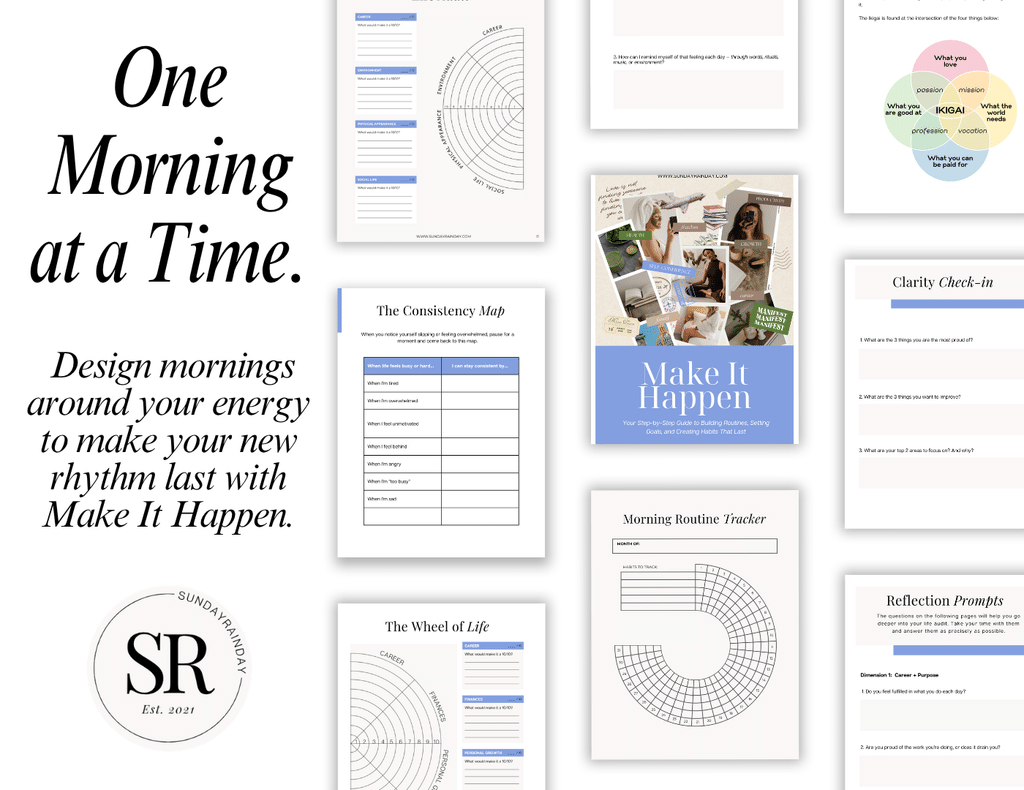
If you’d like support in making that change stick, Make It Happen is built for exactly this stage. Its chapters on habits, routines, environment and consistency help you design mornings and evenings around your energy, track the small wins that keep you going and build a personal consistency map for the days when motivation runs out. With Make It Happen, your new rhythm becomes part of a life you’re shaping on purpose, one morning at a time.
Frequently asked questions
Why am I not a morning person?
Partly genetics: your chronotype gives you a natural leaning towards mornings or evenings. The rest usually comes from your daily signals, such as little daylight in the morning, bright evenings and late weekends, which push your body clock later than your schedule needs it to be.
Can a night owl become a morning person?
Yes, within limits. Research on night owls shows that consistent wake times, morning light and darker evenings can move sleep about two hours earlier in a few weeks. A strong night owl may never love 5am, but most people can shift far enough to make mornings feel manageable.
How long does it take to become a morning person?
Usually a few weeks. The first fortnight is the hardest, because your habits change straight away while your body clock follows more slowly. Keeping the same wake time every day, weekends included, speeds things up.
Are morning people more productive?
Morning people tend to score higher on conscientiousness, and studies link earlier sleep timing with better mood. But people generally think best at their own peak time of day. The biggest benefit of shifting earlier is aligning your body clock with a world that starts early.
Should I sleep in at the weekend?
Ideally, keep your weekend wake time within an hour of your weekday one. Sleeping in for several hours creates social jetlag, which pulls your body clock back and makes Monday mornings much harder.
