

Letting Go of Expectations: 15 Beliefs That Quietly Run Your Life
We all carry around an idea of how our lives are supposed to go.
By this age, I should have figured this out. I should be further ahead. My career should look like this. My relationships should feel like that. I should be happier, more successful, more certain of what I’m doing.
And when reality doesn’t match the picture, we rarely question the picture.
We question ourselves.
That’s the problem with expectations. They can feel like personal ambitions when, in reality, many of them were never consciously ours to begin with. We absorb them from the people around us, from the lives we see online, from culture, from our families, and from all the unwritten rules about what a successful life is supposed to look like.Then we spend years measuring ourselves against them.
Letting go of expectations doesn’t mean lowering your standards or wanting less from your life. It means questioning the beliefs you’ve been using as a measuring stick and deciding which ones still deserve a place in the life you’re building. Because sometimes the problem isn’t that you’re behind.
It’s that you’re measuring your life against a timeline, standard, or definition of success you never chose. Here are 15 expectations worth letting go of and what to believe instead.
You Can’t Let Go Until You Know Who You Are.
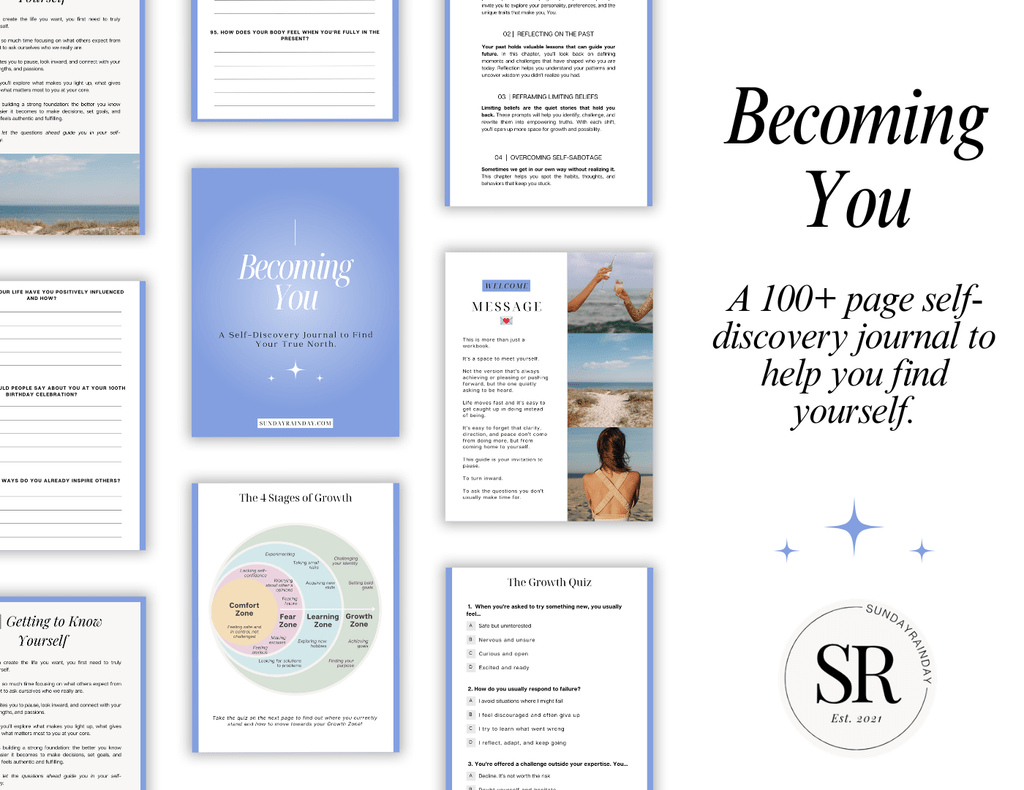
Most of these expectations survive because you’ve never actually defined yourself on your own terms. Becoming You is a guided self-discovery journal that walks you through the questions underneath all of this: what you want, what you value, and who you are when you stop performing the version other people expect. It’s where letting go starts.
Save this article

15 Unrealistic Expectations to Let Go Of
1. You can be anyone you want
There’s a particular exhaustion that comes from trying to become someone you’re not. Not the good ache of growth, but the quiet strain of forcing yourself toward a version of success that was only ever someone else’s idea of it.
You can build a great deal with work, consistency, and a little luck. What wears you down is straining against your own grain, trying to will yourself into a shape that was never going to fit. We’re each wired differently, with our own gifts and our own texture, and there’s real relief in stopping the fight against that instead of reading it as a limit.
So letting go of “you can be anyone” isn’t giving up on your dreams. It’s the opposite. When you stop pouring energy into a life that was never yours, you get all of that energy back for the one that is. You’re not lowering the bar. You’re finally aiming it at something real, something that actually belongs to you.
2. You’ll start loving yourself once other people do
This is the quiet deal most of us make without realizing it: once enough people show me I’m worthy, I’ll finally believe it myself.
It doesn’t work that way. When people love us, we feel permitted to love ourselves, so we wait around for that permission. But it’s a loop with no exit. Someone else’s approval feels like proof for about a day, and then you need more of it. The self-worth never actually transfers.
You can decide not to let an insult land. In exactly the same way, you can decide your worth isn’t up for a vote. Waiting for other people to hand you a sense of value you could give yourself is one of the longest detours there is. This is worth working through, because so much of life gets spent auditioning for people whose opinion you won’t remember in five years.
3. Your life only counts if it looks extraordinary
Somewhere along the way, most of us absorbed a quiet, punishing idea: that an ordinary life is a failed one. That unless you’re the exception, the standout, the person other people point to, you haven’t really made it, and every unremarkable day is proof you fell short.
Here’s the relief hiding inside that belief. The pressure to be extraordinary was never actually yours. You were handed it by a culture that sells the one-in-a-million story as if it were the starting line, so that anything gentler starts to feel like failure. You haven’t been falling behind. You’ve been running a race no one ever entered you in.
You don’t have to earn your place by being remarkable to everyone. The lives that turn out to matter most are usually extraordinary in private: a way of loving the people close to you, work that means something to you, an ordinary afternoon that felt like more than enough. So try a warmer question than “how do I stand out.” Ask what you’d want your life to feel like even if no one were watching. That answer is yours, and it was always allowed to be.
Letting go of expectations isn’t about wanting less. It’s about noticing which beliefs are quietly running your life, and dropping the ones that only exist to make you feel behind.
4. You have plenty of time
Nobody wakes up assuming today is the day it ends. And yet not all of us get the long life we quietly assume we have.
This isn’t a reason to live anxiously. It’s a reason to stop treating right now as a waiting room for the real life that starts later. The assumption that there’s always more time is exactly what lets people postpone the things that matter, year after year, until the years are gone.
It matters most if you’re ambitious. If your plan is to trade years of your life for money or status now, on the promise that you’ll enjoy it later, it’s worth remembering that later was never guaranteed. Do the work. Chase the goals. Just don’t file “enjoy your life” and “be with the people you love” under someday.
5. Your mistakes matter less because you’re young
It’s tempting to believe the things you get wrong now are somehow provisional. That the real version of your life starts later, and these missteps won’t be allowed to follow you into it.
This is an especially common feeling, especially among young adults.
Your mistakes do follow you, but not as a verdict. They follow you as lessons, and only when you let yourself actually look at them. Owning a mistake isn’t the same as punishing yourself for it. It’s the gentler, braver thing: staying with what happened long enough to hear what it’s trying to teach you, so you’re not quietly repeating it for years without noticing. Accountability and self-compassion were never opposites. Done kindly, they turn out to be the same move.
6. You can silence the feelings you don’t like
You can’t play hide-and-seek with a feeling. Not forever. You can bury it, distract yourself from it, and stay busy enough to outrun it for a while, but it’s still there, waiting.
Avoiding what’s uncomfortable doesn’t make you happier. It just narrows your life. Every feeling you refuse to feel takes a piece of your range with it, and you end up smaller, more guarded, and strangely more anxious than if you’d just let yourself feel the thing. Difficult emotions are information. When you stop treating them as problems to eliminate, they start telling you something useful about what you need and what has to change.
7. If you work hard enough, the struggle stops
Hard work is not a receipt you exchange for a life without difficulty. You can do everything right and still hit a wall.
The first time you work genuinely hard for something and don’t get it, something shifts. You realize that no matter how many obstacles you clear, struggle isn’t a phase you graduate out of. It’s just part of being alive and trying to build something.
Here’s where it turns from bleak to freeing. If struggle is simply part of the deal, then its presence in your life was never a personal failing. You can stop bracing against it as though it means you took a wrong turn, and stop waiting for the season when everything finally goes smooth. That waiting is its own kind of suffering. There’s a quiet peace on the other side of accepting that a full life includes hard things, and it lets you meet the next one with a lot less self-blame.
8. You can control how other people see you
You can’t, and it’s freeing to admit it. A slightly different version of you exists in the head of everyone you’ve ever met, and you have almost no say over the edit.
There’s real science here. Psychologists call it the spotlight effect: we badly overestimate how much other people notice and remember about us. In the original Cornell research, people wore an embarrassing shirt into a room and were convinced everyone clocked it. Far fewer actually did. The takeaway is almost comically reassuring. Nobody is thinking about you nearly as much as you’re thinking about how they think about you.
So trying to manage the image in every head you pass through is a full-time job with no salary. And even if you could pull it off, performing a curated version of yourself would only pull you further from the real one. Let people have their versions of you. Your job is to be the actual thing.
9. Hard work always equals success
We’re taught that effort is a contract: put the work in, get the result out. So when the result doesn’t come, the math feels personal, as if you simply didn’t want it enough. But results were never yours alone to control. They ride on timing, luck, other people’s choices, and a hundred things happening outside your reach.
This matters because of what you do with it when a goal doesn’t land. If you believe hard work guarantees success, then falling short can only mean you’re not good enough, and your sense of worth takes the hit every time the world doesn’t cooperate.
Here’s the kinder truth. Your effort is yours. The outcome is a negotiation with reality. You can be fully proud of how you showed up for something that still didn’t work out, because the two were never the same thing. Let the scoreboard stop deciding what you’re worth. You gave it everything you had, and that was the part that was ever actually up to you.
10. Your mindset will change once your life improves
Most people have the order backwards. They assume that once they hit the goal, they’ll finally feel confident, calm, and different. As if the achievement will hand them a new internal state.
It doesn’t. Reaching the goal doesn’t rewrite your self-talk. Your mindset is the thing that changes your life, not the reward you get after your life is already sorted. If you talk to yourself like someone who’s behind and not enough, achieving something won’t fix that. You’ll just find a new benchmark to feel behind on.
Your mind builds your reality, not the other way around. Which is genuinely good news, because it means the one lever you actually control is available today, before anything external changes at all.
11. More money will fix your problems
Your relationship with money doesn’t magically upgrade when the number gets bigger. The habits and the mindset come with you.
The data on this is almost funny. In Goldman Sachs’ 2025 research, 41% of households earning $300,000 to $500,000 said they live paycheck to paycheck, a higher share than among many people earning far less. The mechanism is lifestyle creep: as income rises, spending quietly rises to meet it, and yesterday’s luxury becomes today’s baseline. More money in, more money out, same squeeze.
That’s the point most people miss. Money problems, like most problems, need a mindset shift to actually resolve. Change how you think about money, deal with the debt, build the habit of saving, and your situation improves. Add income while keeping the same spending patterns, and you’ll recreate the exact same stress one tax bracket up.
12. Other people should be who you need them to be
Some of the heaviest expectations we carry aren’t about ourselves at all. They’re the quiet ones we hold about other people: that a partner should know what we need without being told, that a friend should love us the exact way we love them, that a parent should finally turn into the person we always needed.
Here’s what usually happens with expectations of others. The person never knew the standard existed. We wrote the script in our heads, cast them in a role they never auditioned for, and then quietly resented them for not knowing their lines. So much of the disappointment we feel toward the people we love is really just an unspoken expectation coming due.
Letting go of expectations of others isn’t lowering your standards or tolerating being treated badly. Boundaries still matter, and you can always ask out loud for what you need. What you set down is the belief that people are obligated to be who you need them to be. And there’s a strange tenderness on the other side of that. When you stop measuring people against the version of them in your head, you start seeing the actual person in front of you, and it gets easier to love them as they are.
13. Your goals are worth sacrificing your health for
One of the most seductive lies going is that you’re resilient enough to run your body into the ground now and deal with the consequences later.
Feeling invincible is partly a mindset. But treating your health as an infinite resource you can borrow against is a bad bet with compounding interest. Your health is the thing that makes every other goal possible. Building the life you want takes time, energy, and consistency, and all three run on sleep, movement, and food that actually fuels you.
Cutting those to squeeze out more productivity is a false economy. You’re not gaining hours, you’re borrowing them from a future self who has to pay them back with interest. The sooner that clicks, the better positioned you are to build something that lasts.
14. You’ll be happy once you’ve solved your problems
Happiness isn’t a reward you unlock at the end of your to-do list. Thinking you’ll be happy once the weight is off, the debt is gone, or the title is yours is just a socially acceptable way to keep postponing it.
There’s a name for this. Harvard-trained psychologist Tal Ben-Shahar calls it the arrival fallacy: the belief that reaching a specific goal will deliver lasting happiness. What actually happens is that you feel a spike, the spike fades fast, your new situation becomes the baseline, and a fresh goal appears to chase. The finish line keeps moving, and the happiness you were promised never quite arrives.
Your happiness isn’t waiting on the other side of the weight loss or the promotion. At any given moment, you already have reasons to feel it. The only real variable is whether you pause long enough to notice. Gratitude sounds soft, but it’s the practice that pulls your attention off the horizon and back to a life that’s already happening.
15. You’ll feel ready when the right opportunity comes
You won’t feel ready. That’s the whole trick of it.
Waiting to feel ready before you have the child, take the job, move to the new city, or leave the thing that’s making you miserable is how people end up stuck in lives they didn’t choose so much as fail to leave. Readiness is not a feeling that arrives on schedule. It’s something you find on the other side of a decision you made while scared.
The people who build lives they love aren’t braver or more prepared than everyone else. They just learned to act before the fear cleared, because they figured out the fear doesn’t clear first. It clears after. This is one of the reasons getting out of your comfort zone is key for growth.
Related read: How to Step Out of Your Comfort Zone
Readiness isn’t a feeling that emerges in due time. It’s something you find on the other side of a decision you made while scared.
Ready Doesn’t Come First. Clarity Does.
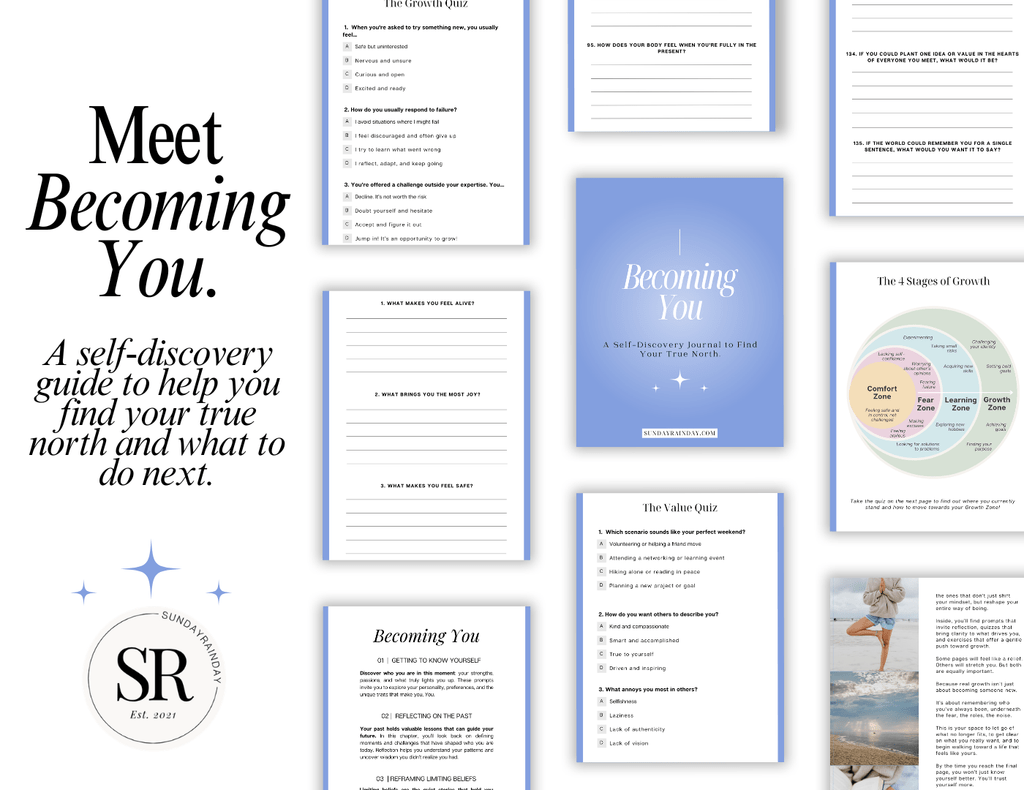
You won’t feel ready, but you can feel clear. Becoming You is the guided journal for the in-between season, when you’re done living by other people’s expectations but haven’t yet defined your own. Work through it once and you’ll walk out with a far sharper sense of what you actually want your life to be about.
How to actually let go of an expectation
Naming the 15 is the easy part. The harder work is doing something with them, because an expectation you’ve carried for years won’t just evaporate because you read a list. Here’s the move, in three steps.
First, catch it. The next time you feel that flat disappointment with your life, stop and find the expectation underneath it. There’s almost always a hidden “I should have by now” running the show.
Second, trace it. Ask where it came from and whether you ever actually agreed to it. Most of the standards we punish ourselves against were absorbed, not chosen. Seeing that a belief is borrowed takes most of its authority away.
Third, replace it. Letting go of a false expectation leaves a gap, and if you don’t fill it with something truer, the old one creeps back. Swap “I should have it all figured out by now” for “I’m allowed to still be figuring it out, and that’s the normal state of being a person.” The goal isn’t zero expectations. It’s expectations that are actually yours.
Frequently Asked Questions
What does letting go of expectations actually mean?
It means releasing the fixed ideas you hold about how your life, other people, or you yourself are supposed to turn out. Letting go of expectations isn’t the same as having no standards or no goals. It’s about dropping the rigid assumptions that only set you up for disappointment, so you can respond to your actual life instead of grieving the imagined one.
Why is letting go of expectations so important?
Your twenties are when the gap between the life you pictured and the life you have tends to open up widest. That gap is where a lot of quiet unhappiness lives. Letting go of unrealistic expectations early means you spend less of the decade feeling behind against standards you never consciously chose, and more of it building something that fits who you actually are.
Is it healthy to have no expectations at all?
No, and that isn’t the goal. Expectations help you set direction and standards. The problem is unrealistic or rigid expectations, the ones based on a fantasy version of life rather than reality. The aim is to hold your expectations loosely: keep the ones that motivate you, and release the ones that only exist to make you feel like you’re failing.
What are the most common unrealistic expectations to let go of?
A few show up again and again: that you can control how others see you, that working hard guarantees success, that more money will fix your problems, and that you’ll finally be happy once everything is solved. Each one sounds reasonable, and each one quietly sets you up for disappointment. Trading them for more grounded beliefs is one of the most freeing shifts you can make.
Final Thoughts
As you start actually shaping your life instead of just imagining it, the most useful thing you can do is break the illusions holding you in place. Realizing you don’t have to be extraordinary to matter, and that your happiness was never tied to solving every problem, isn’t a downgrade. It’s a release.
Whatever you’re building and whatever your version of the ideal life looks like, your ability to appreciate what’s already here is what carries you through. The biggest changes rarely come from a new achievement. They come from a shift in how you see, which is available to you right now, today, before anything external moves at all.
Let go of the expectations that were never yours. What’s left is a life you can actually live.
