

15 Uncomfortable Feelings That Indicate You’re on the Right Path
Three weeks after the decision, the excitement has worn off but the questions have not.
You’ve handed in your notice, ended the relationship or finally moved to a new city. Now you’re standing in a supermarket you don’t know yet, unable to find the lentils, wondering whether you’ve just made a very expensive mistake.
Am I on the right path, or did I talk myself into this?
When your life starts to feel heavy, the first instinct is to ask whether you made a mistake. I have asked myself that question in the middle of every real change I have ever made, and over time I learned to read it differently than I used to.
Discomfort tells you that something in your life is changing. On its own, it can’t tell you whether the change was a good one. What it can do, if you look at it closely, is show you which kind of discomfort you’re in, and that is where the real signs are.
This article covers why a good decision so often feels worse before it feels better, the signs that point toward the right path, the discomfort that is telling you to stop, and a way to check if you’re on the right path.
Need Help Finding Your Direction?
If any of this sounds like where you are right now, the discomfort is not the problem to solve. The real question underneath it is quieter: who are you actually becoming, and what do you want on the other side of this?
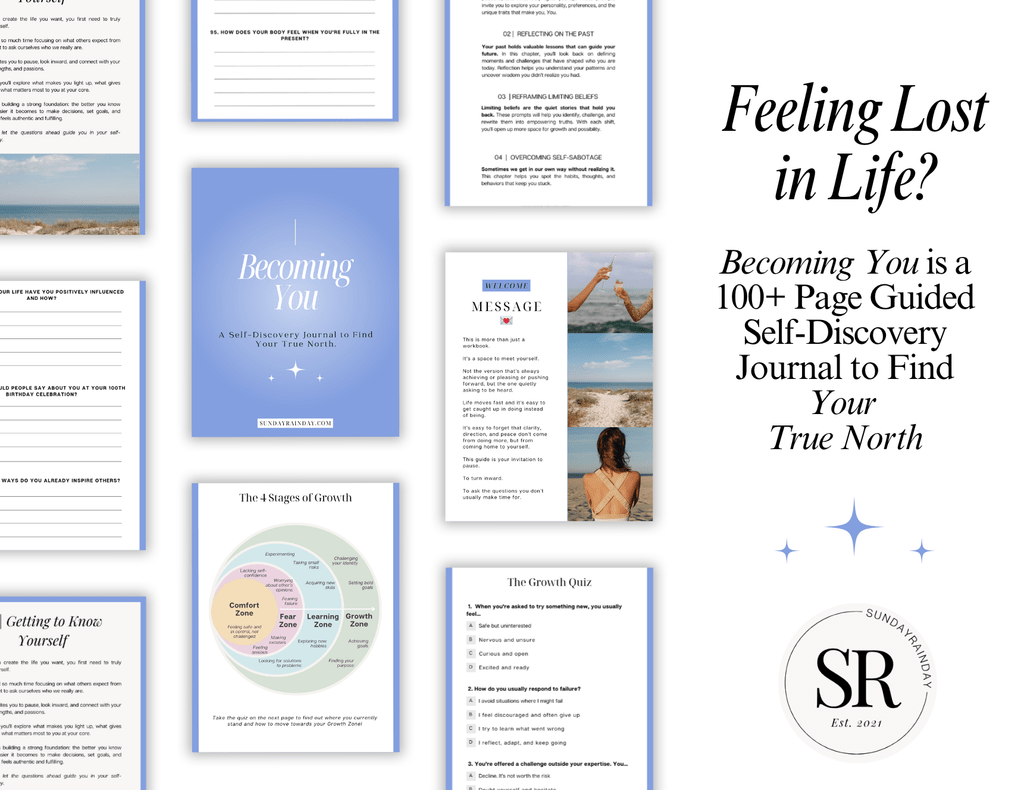
This is the work Becoming You was built for. It is a 100+ page guided self-discovery journal that turns a vague sense of being lost into a clear sense of direction, through guided self-discovery questions and exercises.
Save this article
How to know you’re on the right path
Most people expect the right path to feel like relief. But in the early stages of a real change it usually feels like effort, because you’re doing things you haven’t done before without the routines that used to carry you. Just like a muscle gets stronger when it’s asked to do more than it’s used to, life works in a similar way: the stretch is uncomfortable because it’s new.
If you feel lost and uncomfortable and you’re wondering what to do with your life, a more useful question than why does this feel so bad? is what is this discomfort pointing me toward?
The feelings covered in this article are the ones that look like something is going wrong while in fact meaning the exact opposite.
Why a good decision can feel worse at first
The early weeks of any change are lopsided. What you gave up is specific and immediate: the colleagues you liked, the commute you could do half asleep, the version of your week you knew by heart. What you’re building is still mostly a forecast. For a while, the loss is real and the gain is still hypothetical, and your mind weighs them accordingly.
Those forecasts are also less reliable than they feel. The psychologists Timothy Wilson and Daniel Gilbert, who spent years studying affective forecasting, found that people tend to overestimate how intense and how long-lasting their emotional reactions to future events will be. Part of the reason is that we underestimate how quickly we make sense of what happens to us, which is what speeds emotional recovery. In the middle of a hard month, you are predicting the next year from the worst of it.
Then there’s the question of whether big changes tend to pay off at all. The economist Steven Levitt ran an unusual experiment: people who couldn’t make up their minds about a major decision, such as quitting a job or ending a relationship, let a coin toss help them decide, and he followed up months later. Those the coin told to make the change were more likely to do it, and were happier six months later than those the coin told to stay put. Levitt’s conclusion was that people may be too cautious when facing life-changing choices.
It’s one study, and it says nothing about whether your particular change was right. But it does suggest that the ache of the first few weeks is a poor guide to how you’ll feel by spring.
If what you find hardest is the in-between itself, the stretch where your old life has ended and the new one hasn’t completely formed, this article about how to tell when you’re outgrowing your life will help you explains why it feels so disorienting, and what to do while you’re in it.
In Steven Levitt’s coin-toss study, people who went ahead with a major change they’d been hesitating over were, on average, happier six months later than people who stayed where they were.
The Signs You’re on The Right Path and Growing
None of these proves anything on its own. Together, and over a few months, they’re a reasonable sign that what hurts is the cost of the change itself.
Your doubt is about whether you can, not if you still want to
Doubt comes in two kinds. One sounds like I’m not sure I’m good enough for this or what if I fail in front of everyone. The other sounds like I don’t know if I actually want this.
The first kind is close to guaranteed on the right path, because any change worth making asks you to do something you haven’t ever done before. The second is different information entirely and it deserves you sit with it.
If your fear is about capability, and the wanting is still there when you’re calm, you are most likely scared of the right thing. If you fear you no longer want something, this simple feeling is worth rethinking the entire plan.
You miss specific parts of the old life
Missing things after a change is normal. What tells you something is what you actually miss.
When you’re on the right path it tends to be very specific: the friend from the old office you had coffee with at ten, the walk home along the lake. You’d take those pieces back in a heartbeat, and yet when you imagine returning to the whole arrangement, something in you tightens.
When you miss everything, when you’d go back to all of it tomorrow, including the parts you left because of, take that seriously.
Old patterns come back louder
New situations have a way of reactivating very old scripts. The people-pleaser in a new job says yes to everything in the first month. The person who learnt early that needing help made her a burden finds herself struggling alone in a new city instead of asking anyone. It can feel like regression, as if the change has made you worse. What has usually happened is that the old pattern has lost the familiar routines it used to hide behind.
When you start growing, you become more conscious of the patterns you have been carrying, and the ones from childhood tend to surface first, not to drag you back, but because you are finally aware enough to face them. Working through them is uncomfortable, but it is often what clears the way to clarity about what you actually want.
You’re less willing to shrink yourself
As you settle into a life that fits better, your tolerance for the old compromises significantly drops. You notice when you’re being talked over. You say no to things you’d have agreed to a year ago, and some of the people who were comfortable with the more accommodating version of you are visibly less comfortable now.
That friction is real, and it can cost you relationships. That new urge to speak up and hold your boundaries is not you becoming difficult or ungrateful. It is you recognizing your own worth and refusing to keep betraying it. This is the clearest signs you are becoming more honest about who you are and ready to stand for what matters to you.
The distance to your goals has become visible
Seeing how far you still have to go is often demotivating. You can only see that distance once you’re close enough to measure it, though. From the old life, the goal was a vague direction. From here, it has costs, a timeline and a first step, which is exactly why it suddenly looks so far away.
Don’t take it as a signal you are far behind because this is the evidence you are actually getting closer.
Old goals have gone quiet
Another sign you are moving toward the right direction is that some ambitions you carried for years stop pulling at you. The title you were chasing, the salary figure, the house by forty, the marathon you kept signing up for. This can make you feel you’ve lost your drive at first.
More often, it means those goals were set by an earlier version of you, before you knew what you know now. When they go quiet, there is finally room to set goals that matter to who you are becoming.
You’re asking better questions
How do I get promoted becomes what do I want my days to look like. What will people think becomes what am I willing to trade for this.
You have fewer answers than you used to, and nothing is really clear yet, but the questions themselves are sharper. This is usually what progress looks like early on. If you want more to work with, these self-discovery questions are a good place to start.
You’ve stopped waiting for someone to tell you it was right
At some point you notice you’re no longer looking for permission because you don’t really care. Nobody is going to confirm that the decision was correct, and you’ve made a kind of peace with that. You are taking responsibility for making it work, which is a very different position from hoping it works out.
A lost sense of direction of direction
Feeling lost is a sign that you’re moving away from familiar territory, shedding old identities, and exploring new opportunities. It’s an uncomfortable but essential stage of personal growth where your sense of direction is challenged. Embracing this feeling means that you accept that your old map is no longer working and are on your way to drawing a new one.
Feeling lost in life is absolutely not taking a step backward. Rather, it is the sign that your old life is no longer good enough for you and that you’re finally ready to start a new one.
Related read: 17 Things to Do When Feeling Lost in Life
Sudden waves of saddness or anxiety
Unexplained waves of sadness or anxiety signal that you are emotionally processing changes, even if they aren’t immediately visible. Anxiety is always a call to action. These emotions are your body and mind’s way of letting you know something is deeply not right, releasing old attachments, and making room for new experiences.
Instead of pushing these feelings away, acknowledging them will help you understand what fears and concerns holding you back. It’s often a sign that your internal world is shifting to align your evolving sense of self. That inner shifting is uncomfortable, but it is what growth actually feels like from the inside.
An intense need to be alone
When you are changing, the pull toward solitude is not antisocial. It is necessary. You need space away from other people’s opinions to hear your own, and socializing can feel draining while you are recalibrating who you are. That urge to withdraw is often protective, guiding you back toward your own voice.
Give yourself the alone time, because it is where the clarity comes from.
You feel like your life is collapsing before your eyes
When everything seems to fall apart at once, it usually means the old structures are breaking down to make room for new ones. It does feel like chaos, but this dismantling is often a necessary stage, because you cannot rebuild a life that fits while the old one is still standing in the way.
Psychologists even have a name for the growth that can follow hard upheavals: post-traumatic growth, the real, documented change many people report after struggling through difficult periods of their lives.
None of this makes the collapse pleasant while you’re in it. But it does mean that what’s still standing afterwards is often closer to the life you actually wanted.
Growth can be a good reason to stay through discomfort. It is never a good reason to stay somewhere you don’t belong.
Your mind seems to be your worst ennemy
During times of transition, your mind might focus on doubts, fears, and anxieties, making it feel like it is working against you. It is not. It is trying to protect you by pulling you back toward what is familiar, even when familiar is exactly what you are outgrowing.
Recognizing that pattern is itself progress, because it means you are actively trying to push past it.
Learn to notice those thoughts without believing every one, and meet yourself with self-compassion instead of contempt, because the research is clear that being kind to yourself makes you more resilient, not less.
You don’t really know who you are anymore
When you let go of old identities, roles, and goals, it is normal to feel disconnected from the person you used to be. It is disorienting, but it is also proof that you are evolving rather than staying stuck. Instead of treating it as an identity crisis, treat it as an opening, a rare chance to decide, deliberately, who you actually want to become.
Someone will ask what you’re up to, and you won’t have a tidy answer. For now, that’s fine. The new answer tends to form through what you try next, not through thinking harder about it.
You realize you are the only person responsible for your happiness
Understanding that your happiness is ultimately your responsibility can be both liberating and intimidating.
It means letting go of external validation and taking ownership of your choices and emotions. While this realization may initially feel overwhelming, it’s actually a powerful indication that you’re becoming more self-reliant and proactive about creating a fulfilling life.
The discomfort that is telling you to stop
The idea that every hard feeling helps us grow has a cost: it keeps people in places they should leave. Some discomfort is information about the path itself.
The clearest is dread aimed at the thing itself instead of at your ability to do it. Nerves about a new role fade with practice. Dreading the ordinary Tuesday, weeks after the novelty has gone, usually doesn’t.
Another is a change made mainly to get away from something, or to prove something to someone. Leaving can still be the right call. It’s worth asking what you’re moving toward, though, because when the honest answer is anywhere but there, the same feeling will probably turn up again a year later in different circumstances.
The last is being treated badly and calling it growth. A partner who belittles you or a workplace that runs on shouting is harmful, and no amount of personal-development language makes it character-building. This is where the “discomfort means growth” idea gets misused most.
Final Thoughts
Discomfort is what the middle of a real change usually feels like. You’ve left something familiar, the new life hasn’t proved itself yet, and for a while you carry the cost of both.
That middle stretch is also the part people are most tempted to quit, because it has all the loss of leaving and none of the evidence that it was worth it. Give it longer than feels comfortable. Keep the few feelings that tell you to stop in view, and read the rest as the price of moving somewhere new.
So when the doubt and uncertainty come, try not to read them as proof you took a wrong turn. Read them as confirmation that you are actually moving. The path toward a more authentic life is not a straight line, and the hard stretches are part of it, not detours from it.
Don’t Let These Questions Fade
Feeling lost or stuck is the beginning of the work, not the whole of it. The questions surfacing right now deserve more than a passing thought on a hard day, and left unanswered they tend to circle back.
Becoming You gives them somewhere to go. The prompts, quizzes, and exercises are designed to move you from “something feels off” to knowing exactly what you want and who you are underneath the noise.

Frequently Asked Questions
How do I know if I’m on the right path in life?
You usually know less by how good it feels and more by how true it feels, even when it is hard. Being on the right path often comes with discomfort (doubt, loss, uncertainty), because growth rarely happens inside your comfort zone. If your choices are moving you toward a life that is more honest and more yours, the difficulty is part of it, not a sign you chose wrong.
Does feeling lost mean I’m on the wrong path?
No. It actually usually means the opposite. Feeling lost is what it feels like to leave a life that no longer fits before the next one has taken shape. It is a sign your old sense of direction has expired, not a sign you have failed, and the discomfort tends to lift as you get clearer about what you actually want.
Why is discomfort a sign of growth?
Because growth asks you to leave what is familiar, and leaving what is familiar is uncomfortable by definition. Stretching past your old limits, changing your identity, and letting go of what used to fit all create friction, and that friction is what you feel as discomfort. It does not mean every hard feeling is good, since some discomfort is a signal to stop. But the particular discomfort of outgrowing your old life usually points toward growth, not away from it, which is why so many of the feelings in this article look like failure and actually signal change.
Why do I feel worse when I’m actually growing?
Because growth breaks down the old version of your life before it builds the new one, and that in-between stage is genuinely hard. You are letting go of identities, relationships, or goals that used to give you stability, and the new ones have not formed yet. Feeling worse for a while is not proof you are going the wrong way. It is what the middle of real change feels like.
Is it normal to feel lost when your life is changing?
Completely. People rarely move through a major life change without a stretch of feeling lost, anxious, or unsure of who they are, and it is one of the most common parts of transition. The feeling eases as your sense of direction returns.
