

12 High-Impact Habits That Shape Everything Else
You have probably tried to change your life through habits before. Maybe it was a January list with nine items on it, or a morning routine copied from someone who gets up at five, or an app that congratulated you on a twelve-day streak shortly before you stopped opening it. For a couple of days everything felt different, and then a random Thursday arrived and the whole plan went with it.
The usual conclusion is that you lack discipline. I don’t think that’s the problem. Most habit plans fail because they ask for too much at once, and because they treat every habit as if it mattered equally, so that drinking more water sits on the same list as sleeping properly and gets the same share of your effort.
Good daily habits are not all worth the same. Some improve one small corner of your day, while a few change how much energy, attention and confidence you bring to everything else, and those few are where your effort should go first. This article covers twelve of them: why each one has such a wide effect, what the research says, and how to begin with a single habit and build from there.
Save this article

What separates high-impact habits from other good daily habits
A high-impact habit is a small action, repeated often, whose effects spread well beyond the action itself. Going to bed on time is a single habit, but it changes your patience the next morning, the food you reach for at lunch, the quality of your work in the afternoon and whether you have anything left for the people you live with in the evening. Colour-coding your notes is also a habit, and what it changes is your notes.
Habits carry this much weight because so much of a day runs on them. When the psychologist Wendy Wood asked people to record what they were doing hour by hour, about 43 per cent of their actions turned out to be things they repeated almost every day, in the same place, usually while thinking about something else. Close to half of your day is already on autopilot, so the habits you choose decide a large part of how it goes.
The writer Charles Duhigg gave these a name in The Power of Habit. He called them keystone habits, the ones that set off a chain of other changes once they are in place, and you can usually recognise them by two features.
The first is that they improve the conditions everything else depends on. Your energy, your attention and your state of mind are the raw materials of anything you want to do, so a habit that raises one of them pays out across your whole day. This is why the unglamorous habits, such as sleeping, moving and planning the next day, tend to matter more than the impressive ones.
The second is that they compound. Twenty pages of reading or a small transfer into savings changes nothing on the day you do it, which is exactly why these habits are so easy to skip. Their value only shows over months, when the pages have turned into shelves of books and the transfers into a cushion that lets you make braver decisions.
I’ve grouped the twelve habits below by what they give you: energy, attention, a clearer head, and a stronger life around you. You don’t need all of them, and you certainly don’t need them all at once. Read them as a menu, notice which of the four you are shortest of right now, and start there.
The habits that change a life tend to be the dull ones, because they decide how much energy and attention you have left for everything else.
Habits that give you energy
1. Keep a fixed bedtime
Sleep comes first because every other habit on this list draws on it. When you are tired you have less patience, less self-control and less interest in anything that takes effort, which means one short night quietly cancels the walk, the cooking and the hour of focused work you had planned for the next day.
Sleep researchers recommend at least seven hours a night for adults, and a CDC report found that more than a third of American adults regularly get less. For many of them the cause has little to do with insomnia. It is one more episode, or forty minutes of scrolling in bed, or the feeling that the late evening is the only part of the day that belongs to them.
That is why the habit to build is a fixed bedtime, more than a target number of hours. Your waking time is usually set by work or children, so the evening is the only end you control. Count back eight hours from your alarm and treat that time as an appointment. The practical version is a second alarm, set half an hour earlier, which tells you to start getting ready for bed. And if the late evening really is your only time to yourself, the answer is to find that time somewhere else in the day, because borrowing it from your sleep costs you more than it gives.
2. Move your body every day
Exercise earns its place for what it does on the same day. Many people think more clearly and feel steadier for hours after moving, long before anything changes in the mirror, and that makes it one of the fastest ways to improve an ordinary Tuesday.
The World Health Organization recommends at least 150 minutes of moderate activity a week for adults, which works out at a little over twenty minutes a day. It also makes a point that is easy to miss: some physical activity is better than none.
That second point matters more than the target. The people who are still exercising five years later rarely began with a punishing programme. They chose something they didn’t dread and attached it to a part of the day that already existed, such as a walk straight after lunch, a stretch while the coffee brews, or the cycle to work. If you currently do nothing, ten brisk minutes at the same time each day is a perfectly good place to start. At this stage you are building the slot in your day, and the intensity can come later.
There is a quieter benefit too. Every time you move when you said you would, you have kept a promise to yourself, and a growing pile of kept promises is where self-confidence comes from.
3. Cook most of what you eat
“Eat healthily” is an outcome, and outcomes are hard to practise. Cooking is the habit underneath it. Food you make yourself is almost always simpler than food you buy ready-made, because you decide what goes into it, and it is cheaper by a wide margin, which gives this one habit a second pay-off in your bank account.
It doesn’t have to mean cooking every evening. For most busy people the workable version is to cook twice a week in quantity, say on Sunday and Wednesday, and eat from that in between. It also helps to have three or four default meals you can make without a recipe and without much thought, so that a tired evening doesn’t automatically turn into a delivery.
The decision that makes the biggest difference is made the day before. Poor food choices mostly happen at seven in the evening, when you are hungry, the fridge is uninspiring and something hot can be at the door in twenty minutes. If you already know what tomorrow’s dinner is, and the ingredients are in the house, that moment mostly disappears.
Habits that protect your attention
4. Plan tomorrow before you finish today
A good morning is decided the evening before. If you sit down at your desk without knowing what the day is for, the first thing to ask for your attention will get it, and that is usually an email about somebody else’s priorities.
The habit takes five minutes. Before you stop work, or before you go to bed, write down the three things that would make tomorrow a good day, and decide when you will do the first one. Three is the important number. A list of twelve is an inventory, and it leaves the real question, which of these matters, for a moment when you’ll be least able to answer it.
This habit has a second effect that people rarely expect: it helps you switch off. Unfinished tasks tend to follow you around in the evening, and writing down where each one stands and when you’ll return to it is often enough to let your mind put them down. It is also the piece that makes a morning routine worth having, because a calm first hour only helps if you know what it is leading up to. If you’d like to build that part properly, I’ve written a guide on how to create your ideal morning routine.
5. Give your most important work the first hour
For most of us, the clearest thinking of the day comes in one stretch, often in the morning, though not for everyone. Whenever yours is, the habit is to spend the first part of it on the thing that matters most, before you open your inbox or your messages.
The reason is simple. Urgent things always get done, because somebody is waiting for them. Important things that nobody is chasing, like the application, the course, the business idea or the difficult piece of thinking, only get done if they have a protected place in the day. Left to compete with everything else, they lose every time, and a year later they are still on the list.
An hour is the aim, but twenty-five minutes with a timer running is enough to begin with, and far better than waiting for a free morning that never comes. If your job fills your calendar for you, book the time as a meeting with yourself and defend it the way you would defend a meeting with anyone else.
6. Put your phone out of reach for part of the day
A good part of your autopilot now lives in your phone. You pick it up without having decided to, and each check, however short, breaks the thread of whatever you were doing.
Trying to resist it by willpower is a losing game, because the device was designed by very capable people to be picked up. What works is distance. A phone in another room tends to get checked far less than a phone on the desk, simply because the habit needs the phone to be within reach, and a little inconvenience is enough to interrupt it.
Three places make most of the difference. Charge it outside the bedroom, which protects your sleep at one end of the day and your first hour at the other (an ordinary alarm clock costs very little). Leave it in a drawer or a bag during your focused work. And keep it off the table when you eat with other people. You will probably feel a faint itch for the first week. It fades, and what replaces it is a kind of attention you may not have had for a while.
Habits that clear your head
7. Write for ten minutes
Thoughts behave differently on paper. In your head, a worry can circle for weeks without getting any clearer, because each time it comes round it feels new. Written down, it turns out to be three sentences long, and you can see whether it needs a decision, a conversation or nothing at all.
Ten minutes a day is enough, and it doesn’t need to be a record of what happened. Three questions cover most of what is useful: what went well today, what is bothering me, and what do I want from tomorrow. Some days you will write half a page and some days two lines, and both count.
The real value comes later, when you read back over a few weeks at once. That is when you notice you have complained about the same meeting five times, or that every good day in the past month had the same two things in it. Patterns like these are almost impossible to see from inside a single day, and they are what turn a vague feeling of dissatisfaction into something specific enough to act on.
8. Take note of what went well
Gratitude has been so heavily marketed that it’s easy to dismiss, which is a pity, because the research behind it is better than the posters suggest. Harvard Health describes a study by the psychologists Robert Emmons and Michael McCullough in which people wrote a few sentences each week. Those who wrote about things they were grateful for were, after ten weeks, more optimistic and felt better about their lives than those who wrote about what had irritated them.
Two details from that study are worth holding on to. The first is that the writing was weekly, so this habit works without being a daily chore. A few lines on a Sunday evening will do. The second is that it was writing, something more deliberate than a passing thought.
Be specific when you do it. “My job” teaches you nothing, whereas “the way Anna covered for me on Tuesday without being asked” makes you live the moment again and usually leaves you wanting to thank her. None of this means pretending that things are fine when they aren’t. A hard week can still contain three good things, and noticing them is how you keep an accurate picture of your own life.
9. Read or learn something every day
This is the clearest example of a habit that compounds. Twenty pages a day feels like nothing, yet over a year it comes to more than seven thousand pages, which is somewhere around twenty to twenty-five books. Very few people who think of themselves as “not readers” would turn down the chance to have read twenty-five books by next autumn.
What reading gives you over time is range. You meet ideas, lives and ways of solving problems that your own circle would never have shown you, and they tend to resurface at useful moments: in a negotiation, in a career decision, in a conversation with someone you want to understand better.
The habit sticks when it has a fixed slot and no obstacles. Bed and the commute are the obvious places, especially if your phone is no longer in either. Keep the book where you’ll be, and give yourself permission to abandon anything that bores you, since most people who stop reading stopped in the middle of a book they felt obliged to finish. If you would rather learn a skill than read widely, the same rule applies: one subject, a small amount every day, for a whole season.
Habits that build the life around you
10. Reach out to one person
The strongest finding in the long-term research on happiness has nothing to do with productivity. The Harvard Study of Adult Development has been following its participants since 1938, and its researchers report that close relationships were better predictors of a long and happy life than social class, IQ or genes.
Adult friendships seldom end in an argument. They fade because both people are busy and each is waiting for the other to get in touch. The habit that prevents this is very small: once a day, contact one person for no practical reason. Send the article that made you think of them, the photo from four years ago, or a voice note on the walk home. It takes two minutes, and it keeps a relationship warm enough that meeting up doesn’t feel like starting again.
Alongside that, have one plan each week that involves seeing someone in person, and be willing to be the one who suggests it. Standing arrangements work best, such as the first Thursday of the month or a Saturday morning walk, because they remove the long exchange of messages about diaries that defeats so many good intentions.
11. Look at your money once a week
This one is weekly by design, and it is on the list because few things drain energy like money you are afraid to look at. Avoidance makes the worry bigger and vaguer, and a vague worry sits in the background of everything else you do.
Set aside fifteen minutes on the same day each week. Open your accounts, look at what came in and what went out, check for anything you didn’t expect, and note one thing you would do differently. You are not building a detailed budget at this point. The aim is simply to know your own numbers, because nearly every good financial decision starts there.
Then let automation do the part that discipline does badly. A standing transfer into savings on the day you are paid means the money has moved before you have had a chance to consider spending it, and it works just as well in the months when your motivation is low. Over a few years, this is the habit that buys you choices: the ability to leave a job, take a risk or absorb a bad surprise without your whole life wobbling.
12. Do one slightly uncomfortable thing
Most of what you want is on the far side of a small discomfort. It might be a question you haven’t asked, a message you haven’t sent or an honest opinion you have been keeping to yourself. Each of these carries a chance of hearing no, and so they get postponed, sometimes for years.
The habit is to do one of them a day and to keep it small. Ask for the discount, pitch the idea, introduce yourself, say “I see it differently”. Most of the time nothing dramatic happens, and that is the lesson. You learn from experience that a no is survivable and usually forgettable, and you start to collect the occasional yes that you would otherwise never have heard.
This habit also changes how failure feels. When your attempts are rare, each one carries enormous weight. When they are daily, any single one matters much less, and you can treat a bad result as information. If the idea makes you uneasy, that is normal, and I’ve written a full guide on how to get out of your comfort zone in steps small enough to repeat.
The habits to develop first
Twelve habits add up to a whole life, and nobody rebuilds a life in a week. The most common mistake with a list like this one is to start five things on a Monday, keep all of them for nine days and then drop all of them together, with a fresh conviction that you are someone who can’t stick to anything.
Start with one. Choose it by asking what you are shortest of at the moment, since that is where a single habit will be felt the most.
| If you are… | Start with | The smallest version |
|---|---|---|
| Tired most of the time | A fixed bedtime (1) | An alarm that tells you to start getting ready for bed |
| Busy all day without moving forward | Planning tomorrow (4), then the first hour (5) | Three lines before you close your laptop |
| Distracted and scattered | Your phone out of reach (6) | Charging it outside the bedroom |
| Restless without knowing why | Writing for ten minutes (7) | Three questions each evening |
| Out of touch with people | Reaching out to one person (10) | One message a day for no reason |
| Anxious about money | The weekly money check (11) | Fifteen minutes every Sunday |
| Stuck and playing safe | One uncomfortable thing (12) | One small request a day |
Then give it longer than you think it should need. When researchers at University College London tracked people building a new daily habit, it took an average of 66 days for the behaviour to become automatic, and individual results in the study ranged from 18 days to 254. The popular idea that a habit takes twenty-one days sets a lot of people up to quit shortly before theirs would have taken hold.
The same study has better news in it. Missing a single day made no significant difference to how a habit formed, and what stopped habits from forming was being very inconsistent over time. So a missed Tuesday needs no analysis and no fresh start on Monday. It only needs you to do the thing again on Wednesday.
Two things make the early weeks easier. Attach the new habit to something you already do every day, such as finishing lunch, putting the kettle on or closing your laptop, because the UCL researchers found that repeating a behaviour in the same situation is what makes it automatic. And make it smaller than seems worthwhile, so that you can still do it on your worst day. Add a second habit only when the first no longer needs remembering. If you want the full method, including what to do when a habit stalls, read how to make habits stick.
A habit you keep imperfectly for three months will change more than one you keep perfectly for nine days in January.
Turning good habits into a system
Knowing which habits matter is the easier half. The harder half is choosing the ones that fit the life you want, and then keeping them going through the weeks when you are tired, busy or simply bored of them.
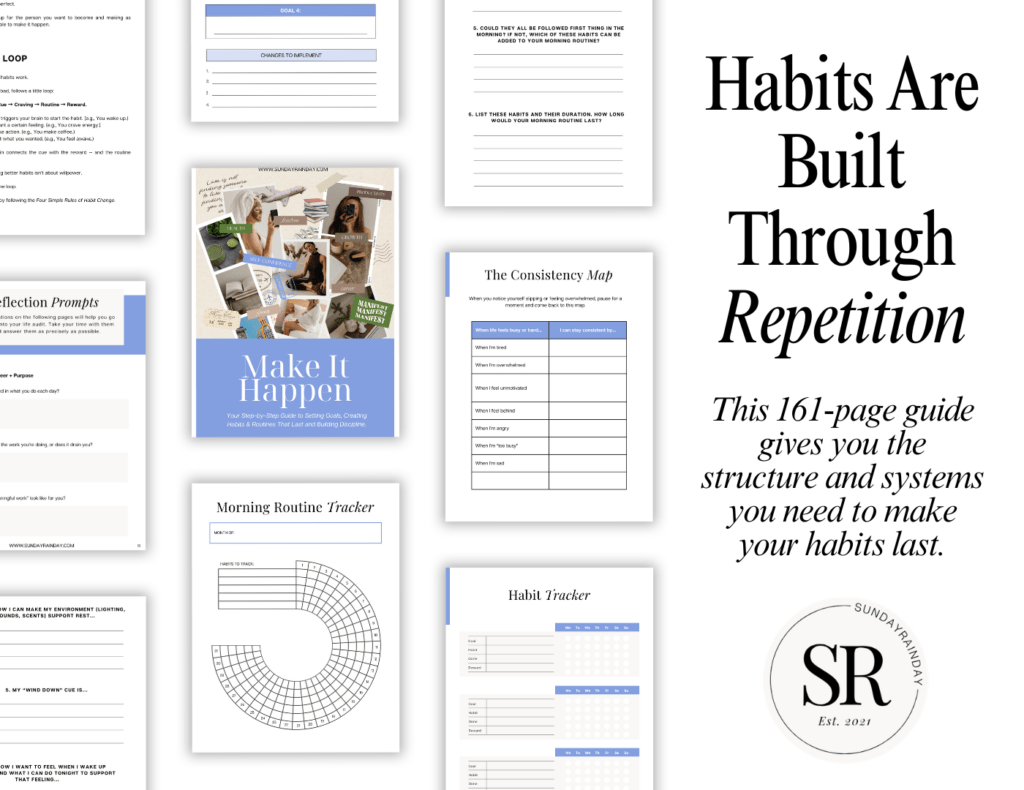
Make It Happen was written for that second half. It is a 161-page workbook that begins with a life audit, so the habits you pick come from your own priorities, and then takes you through setting goals, the psychology of how habits form, and designing morning and evening routines. It includes a habit tracker, routine trackers and a Consistency Map, where you decide in advance what you will do on the days you feel tired, overwhelmed or too busy, which are the days that decide whether a habit survives.
Frequently Asked Questions
What are good daily habits to have?
The ones with the widest effect are a fixed bedtime, daily movement, cooking most of your meals, planning tomorrow the evening before, doing your most important work first, keeping your phone out of reach for part of the day, writing for ten minutes, noticing what went well, reading, contacting one person, checking your money every week and doing one slightly uncomfortable thing. You don’t need all twelve. One or two, kept for several months, will change more than a long list attempted all at once.
What is a high-impact habit?
A high-impact habit is a small, repeated action whose effects spread beyond the action itself. Sleeping enough is the clearest example, because it improves your mood, your focus, your food choices and your patience the following day. A low-impact habit only improves the thing it touches. Both can be good daily habits, but when your time and energy are limited, the high-impact ones are worth building first.
What is a keystone habit?
It is the term Charles Duhigg uses in The Power of Habit for a habit that sets off other changes you didn’t plan. Exercise is the example most often given: people who begin exercising regularly often find they start eating and sleeping better as well. Which habit plays that role differs from person to person, so it’s worth noticing which single change tends to make the rest of your day go better.
How long does it take to build a new habit?
Longer than the 21 days you may have heard. In a University College London study, a new daily behaviour took 66 days on average to become automatic, with individual results ranging from 18 to 254 days. Simple habits form faster than demanding ones. Missing one day did not affect the result, so plan for two to three months and don’t restart the count when you slip.
How many habits should I start at once?
One, or two at most if they are very small and happen at different times of day. Every new habit needs your attention until it becomes automatic, and attention is limited. People who start five habits together often lose all five in the same bad week. Add the next habit when the current one no longer needs a reminder.
Which habits will change my life the most?
The habits to change your life are the ones that fix whatever you are shortest of. For most people that begins with sleep, because it affects everything else. After that it depends on you: planning and focused work if you are busy without making progress, writing if you feel restless, regular contact with friends if you feel isolated, a weekly money check if finances worry you. The best habits to improve your life are the few that address your real bottleneck.
