

How to Change Your Life in 30 Days: A Realistic, Science-Backed Roadmap
You’ve felt it before.
That quiet Sunday-night conviction that this is the week everything changes, followed by a burst of ambition, a list of thirty things to do differently, and by Thursday, the familiar slide back into exactly who you were.
It’s not a willpower problem, and it’s not you. It’s the plan. Almost every “how to change your life in 30 days” challenge is built to fail, because it asks you to change thirty things at once, and changing thirty things at once is how you change nothing at all.
Real change works the other way around.
You pick one thing that actually matters, and you use the month to make it stick. Do that, and you walk out of these 30 days with something a checklist could never give you: genuine momentum, and proof that you’re someone who follows through. That’s not the small version of transformation. It’s the only version that lasts.
Here’s the roadmap, one week at a time, with the science behind why each step works.
Stop Restarting From Scratch
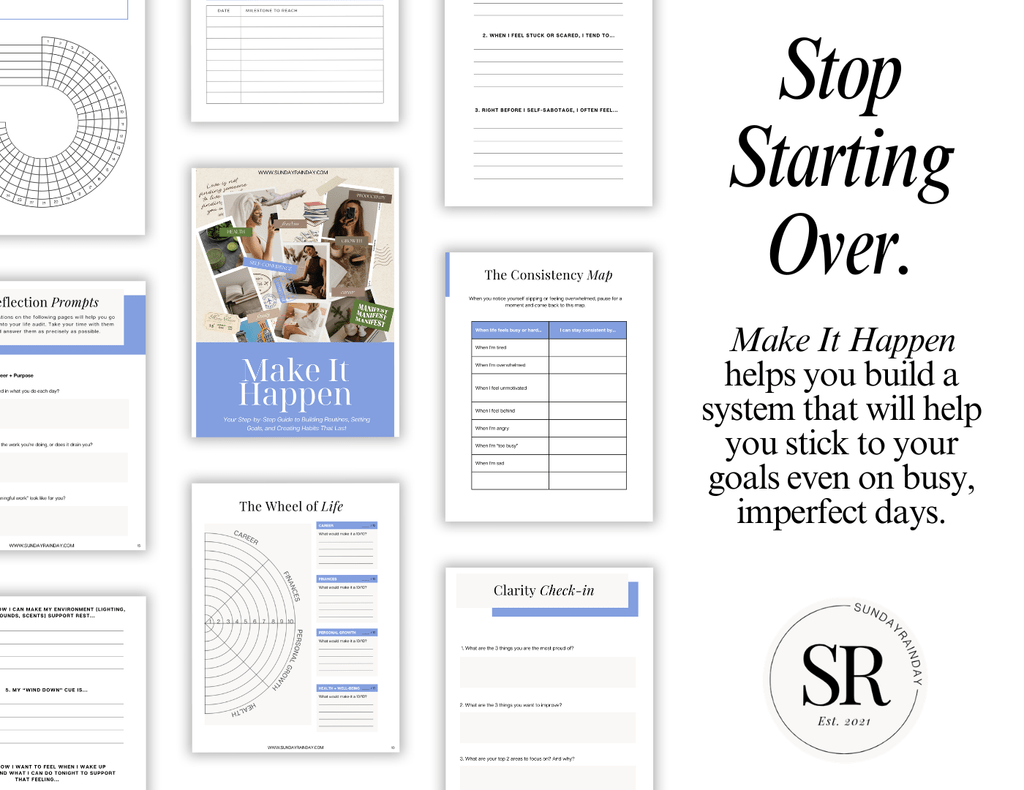
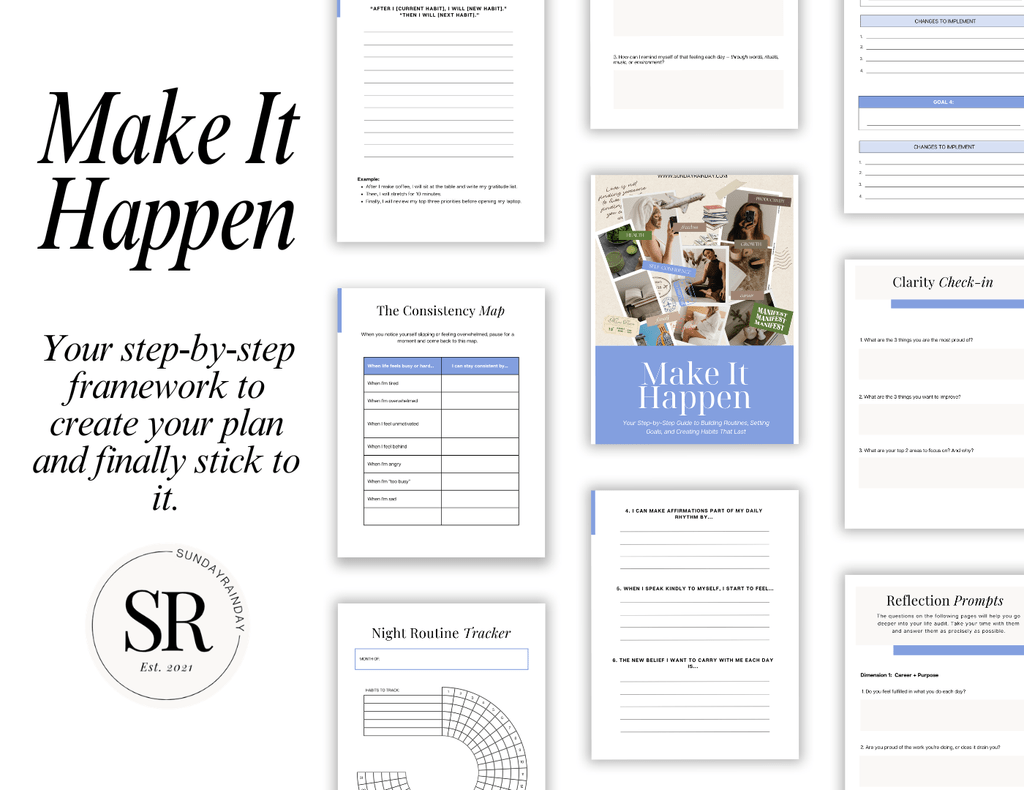
Choosing one change, shrinking it, anchoring it, designing your environment: this is a system, and you don’t have to figure it out alone. Make It Happen is the step-by-step framework, already built for you. This 161-page workbook walks you through turning one goal into a habit that actually holds, with the trackers, prompts, and consistency tools that keep you going long after week one.
Save this article
Can You Really Change Your Life in 30 Days?
Let’s be honest about what a month can and can’t do, because the usual promises are the reason these challenges fail.
First, what 30 days absolutely can do, and this is the part worth getting excited about.
A month is more than enough time to interrupt an old pattern, build real momentum, and prove to yourself that change is possible. That last one matters more than it sounds. Most people aren’t stuck because they can’t change. They’re stuck because they don’t believe they can, and 30 focused days is how you replace that doubt with evidence.
Now, what 30 days won’t do. It won’t fully automate a new habit. You’ve probably heard it takes 21 days to build one, but that number is a myth with no real research behind it. When researchers at University College London actually studied it, they found it took an average of about 66 days for a behavior to become automatic, and anywhere from 18 to 254 days depending on the person and the habit. So if you expect a new you by day 30, you’re setting yourself up to feel like a failure right when it’s starting to work.
And there’s one rule that makes all of it work: you change one thing, not everything. Everything else in this roadmap follows from that.
Why Most 30-Day Challenges Fail
Before the plan, it helps to understand why the standard version doesn’t work, so you don’t repeat it.
Most 30-day challenges fail for the same reason: they ask you to change too much at once. Thirty new behaviors, or five habits starting Monday, all competing for the same limited pool of energy. And that pool really is limited. Researchers describe self-control as behaving like a resource that gets quickly depleted the more you draw on it through the day. So when you spread yourself across a dozen new behaviors, each one gets a thin slice of willpower, and the first hard day collapses the whole thing.
The other reason is that the activities are usually disconnected. A random act of decluttering on day four has nothing to do with the cold shower on day five. Nothing compounds. You’re not building toward anything, so even if you finish all 30, you end the month roughly where you started, just tired.
Real change works the opposite way. You go narrow, not wide. One change, repeated and reinforced, until it holds. Here’s how to do that across four weeks.
How to Change your Life in 30 Days
Week 1: Choose One Change, Not Thirty
Your entire first week has one job: decide what you’re actually changing. No new habits yet. Just clarity, because a month spent on the right change beats a month scattered across ten.
Start by accepting the paradox: you change more by doing less. When you pour all your focus into one thing, it gets enough energy to survive the hard days. Spread that same focus across ten things and none of them get enough to stick. Narrowing down isn’t giving up on the rest of your life. It’s the only way to actually move any part of it.
So find your one thing, and make it a keystone change, the one whose ripple reaches everything else. Daily movement is a classic example, because it tends to improve your sleep, energy, mood, and focus all at once. Consistent sleep is another. Ask yourself which single change, if you held it for a month, would make the most other things easier. That’s where you start.
Then name the gap specifically. “Get healthier” is too vague to act on, and vague goals are where good intentions quietly die. “Move my body for 20 minutes every day” is specific enough to build a plan around. If you’re not sure which area needs it most, a life audit will show you where the biggest gap between your current life and the one you want actually sits.
For the rest of this roadmap, let’s follow one example: your one change is to move your body every day. Watch how it develops.
Week 2: Shrink It Into a Minimum Viable Habit
Now you build the habit, and here’s where most people go wrong. They start big. A full hour at the gym, five days a week, starting Monday. It works until motivation dips, and motivation always dips.
The fix is to shrink the habit until it’s almost too small to fail. This is the heart of what we call a minimum viable habit, and it’s backed by the work of Stanford behavior scientist BJ Fogg, whose behavior model shows that a behavior happens when motivation, ability, and a prompt line up at the same moment.
The lever you actually control day to day is ability, so you make the behavior so easy that it happens even when your motivation is on the floor. Not “work out for an hour.” Just “put on my running shoes and walk out the door.” The tiny version is what keeps the streak alive on the days you’ve got nothing, and those are exactly the days that decide whether a habit survives.
Then anchor it to something you already do. Your existing routines are full of automatic cues, so attach the new habit to one of them. “After I finish my morning coffee, I put on my shoes and move for 20 minutes.” The old habit becomes the trigger, so you don’t have to remember or decide.
Next, design your environment so the right choice is the easy one. You shouldn’t have to win an argument with yourself every day. Lay your workout clothes out the night before. Keep them in sight. Remove the friction once instead of fighting it every morning, because a good environment quietly does the work that willpower otherwise has to.
Finally, decide in advance with an if-then plan. Instead of hoping you’ll follow through, script it: “If it’s 8 a.m., then I go for my walk.” These are called implementation intentions, and the research is striking. Studies show they sharply increase follow-through, because you’ve already made the decision, so there’s nothing left to negotiate when the moment comes. If you want to go deeper on making a habit stick, here’s the full method to make habits stick.
Week 3: Protect the Focus That Makes It Stick
By week three, your habit exists. Now you protect it, because the quiet killer of change isn’t a lack of effort. It’s scattered attention.
Here’s the trap. You tell yourself you’ll fit your one change in around everything else, half-doing it while checking your phone, answering messages, jumping between tasks. It feels efficient. It isn’t. Every time you switch tasks, part of your mind stays stuck on the last one, a cost researchers call attention residue. You end up busy but scattered, present for nothing, which is exactly how you can be busy all day without making real progress.
So give your one change a focused block instead of leftover scraps of attention. It doesn’t need to be long. Twenty undistracted minutes beats an hour of half-presence. Put it on the calendar, close the other tabs, silence the phone, and let the habit have your full attention for that window. In our example, that’s your 20-minute walk with your phone on do-not-disturb, actually noticing how you feel, rather than a distracted shuffle while scrolling.
And cut the inputs competing for that focus.
You can’t protect your attention while feeding it endless noise. For this one month, trim what you consume: fewer notifications, less doom-scrolling, one fewer podcast in your ears. You’re not doing this forever. You’re clearing enough space for one change to take root, and protecting focus like this is the core of focused productivity, which is really just deciding what deserves your attention and defending it.
Related read: Busy But Not Productive? How Attention Residue Drains Your Focus
Week 4: Become the Person, and Lock It In
The final week is about identity, because a habit only lasts once it stops being something you do and becomes part of who you are.
Shift the language you use with yourself. Stop saying “I’m trying to exercise” and start saying “I’m someone who moves every day.” It sounds small, but it’s one of the most powerful levers in behavior change.
As James Clear puts it in his identity votes theory, every action you take is a vote for the type of person you want to become. No single walk transforms your identity, but the votes add up, and after a month of them you have real evidence that you’re this kind of person now. The habit stops needing motivation because it’s become part of your self-image.
Track it so you can see the votes stacking up. A simple habit tracker, an X on a calendar, a note in your phone, anything that turns invisible effort into a visible streak. Watching the chain grow is motivating on its own, and it makes the gaps obvious enough to catch early.
And when you miss a day, and you will, follow one rule: never miss twice. One missed day is a slip and changes nothing. Two in a row is where a slip hardens into the old pattern coming back. So the day after a miss isn’t a referendum on whether you’ve failed. It’s just the next vote, and you cast it. Getting back the very next day matters far more than the day you lost.
If holding that consistency is the part you struggle with most, here’s a full guide on how to build self-discipline that lasts.
What to Do After Day 30
So the month ends. What now?
First, review honestly. What worked, what didn’t, and what got in the way. You’re not grading yourself. You’re gathering information for the next round, because this is a system you’ll reuse, not a one-time event.
Then keep the one habit, and only now add the next thing. Your one change should feel lighter by now, closer to automatic. That’s your signal that there’s room for another. So you choose your next one thing and run the same 30-day play again, while the first habit keeps running in the background.
Because here’s the real secret nobody puts in the “transform your life in 30 days” headline: lasting change isn’t one perfect month. It’s a series of focused months, each one adding a single habit that holds, stacked over a year until you look up and barely recognize the life you were living before. One month changes a habit. A year of intentional months changes a life.
If you want to see it from the other direction, these are the patterns worth stopping as you build the new ones.
Turn One Month Into a Real Plan
You’ve read the method. The hard part is running it consistently, month after month, without letting it fade. That’s exactly what Make It Happen was built for. It’s the complete system for choosing your goals, shrinking them into habits that stick, and following through long after the fresh-start energy is gone, so 30 days of change becomes a life that actually looks different.
Frequently Asked Questions
Can you really change your life in 30 days?
Not your whole life, but yes, you can make a real, lasting change in 30 days. A month isn’t long enough to fully automate a new habit, which research suggests takes closer to 66 days on average, but it’s more than enough to interrupt an old pattern, build momentum, and prove to yourself that change is possible. The trick is to change one meaningful thing well, rather than many things badly.
How many new habits should I start at once?
One. It feels counterintuitive, but starting a single habit is what makes change actually stick. Your self-control is a limited resource, so spreading it across several new habits at once means none of them get enough to survive the hard days. Focus everything on one keystone change for the month, then add the next one only once the first feels automatic.
Why do most 30-day challenges fail?
Because they ask you to change too much at once, and the activities rarely connect to each other. Thirty disconnected tasks split your focus and drain your willpower, so nothing compounds and nothing lasts. A challenge works when it’s built around one change that’s reinforced daily and gets easier over the month, rather than a checklist of unrelated activities.
What habit should I start with?
Start with a keystone habit, the one whose effects ripple into other areas of your life. Daily movement, consistent sleep, and a short morning planning routine are common examples, because improving them tends to improve your energy, mood, and focus at the same time. Ask yourself which single change, held for a month, would make the most other things easier, and start there.
How long does it actually take to change your life?
There’s no fixed number, but expect a single habit to feel effortful for several weeks and closer to automatic after a couple of months. Changing your whole life is slower and quieter than that: it happens as you stack one held habit on top of another over many months. Thirty days changes a habit. A year of intentional months changes a life.
Final Thoughts
You can’t change everything in 30 days. But you can change one thing that matters, and that’s worth far more than a checklist of thirty you’ll have forgotten by February.
So don’t spend the next month collecting activities. Spend it proving something to yourself. Pick the one change with the biggest ripple, make it small enough to survive your worst day, protect it from the noise, and let each repetition become a vote for who you’re becoming. Do that, and by day 30 you won’t have a transformed life.
You’ll have something better: real momentum, real evidence, and a method you can run again and again until the change adds up to exactly that.
