

30 Vision Board Prompts to Help You Get Clear on What You Want
Before you choose a single picture for your vision board, there’s a piece of work to do, and it happens on paper. Most of us skip it. We open Pinterest, save what catches our eye and assume the board will tell us what we want. Usually it tells us what looks nice, which isn’t quite the same thing.
A notebook and the right questions change that. When you write about your life before you build your board, you find out what you value, what you’re tired of and what you’d choose if nobody else’s expectations were in the way. The pictures you choose afterwards stop being decoration and start describing a life you recognise as yours.
The 30 vision board prompts below are arranged in five groups, and the order matters. They move from where you are now to the future you’d love, then to the work it will take and what might get in the way, and finally to the words and images for your board. At the end of each group you’ll find a short note on what to carry over to your board.
Save this article
Why journaling before you make a vision board works
Writing about the future you want is one of the better-studied exercises in psychology. In 2001, the psychologist Laura King asked students to spend twenty minutes a day, for four days, writing about their best possible self: their life in the future, imagined as if everything had gone as well as it could. Three weeks later, they reported a significant rise in their well-being, and over the following months they visited the campus health centre less often than students who had written about something neutral.
The exercise works partly because writing forces you to be specific. A vague wish to be happier has to become sentences about where you live, what you do on a Tuesday and who’s at the table with you, and those details are exactly what a vision board needs.
There’s one catch. Gabriele Oettingen’s research on positive fantasies, which we look at in more detail in our guide to making a vision board, found that picturing only the ideal outcome can leave people less motivated to pursue it. People do better when they picture the result and then name the obstacle most likely to get in the way, a technique she calls mental contrasting. That’s why the prompts below don’t stop at the dream. The fourth group asks about the work and the obstacles, so your board ends up honest as well as inspiring.
Write about the life you want in enough detail that you could photograph it, then write about what might stand in the way.
How to use these vision board prompts
Give yourself two sittings, about an hour each. Work through the first three groups in the first sitting, while you’re thinking about your life as a whole, and the last two in the second, when you’re ready to get practical. A few days between them gives your answers time to settle.
Write by hand if you can, and don’t edit as you go. Your first answer is often the most honest one, and a crossed-out sentence can tell you as much as a finished one. When you’ve finished each group, read your answers back and underline anything that comes up more than once. Those repeated words and images are the ones that belong on your board.
30 vision board prompts in five groups
Each group has six prompts and ends with a note on what to take from your answers to your board. You don’t have to answer every prompt at length. A few honest lines are worth more than a page written to impress yourself.
Group 1: Where you are now and what you value
It’s tempting to jump straight to the future, but a board built without an honest look at the present tends to show a vague, different life rather than a better version of yours. These six prompts help you see what’s working, what isn’t and what matters most to you.
1. What does an ordinary day in your life look like right now?
Describe yesterday, or a typical weekday, from the moment you woke up to the moment you fell asleep. Notice which parts you’d happily repeat and which you’d change if you could.
2. Which parts of your life feel most like you, and which feel borrowed?
Some of what we do comes from our own choices, and some comes from what our family, friends or social media expect. Write down which is which, without judging either list.
3. What values are at the core of the life you want to live?
Think of words like freedom, security, creativity, connection or calm. Choose the three that feel most essential, and write a sentence about why each one matters to you.
4. What are you tired of tolerating?
The things that drain you quietly are often the clearest signs of what needs to change. Make a list, from the small irritations to the larger frustrations you’ve stopped talking about.
5. What would you love to let go of this year?
It might be a habit, a fear, a belief about yourself or something physical, like a cluttered room. Write about how your life would feel lighter without it.
6. What does success mean to you now?
Your definition may have changed since you last thought about it. Is it about achievement, balance, impact, peace or something else entirely?
For your board: underline the values from prompt 3 and any word that appeared more than once in this group. These become the words you’ll place on your board later.
Related read: How to Do a Life Audit With the Wheel of Life
Group 2: Your best possible future
This is the part of the exercise Laura King studied. Imagine your life a year or two from now, as if everything had gone as well as it reasonably could, and describe it in enough detail that you could picture it clearly. The more specific your answers, the easier it will be to find images that match.
7. What does your ideal day look like?
Walk through it from morning to night: where you wake up, what you do, who you see and how you spend the evening. Focus on an ordinary good day rather than a holiday, because that’s the life you’ll be living most of the time.
8. How do you want to feel?
Calm, energised, secure, free, proud? Describe the feeling and the moments when you’d notice it, so it becomes something you can recognise when it arrives.
9. Where do you live, and what does home feel like?
Describe the place, the light, the sounds and the room you spend most of your time in. Notice whether it’s the location that matters to you or the feeling of the space.
10. Who is in your life?
Think about the people around you: friends, family, a partner, colleagues or a community. Write about the kind of relationships you have and how you spend time together.
11. How do you spend your free time?
List the hobbies, activities and simple pleasures that fill your evenings and weekends. Include the things you’ve been meaning to try and the ones you used to love and gave up.
12. What would you do if you knew you couldn’t fail?
Let yourself answer without arguing back. Even if the answer feels unrealistic, it often points to something you want more than you’ve admitted.
For your board: circle the two or three scenes from this group that you can picture most clearly. These are your result images, the pictures of where you’re going.
Group 3: What you want in each area of your life
Now you narrow the picture down to specific areas. You won’t change all of them this year, and you don’t need to. These prompts help you see which ones matter most right now, so your board can focus on three or four goals instead of fifteen.
13. What does your work look like?
Describe the work you’d like to be doing, the people around you and how a good workday feels. Think beyond the job title to the environment and the kind of impact you want to have.
14. What does financial security mean to you?
For some people it’s a number in a savings account, and for others it’s the freedom to say no. Write about the choices and the peace of mind you’d like money to give you.
15. What does feeling well look like for you?
Think about your energy, your sleep, the way you move and the way you eat. Describe how you’d like your body to feel on an ordinary morning.
16. What would you love to learn or master?
A language, an instrument, a craft or a professional skill. Write about why it appeals to you and what it would change in your life.
17. What adventure keeps calling you?
It might be a trip, a move, a creative project or starting something of your own. Write about why this particular adventure has stayed with you.
18. What would you like to give back?
Think about the people, causes or communities you’d like to support, and how you’d like to be remembered by the people who know you best.
For your board: choose three or four goals from groups 2 and 3, one for each area you most want to change this year. These are the goals your board will be built around.
When patterns start to appear
By now you’ll probably notice the same themes coming up again and again: a place, a feeling, a kind of work or a person you’d like to become. That’s usually the moment to move from reflection to something more concrete.
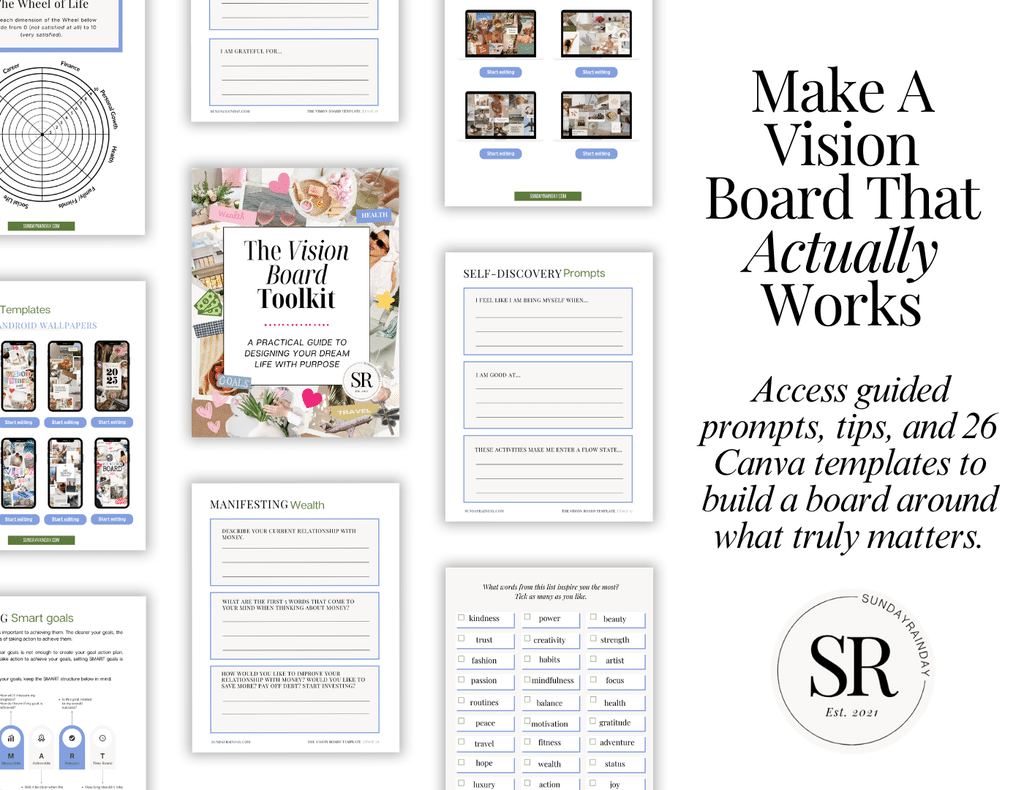
The Vision Board Toolkit was designed for that step. Its guided exercises help you turn your answers into clear goals, and its templates help you build a board around them.
Group 4: The work and what might get in the way
This is the group most vision board prompts leave out, and it’s the one Oettingen’s research suggests matters most. For each of the goals you chose in group 3, answer these six prompts. They turn a picture of the future into a plan you can start on.
19. What would the person you want to become do on an ordinary weekday?
Picture that future version of you on a normal Tuesday, not a special occasion. Write down what they do that you don’t do yet.
20. What is one daily habit that would move you closer?
Choose one small habit for each goal, such as thirty minutes of writing, a walk after lunch or checking your spending every evening. Make it small enough that you could start tomorrow.
21. What could you do this week?
Write down the first step, as specifically as you can. “Look at flats” is a wish, while “book two viewings for Saturday” is a step.
22. What is most likely to get in your way?
Be honest and look inside yourself as well as outside. Tiredness, self-doubt, a full diary or the habit of putting everyone else first are all common obstacles.
23. What will you do when it does?
Write one sentence for each obstacle in the form “If this happens, then I’ll do that.” Deciding in advance makes it much easier to keep going when the moment arrives.
24. Who could help you?
Think about the friends, mentors, communities or professionals who could support you, and the people whose example inspires you. Write down one person you could reach out to this month.
For your board: for each goal, find one picture of the work, such as your trainers by the door or your desk early in the morning, to place next to the picture of the result.
Related read: The 2-Minute Rule: How to Start What You Keep Putting Off
Group 5: Words and pictures for your board
The last group helps you choose what will go on the board itself. By now you have values, scenes, goals and the work behind them. These prompts turn them into the few words and images you’ll see every day.
25. What is your word for the year?
Look back at the words you underlined in group 1. Choose one that captures how you want to live this year, and let it sit at the centre of your board.
26. What would you like to read on your hardest day?
Write the sentence you’d want to see on a day when everything feels difficult. It might be your own words or a quote that has stayed with you for years.
27. What would bring more joy into your everyday life?
Think of small, regular pleasures rather than big events. A vision board needs a few of these too, so it reminds you to enjoy the year as well as work through it.
28. How will you celebrate your progress?
Decide how you’ll mark each milestone along the way, from a quiet evening to a trip you’ve been saving for. Celebrations give you something to look forward to between the start and the finish.
29. What are you already grateful for?
List the things in your life now that you’d want to keep, whatever else changes. They deserve a place on your board as much as anything new.
30. A year from now, what would you like to have changed?
Imagine looking at your finished board next year. Write down the one change that would make you proud, and keep this answer somewhere you’ll find it again.
For your board: place your word for the year at the centre, your sentence for hard days next to your most difficult goal and one image of everyday joy somewhere you’ll see it first.
Related read: 75 Vision Board Quotes Worth Reading Every Day
From your answers to your vision board
When you’ve worked through all five groups, you’ll have more than you need for a board, and that’s a good thing. Most of your answers will stay in your notebook, where they’ve already done their job of helping you think. Only the clearest of them belong on the board.
Gather your three or four goals from group 3. For each one, take the result image from group 2, the picture of the work from group 4 and, if it fits, a few words from group 5. Add your word for the year and one image of everyday joy, and you have everything your board needs. Our step-by-step guide to making a vision board walks you through putting it together, on paper or in Canva.
Keep your notebook somewhere you’ll find it again. Reading your answers in six months is one of the best ways to see how far you’ve come, and to notice which goals still feel like yours.
Know what you want before you choose a single picture
The best vision boards begin in a notebook. When you write about where you are now, the future you’d love, the work it takes and what might get in the way, you end up with a board that describes a real life rather than a mood, and research on writing about your best possible self suggests the exercise is good for you in its own right.
You don’t need to answer all 30 prompts in one go. Take them in two sittings, notice the words and images that keep coming back, and let those guide what you put on your board. Your answers will tell you more about what you want than any collection of saved pins.
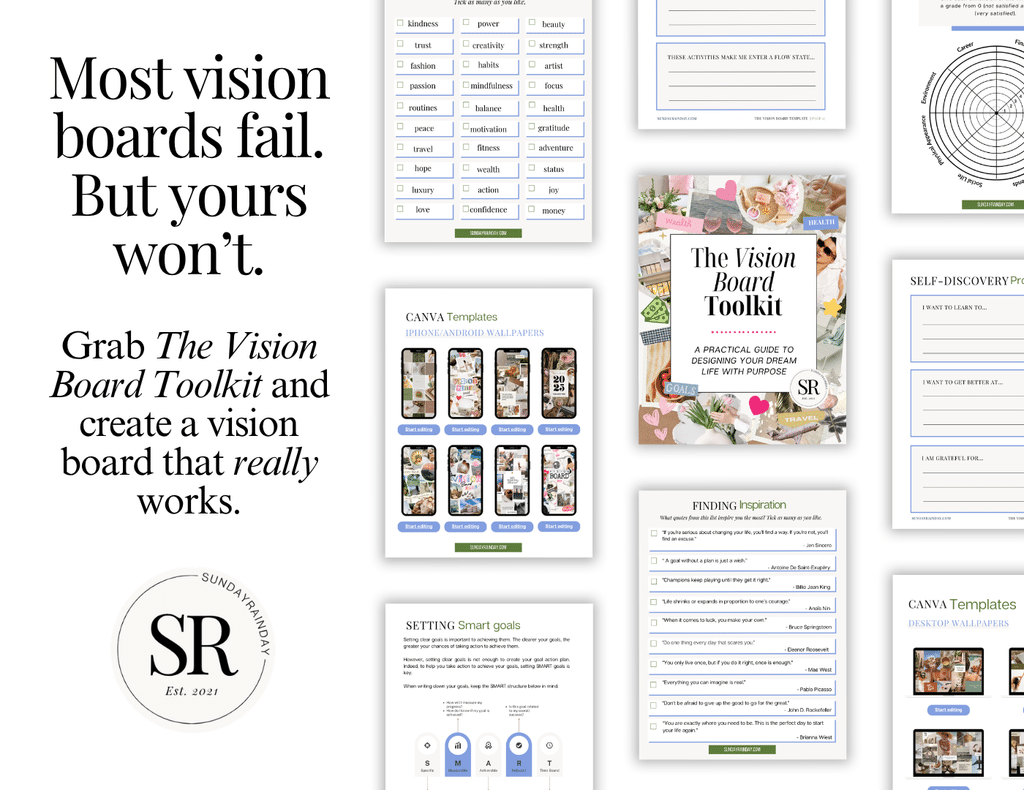
If you’d like more guidance along the way, the Vision Board Toolkit brings together guided prompts, practical exercises and 26 Canva templates to take you from your first reflections to a finished board you’ll want to look at every day.
Frequently asked questions
What questions should I ask myself before making a vision board?
Start with where you are now: what you value, what drains you and what success means to you. Then imagine your best possible future in detail, choose three or four goals and ask what work each one will take and what might get in the way. Finish with a word for the year and a sentence you’d like to read on hard days.
How do you journal for a vision board?
Set aside two sittings of about an hour. Write by hand if you can, answer each prompt honestly without editing and underline any word or image that comes up more than once. Those repeated themes become the goals, pictures and words on your board.
What should I write on my vision board?
Write a few words that capture your values or your word for the year, and perhaps one quote or sentence for difficult days. Keep it short. Most boards work best with one word at the centre and two to five short phrases placed next to the goals they belong to.
What is the “best possible self” exercise?
The “best possible self” exercise asks you to imagine your life in the future as if everything had gone as well as it could, and to write about it in detail. In a 2001 study by the psychologist Laura King, people who wrote about their best possible self for twenty minutes a day over four days reported higher well-being three weeks later.
How many vision board prompts should I answer?
As many as feel useful. If you’re short on time, answer prompts 3, 7, 12, 22 and 25: your values, your ideal day, what you’d do if you couldn’t fail, your main obstacle and your word for the year. Those five give you enough to build a meaningful board.
