

How to Make Habits Stick: A Framework for Lasting Change
Most people fail to make habits stick because they rely on willpower instead of structure.
We assume inconsistency is a character flaw, but in reality, it is a structural failure.
When a habit is built on motivation alone, it collapses the moment life becomes demanding.
To make new habits stick, you need to shift from trying harder to designing better. This means moving beyond willpower and building a system where follow-through becomes the easiest path.
The Habit Framework: Lasting change requires three pillars: reducing friction, establishing a “behavioral floor,” and anchoring the new action to an existing structure.
This framework combines behavioral psychology, neurological habit research, and practical implementation principles designed for real life, not ideal conditions.
It is built on the principle that behavior is shaped more by environment and repetition than by motivation alone.
After testing it across multiple habit cycles, one pattern becomes clear: the habits that last are the ones designed to survive ordinary days.
If you wonder how to make habits stick, this article will help you build the structure you need to make it feel almost effortless.
Design Your Habits to Last
Most people don’t struggle with discipline. They struggle with design.
Your habits don’t stick because they’re poorly structured, not because you lack willpower.
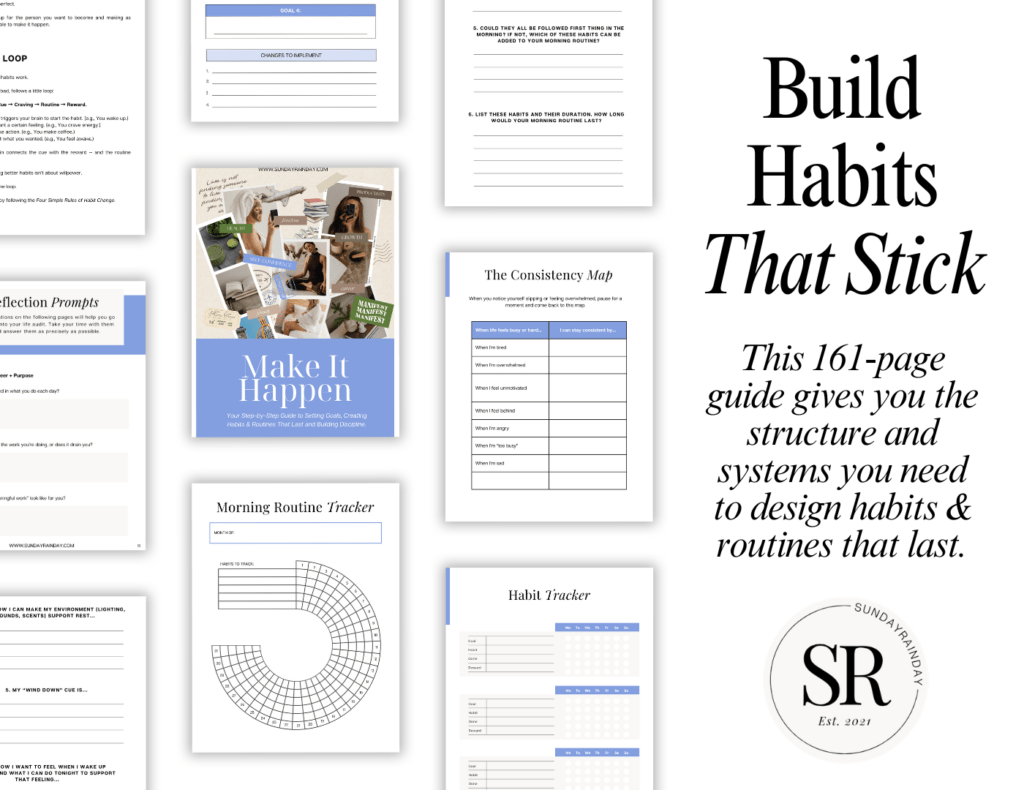
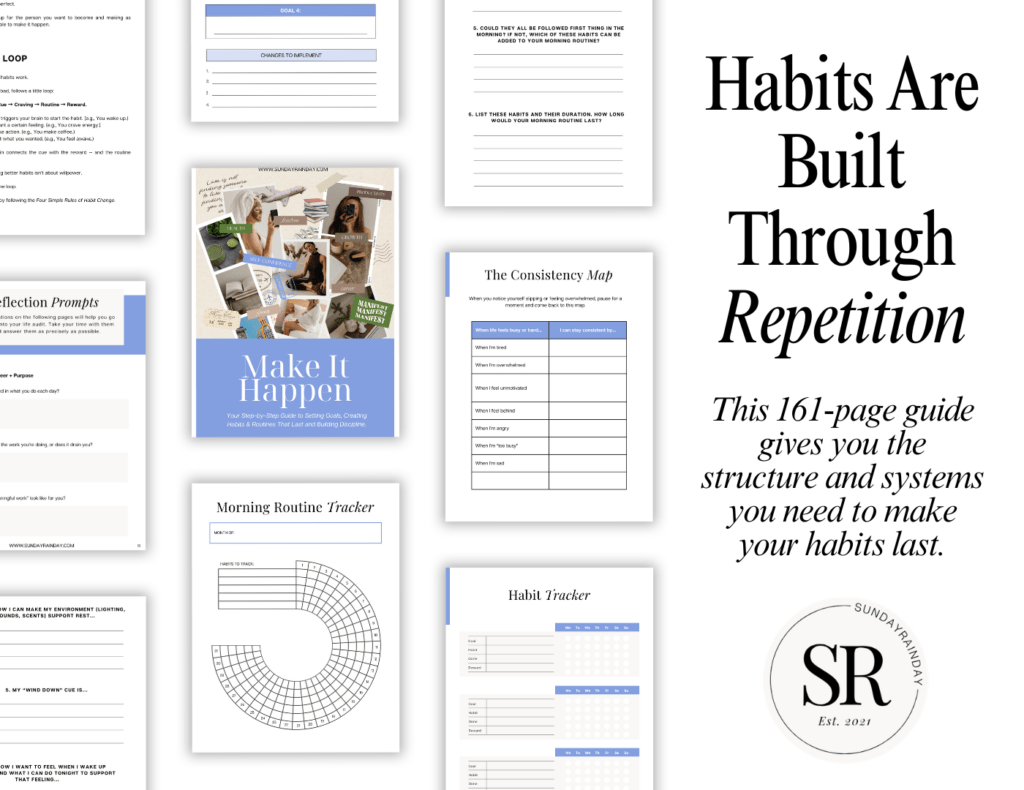
If you want a clear, step-by-step system to build habits that hold even on the busiest days, Make It Happen is the framework that will guide you through that process.
Save this article
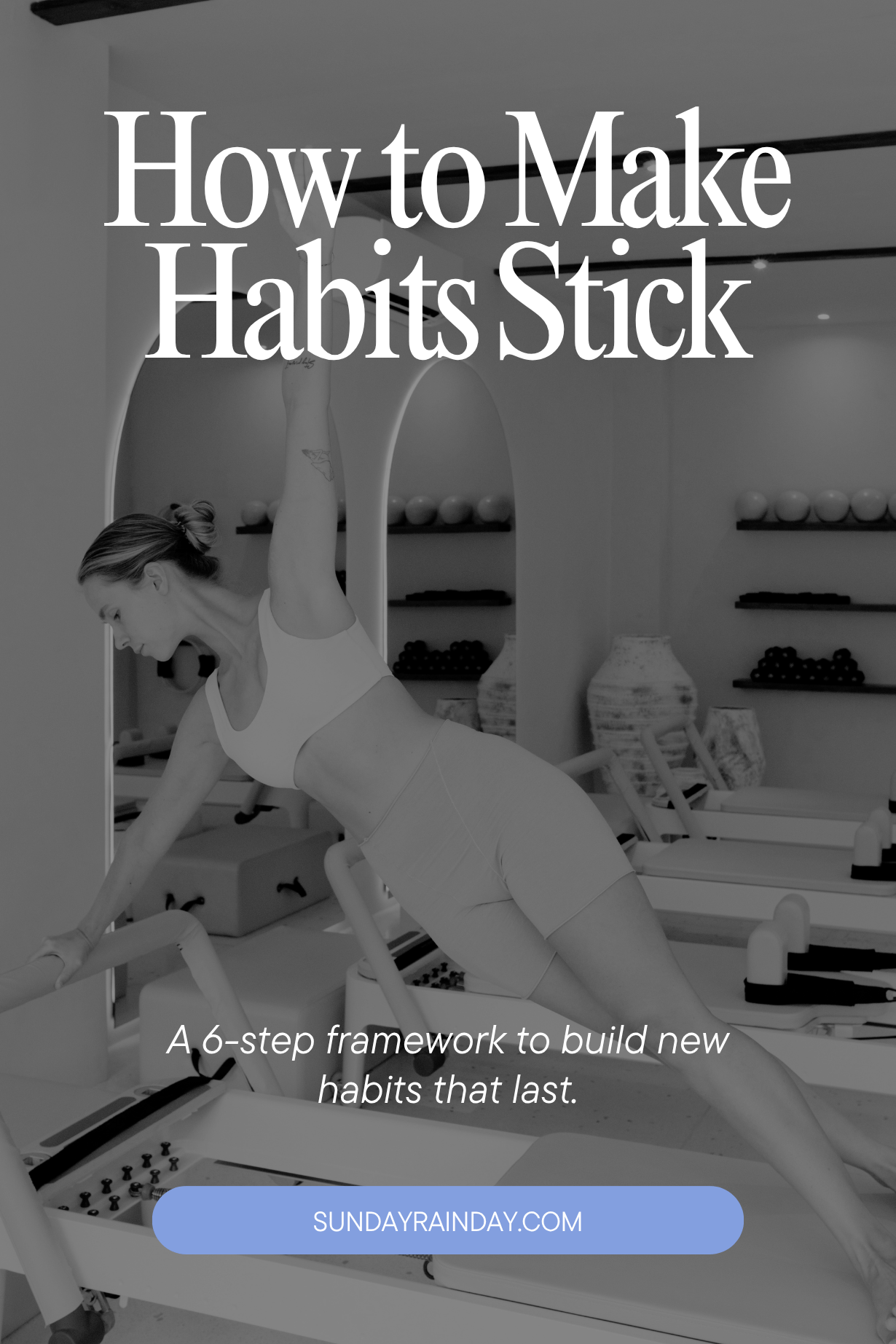
The 6-Step Habit Framework at a Glance:
- Establish a Behavioral Floor (The “minimum” version of your habit).
- Intentional Habit Stacking (Anchor your new habit to existing routines).
- Design for Zero Friction (Environment over willpower).
- Shift to Identity-Based Habits (Who you are becoming).
- The Never Miss Twice Protocol (Recovery speed over perfection).
- Find the Right Timing (Strategic placement in your day).
The Science of Why Habits Do Not Stick
Habits are not personality traits.
They are neural pathways that become stronger each time we repeat them.
When you consciously try to start a new behavior, your prefrontal cortex is responsible for the effort.
This is the part of your brain that handles decision making, planning, and self-control. Your prefrontal cortex is powerful, but it also fatigues very quickly.
Research in behavioral neuroscience shows that repetition gradually shifts control from the prefrontal cortex to the basal ganglia (Wood & Neal, 2007).
Once a habit is encoded there, it requires far less effort to perform.
Our brain is wired to seek efficiency and favor patterns that preserve energy to protect itself.
When you attempt to force a new habit through willpower alone, you are asking the most energy intensive part of your brain to override its preference for stability and safety.
This is why habits that rely on motivation alone often collapse the moment life becomes demanding. Habits stick when they become neurologically efficient, not when they feel exciting or impressive.
The Cue, The Routine & The Reward Pattern
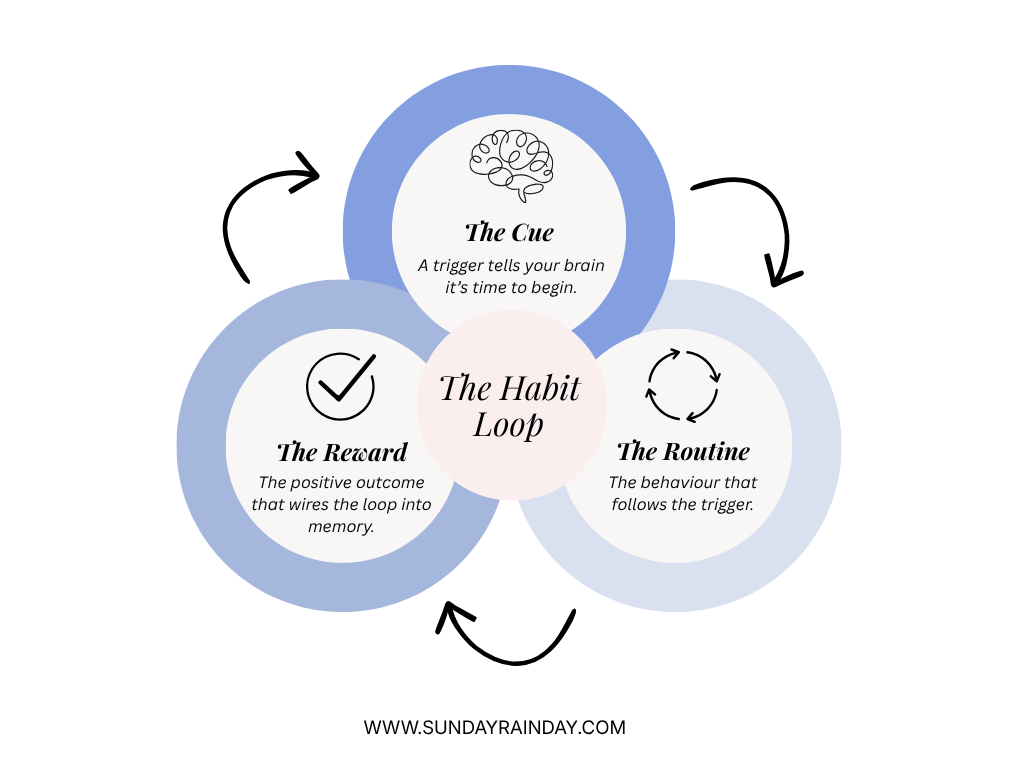
Every habit follows a loop:
- A cue signals the brain.
- A routine follows the cue.
- A reward reinforces the behavior.
Most people focus almost exclusively on the routine.
They try to perfect the workout, the journaling method, the productivity system.
But without a stable cue and a consistent reward, the loop never fully closes.
Without a loop, there is no automation.
And without automation, there is only effort. Unfortunately, this is not sustainable over time.
This is the main reason why most habits fail.
Why Motivation Is Not the Missing Piece
It is easy to believe you struggle to stick to new habits because you don’t want it bad enough.
But motivation varies greatly depending on sleep, stress, workload, emotional state, and countless other invisible variables.
Your nervous system, however, prioritizes safety and familiarity above aspiration. On stressful days, your brain defaults to behaviors that feel predictable.
Scrolling feels easier than reflection.
Skipping feels easier than starting.
Not because you are weak.
Because your brain has not yet encoded the new habit as safe and automatic.
If your habit relies on feeling motivated enough to take action, it will disappear as soon as inspiration fades. Structure creates stability. Stability creates repetition. Repetition creates identity.
This sequence is how habits become sustainable.
6 Steps to Make New Habits Stick
These 6 steps to make habits easier to stick to form a psychology-backed framework designed for everyday life, not perfect conditions.
1. Establish Your Behavioral Floor
Most people define habits by their ideal version.
Thirty minutes of movement.
Twenty minutes of journaling.
Waking up at five in the morning.
The problem with ideal versions is that they collapse as soon as life gets in the way. So instead of aiming for perfection, define your floor.
Your behavioral floor is the smallest version of the habit you commit to completing even on your most inconvenient day.
If your goal is thirty minutes of yoga, your floor might be two minutes of stretching.
If it’s daily writing, your floor might be two sentences.
If your goal is running, your floor might be putting on your shoes and going for a 5-minute walk.
Your behavioral floor must be so easy to accomplish that it feels ridiculous.
This mirrors BJ Fogg’s research at Stanford’s Behavior Design Lab: the most reliable way to build a new behavior is to shrink it until it’s almost impossible to fail.
Because its purpose is not transformation.
It is follow-through.
When you protect the pattern, even in its smallest form, you teach your brain that this is who you are.
So if you struggle with making new habits stick, lower the bar until you build consistency and raise your standards over time.
2. Use Intentional Habit Stacking
Habits survive when they are part of a structure. Not when they are added as isolated tasks floating in your schedule.
So instead of relying on memory or motivation, attach your new habit to something you already do automatically.
For example:
After I pour my morning tea, I will write one sentence.
After I brush my teeth, I will stretch for two minutes.
After I close my laptop, I will plan tomorrow.
By doing so, you are building stability from an existing neural pathway.
The anchor already exists. You are simply placing a new behavior immediately after it.
Habit stacking reduces cognitive load before it even appears.
This is one of the most effective ways to reduce friction and make action easier.
Related read: How to Create Your Ideal Morning Routine Based on Your Goals
3. Design for Zero Friction
Understanding how to make habits stick starts with one shift: stop relying on discipline, and start designing your environment so the habit becomes the path of least resistance.
Your environment quietly shapes your behavior more than intention ever could.
If your journal is hidden in a drawer, journaling requires extra steps.
If your running shoes are buried in the closet, movement becomes negotiable.
If your phone sits beside your bed, distraction becomes effortless.
Small environmental adjustments often create disproportionate results.
So if you want to journal in the morning, place your notebook and pen on your nightstand. Leave the book open on your couch if you want to read. Prepare your workout clothes before bed if you tend to skip workouts.
Your brain will almost always choose the easier path.
So design the right path to be the easiest one.
Reducing friction is strategic self-leadership disguised as laziness. When your environment supports you, discipline feels natural rather than forced.
Remove Friction. Increase Follow-Through.
Designing habits for zero friction makes it easier to stick to them. But that’s not the only step your need to increase discipline.
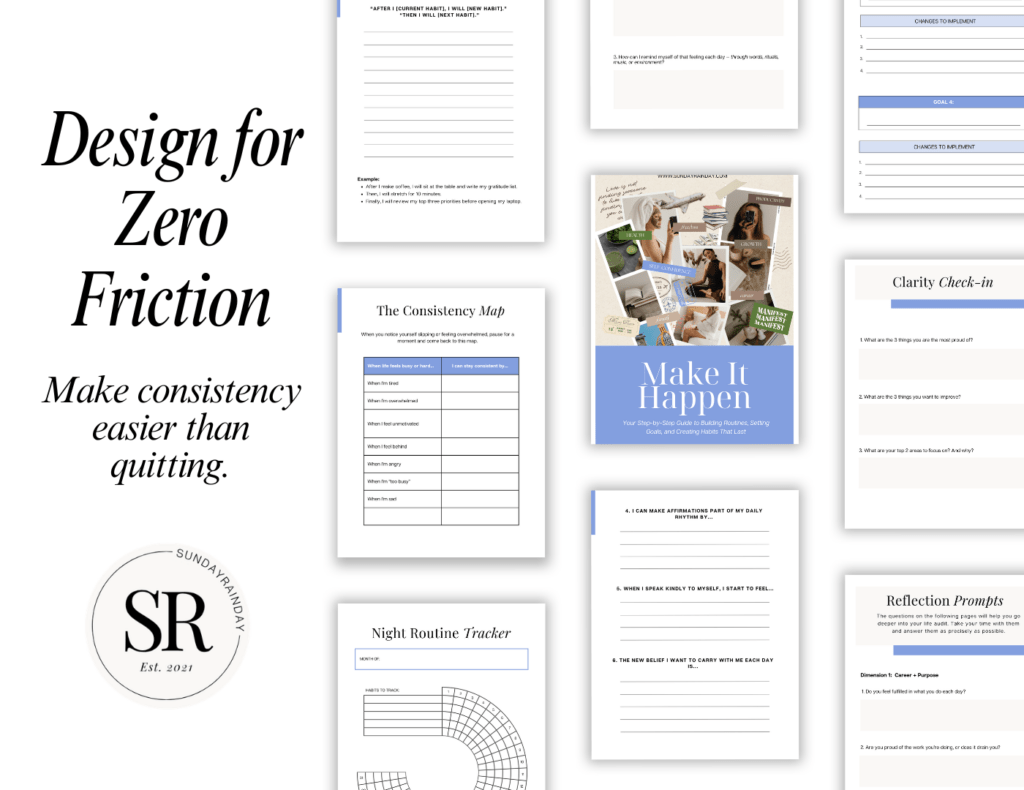
Make It Happen walks you step by step through simplifying your environment, stacking cues, and reducing resistance so consistency becomes the easiest option.
4. Shift From Goal-Based to Identity-Based Habits
Goals focus on outcomes.
Identity focuses on direction.
Saying you want to run a marathon creates distance. Saying you are becoming someone who trains consistently creates alignment.
It’s easier to make your habits stick when they reinforce the version of you that you are building toward.
But identity is only built through repetition.
Which is why your behavioral floor matters so deeply.
If you are unclear about the identity you are shaping, begin by clarifying your priorities. Do a Life Audit to Find Your True Priorities and define what truly matters over the next year.
When habits are connected to a long-term vision, they feel purposeful rather than optional.
They become daily votes for your future self.
5. The Never Miss Twice Protocol
If you miss a day, it’s not failure. It’s life.
The critical moment is not missing once.
It is what happens next.
Because missing once is a pause but missing twice creates a new pattern.
The priority after a missed day is not perfect execution. It is to get back on track.
Even if the return is only your floor.
Consistency is not about flawless execution but about recovery speed.
The faster you return, the stronger your identity becomes.
While habits create the structure, discipline protects it when resistance appears.
Related read: How to Be More Consistent: A Guide to Effortless Discipline
6. Find the Right Time for the Habit to Live
Where you place a habit inside your schedule determines whether it becomes stable or constantly negotiable.
Many routines disappear not because they are too difficult, but because they are scheduled in the most fragile part of the day.
For months, I struggled to stay consistent with a fitness routine.
I always planned to work out in the evening, after work, when everything else was done.
But my days rarely ended the same way twice. Some evenings I was tired. Other days ran late.
So the habit kept slipping.
Moving my workouts to my lunch break changed everything.
Nothing about the workout itself changed. Only the timing did. And that small adjustment took me from months of inconsistency to training four times a week with ease.
If your evenings are unpredictable, placing your habit “after work” leaves it vulnerable.
If you are mentally drained at night, creative work will always feel heavier.
Instead of asking when you feel motivated, ask when your life is most reliable.
Sometimes the habit itself is not the problem. Timing is.
The Bridge Between Habits and Discipline
Habits reduce the number of decisions you need to make.
Discipline sustains action when those habits are tested.
Many people attempt to build discipline first, believing that willpower comes before structure.
In reality, structure makes discipline lighter.
When habits are small, anchored, and supported by your environment, discipline becomes the easiest option.
This is how consistency begins to feel steady instead of forced.
How Long Does It Take to Make a Habit Stick
On average, it takes 66 days for a new habit to become automatic.
That figure comes from a 2010 University College London study led by psychologist Phillippa Lally, which tracked how long it took people to make everyday behaviors automatic.
The average was 66 days, but the range was huge: anywhere from 18 to 254 days, depending on the person and the behavior.
So the honest answer is: it depends.
Simple habits, like drinking a glass of water after breakfast, automate quickly. More demanding ones, like a full workout, take significantly longer.
Time is not the decisive factor. Repetition is.
A habit becomes automatic when it stops feeling negotiable, not when it reaches a specific day on the calendar.
And it stops feeling negotiable when it is aligned with identity and supported by structure.
Habit Stack Reflection
Take a moment to reflect.
What do you want to achieve in the next year?
What daily behavior supports that direction?
What is the smallest version you will complete no matter what?
Then complete the following sentence:
After I ________, I will ________.
This is the easiest way to stack your new habits into an already existing routine, which is key to making it stick.
Make Consistency Your Default
Habits aren’t built on motivation.
They’re built through deliberate systems repeated daily.
Understanding how habits form is the first step. But designing a structure that supports daily execution is what creates lasting change.
If you’re ready to implement a system that supports consistent action regardless of how you feel, Make It Happen gives you the structure to turn progress into a standard, not an exception.
How to Make Habits Stick for the Long Term
Learning how to make habits stick isn’t about being more disciplined than everyone else. It’s about following a framework that makes consistency feel less like a fight and more like a system you can actually run.
Because habits don’t change in dramatic moments.
They change in the small decisions we repeat when no one is watching.
Day after day, the structure you return to becomes the standard you live by. If your habits haven’t been sticking, it isn’t because you lack discipline. It’s because discipline without design is vulnerable.
So design the cue. Reduce the friction. Repeat the system.
Over time, what once required effort becomes automatic. And what once felt like progress becomes your standard.
Bu building better habits is only half the work, the other half is letting go of the patterns that quietly undo them, which is why it helps to know the things to stop doing to transform your life.
That’s how you make habits stick.
