

How to Turn Your Life Around in 3 Months
Think about the last time you decided that everything had to change. Maybe you were on the sofa with a takeaway you didn’t really like, your phone in your hand and yesterday’s washing still in the machine, and it struck you that you’d been tired, behind and a little disappointed in yourself for months. So you made the promise to turn your life around. From Monday you’d get up at six, exercise, eat well, sort out your money, clear the flat and finally start the thing you keep putting off.
By Thursday you were exhausted. By the following Monday the plan was gone, and you felt slightly worse than before, because now you had one more piece of proof that you can’t stick to anything.
If you’ve been round that loop a few times, you might have come to believe that you’re not disciplined enough. But I’d like to offer you a kinder explanation than a lack of willpower. The real problem is that you tried to change everything in the same week, at the very moment you had the least energy and the least faith in yourself. You can turn your life around, and three months is a realistic amount of time to do it in, as long as you take things in the right order.
Save this article

Turning your life around takes structure
Three months is enough time to change the direction of your life, as long as what you do in those months is consistent. Clear goals, habits that support them and a structure you can lean on when life gets busy will carry you much further than intensity.
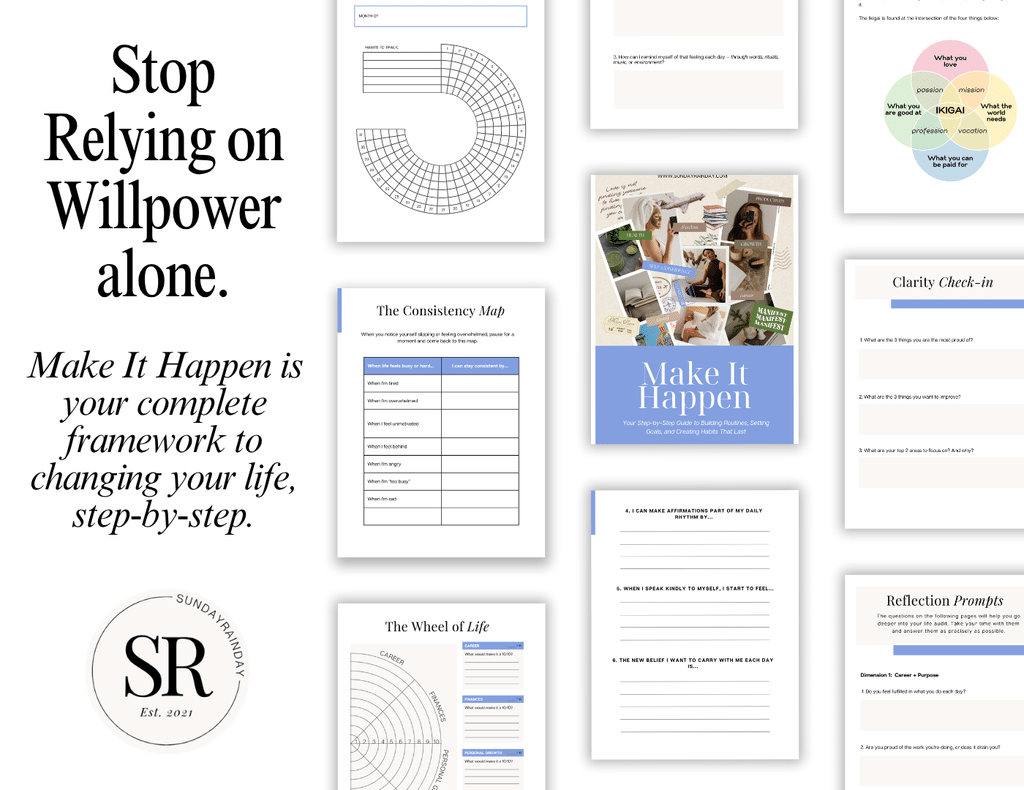
That’s what Make It Happen was created for. This eBook is a 161-page step-by-step guide that helps you build that structure, so your progress doesn’t rely on willpower alone.
What it really means to turn your life around
Take the phrase at its word for a moment. When you turn around, you’re standing in almost the same spot, but you’re facing a different way. That’s what three months can do for you, and it helps to be clear about it before you start.
At the end of those months you probably won’t have the new job, the cleared debt or the body you’d like. What you can have is a life that’s heading towards them. You’re sleeping properly, you’re keeping the small promises you make to yourself, you’re working steadily on one goal that matters, and your days have a shape again. From there, the rest is mostly a matter of time.
Why changing everything at once backfires
The psychologist Albert Bandura spent decades studying what he called self-efficacy, which is your belief that you’re capable of doing what a situation asks of you. It shapes whether you start something, how hard you try and how long you keep going when it gets difficult. Bandura also found that the most dependable way to build that belief is to succeed at something yourself, however small it is. Encouragement helps a little, but nothing convinces you like your own evidence.
When life has been going badly for a while, that evidence is exactly what you’re short of. Every abandoned plan has taught you that you don’t follow through. A huge new plan asks the most of you at the moment you believe in yourself the least, which is why it collapses within days, and why the first month of a real turnaround should be almost embarrassingly small.
Then there’s the problem of numbers. Amy Dalton and Stephen Spiller ran a series of studies on planning, and they found that deciding exactly when and how you’ll act helps a great deal when you have one goal. When people made the same kind of plans for several goals at once, the benefit disappeared. Seeing everything they’d signed up for laid out in front of them made it all feel so hard that their commitment dropped.
Most turnarounds fail because they ask the most of you at the moment you trust yourself the least.
Why three months is the right length
Thirty days is enough to start something, and most of us have started plenty of things. It’s rarely enough to make a change stick. When Phillippa Lally and her colleagues at University College London followed people who were building a new daily habit, it took 66 days on average before the behaviour felt automatic, and for some people it took a good deal longer. Three months gives a new habit time to settle, with a few weeks to spare.
A year has the opposite problem. It’s so long that there’s no reason to start today, and the end is too far away to feel real. Twelve or thirteen weeks is short enough that every week counts and long enough for the people around you to notice a difference. It also divides neatly into three, which is how we’re going to use it.
| Month | Your aim | What you do | What can wait |
|---|---|---|---|
| 1. Stabilise | Get your energy back and prove to yourself that you keep your word | Regular sleep, daily movement, one cleared space, one small promise a day | Big goals and new projects |
| 2. Choose one direction | Put your effort behind the one thing that matters most | One goal, one habit that supports it, a plan for the obstacles | Every other goal on your list |
| 3. Make it hold | Turn what’s working into a normal week | Morning and evening routines, a weekly review, a plan for bad days | Anything new until week twelve |
Month 1: stabilise
In the first month you leave your goals alone. I know that feels wrong when you’re desperate for things to change, but you have only two jobs for these four weeks. The first is to get some energy back, and the second is to collect proof that you do what you say you’ll do.
Everything on this list is deliberately small, and none of it will impress anyone. That’s the point. Month one is where you rebuild the belief in yourself that the next two months are going to need, and you rebuild it with things you can’t fail at.
- Fix your sleep first. Choose a wake-up time you can keep seven days a week, then work backwards to a bedtime. When you’re tired you make worse decisions and give up sooner, so this one change makes all the others easier.
- Move every day, even for ten minutes. A walk around the block counts. You’re practising turning up, and the fitness can come later.
- Clear one space and keep it clear. Your desk, your bedside table or the kitchen counter, and only that. It becomes a small daily reminder that things can stay better once you’ve improved them.
- Make one small promise a day and keep it. Decide the night before, write it down and tick it off: ring the dentist, spend twenty minutes on the tax form, reply to the email you’ve been avoiding. This is your evidence, collected one tick at a time.
- Notice what drains you. Keep a note on your phone of what leaves you flat and what gives you energy. You’ll need it in month two.
Month 1, week by week
You don’t start all five on the same day, for the same reason you’re not changing your whole life in one week. Here’s a way to spread them out.
- Week 1: sleep. Choose your wake-up time and keep it every day, weekend included. Start your note of what drains you and what gives you energy. Nothing else is asked of you this week.
- Week 2: movement. Keep the wake-up time and add ten minutes of movement at the same point each day. Straight after you get up works well, before the day has a chance to get in the way.
- Week 3: one space, one promise. Clear your chosen space on the first day, then spend two minutes each evening putting it back. Begin your daily promise too: write it down the night before and tick it off the next day.
- Week 4: hold steady. Keep all four going and add nothing. At the end of the week, count your ticks and read back through your energy note, because you’ll use both in month two.
By the end of the month you should be sleeping more regularly, moving most days and looking at thirty or so promises kept. If a bad week lands in the middle, repeat it. You lose nothing by taking five weeks over month one.
Related read: The 2-Minute Rule: How to Start What You Keep Putting Off
Month 2: choose one direction
Now that you have some energy and some evidence, you can decide where to point them. This is the month for goals, and the hard part is choosing only one. You probably have five or six things you’d like to fix, and every one of them feels urgent.
Choose the one that would make the others easier, or matter less, once it was dealt with. For some people that’s money, because money is what keeps them awake at night. For others it’s work, their health or a relationship. If you can’t tell, the notes you kept in month one about what drains you will usually point straight at it.
- Write the goal so that you could tick it off. “Feel better about money” gives you nothing to do tomorrow. “Follow a written budget for eight weeks” does, and you’ll know on the last day of month three whether you did it.
- Attach one habit to it. A goal is reached through something you do most days. For the budget, that might be five minutes checking your spending every evening. For a new job, thirty minutes on applications before work. Tie it to something you already do, like your first coffee, so you don’t have to remember it.
- Decide now what you’ll do when it goes wrong. Write one sentence in this form: “If I’m too tired after work, then I’ll do ten minutes and stop.” The psychologist Peter Gollwitzer has studied if-then plans like this one for years, and they make people considerably more likely to follow through.
- Park everything else. Write your other goals on a list called “later”. They’re still yours, and they’re waiting their turn. Having them written down makes it much easier to stop turning them over in your head.
- Keep your month-one basics going. Your sleep, your daily movement and your clear space are what make this month possible.
Month 2, week by week
The choosing takes a week and the habit takes three. Give the decision the time it needs, because everything after it depends on it.
- Week 5: choose and write. Read your energy note, pick your one goal and write it so that you could tick it off. Make your “later” list on the same day, so the other goals have somewhere to go.
- Week 6: start the habit at half size. Begin with half of what you think you can manage, so fifteen minutes if you were planning thirty. Write your if-then sentence and keep it somewhere you’ll see it.
- Week 7: bring it up to full size. If week six went well, move to the full version. If it was a struggle, stay small for another week. A small habit you keep is worth more than a big one you drop.
- Week 8: check where you are. Look at what three weeks of the habit have produced and compare it with your goal. If the goal now looks too big or too easy for the time you have left, change the goal and keep the habit.
You’ll know it’s working when the habit starts to feel like part of the day and you’ve stopped arguing with yourself about whether to do it.
Related read: 8 Reasons Why You Give Up on Your Goals
Month 3: make it hold
By now you’ve kept your month-one basics going for eight weeks and your new habit for four. Month three is about turning all of that into a normal week, so that it carries on without you having to think about it. This is also when motivation usually dips, because the novelty has worn off and the results aren’t dramatic yet.
So this month you lean on structure. You give your days a beginning and an end, you check in with yourself once a week, and you plan for the bad days before they arrive.
- Give your mornings and evenings a shape. Build a short morning routine and a short evening one around what you’re already doing. Three or four steps each is plenty.
- Review your week every Sunday. Ask yourself three questions: what did I do, what got in the way, and what is the one thing that matters next week? Ten minutes is enough.
- Don’t let one missed day become a missed week. In Lally’s study, missing a single day made no measurable difference to how well a habit formed. What matters is that you pick it up again the next day.
- Add nothing new until week twelve. You’ll be tempted, because things are going well. Let them go well for a little longer.
- In the last week, look back and choose what’s next. Compare this week with the week you started. Then take one goal from your “later” list and begin your next three months at month two.
Related read: Discipline vs Motivation: Why Willpower Isn’t Enough
Month 3, week by week
This month adds very little that’s new. Most of it is arranging what you already do so that it holds together when you’re busy or tired.
- Week 9: mornings. Put your wake-up time, your movement and, if it fits, your goal habit into one short sequence that you follow in the same order every day.
- Week 10: evenings and your first review. Build the evening version: reset your clear space, write tomorrow’s promise and go to bed at your set time. On Sunday, do your first weekly review.
- Week 11: plan for the bad days. Write down a minimum version of your day for when you’re ill, travelling or overwhelmed. It could be your wake-up time, ten minutes of movement and five minutes on your habit. On a bad day you do the minimum, and it counts.
- Week 12: look back and choose. Read your first week’s notes next to this week’s. Then pick the next goal from your “later” list, and keep everything else exactly as it is.
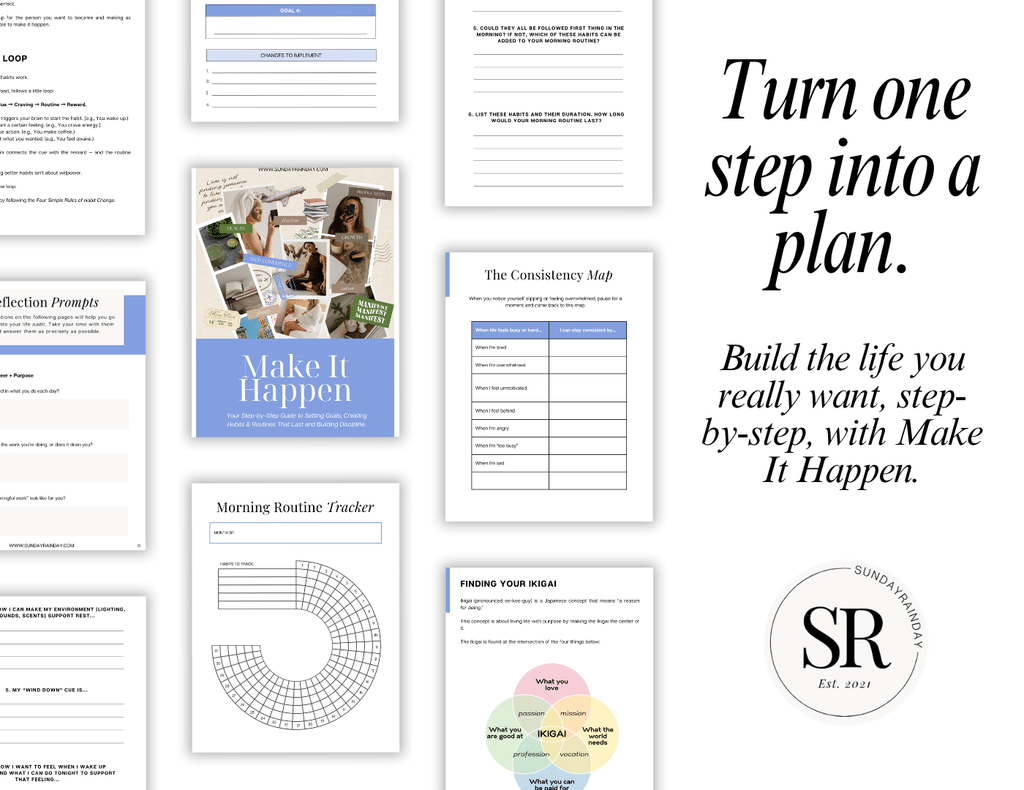
If you’d like all of this on paper, Make It Happen will guide you step-by-step. It walks you through a life audit, your goal, your habits and your routines, with three-month routine trackers and a consistency map for the weeks when your motivation drops.
Turning your life around, one month at a time
If you take one thing from this article, let it be that changing your life has an order. The last time you tried, you probably asked everything of yourself in the first week. This time you ask for very little at the start, and a little more each month.
In month one you stabilise. You sleep, you move, you keep one space clear and you keep one small promise a day, until you trust yourself again. In month two you choose a single goal, attach one daily habit to it and let every other goal wait its turn. In month three you give your days a shape, with a morning and an evening routine, a weekly review and a plan for the bad days, so that what you’ve built carries on when your motivation dips.
Three months from now you won’t have fixed everything, and you were never supposed to. You’ll be facing a different way, with the energy, the evidence and the habits to keep going, and a list of what comes next. You can begin tonight: choose the time you’ll get up tomorrow and write down one small promise for the day.
And if you’d like all of this on paper, it’s the whole reason Make It Happen exists. It walks you through a life audit, your goal, your habits and your routines, with three-month routine trackers and a consistency map for the weeks when your motivation drops, so you always know what this week is for.
Frequently asked questions
How do you turn your life around?
You turn your life around by changing one thing at a time, in order. Start by stabilising the basics, which are sleep, daily movement and keeping small promises to yourself. Then choose one goal that matters and attach a daily habit to it. Finally, build routines and a weekly review so the change holds. Trying to fix everything in the same week is the most common reason people give up.
Can you really turn your life around in 3 months?
You can change its direction in three months, and that’s what turning around means. You’re unlikely to reach every goal in that time. But twelve weeks is long enough to restore your energy, build one or two habits until they feel automatic and make visible progress on one goal. Research on habit formation suggests a new habit takes about two months on average to settle, which fits comfortably inside three.
Where do you start when everything feels wrong?
Start with the smallest things that give you energy back: a fixed wake-up time, ten minutes of movement and one small promise kept each day. When everything feels wrong, a big plan is the last thing you need. A month of small things done reliably will give you both the energy and the confidence to choose what to tackle first.
How long does it take to change your life?
It depends on what you’re changing. A single habit takes around two months to become automatic for most people, and sometimes much longer. A bigger change, such as a new career or clearing a debt, can take a year or more. Three months won’t finish the job, but it’s long enough to get you moving in the right direction with habits that will keep you going.
What if you have no motivation?
It doesn’t matter. You’re not supposed to build your plan on motivation anyway. Motivation tends to follow action, so make the first step small enough that you can do it without feeling ready, like a ten-minute walk or one phone call. Each small thing you finish adds to your belief that you can do the next one. That belief does more for you over three months than a burst of enthusiasm on day one.
Is it too late to turn your life around?
No. People change direction at thirty, at fifty and at seventy, and the method is the same at any age: stabilise, choose one thing, and build the structure that keeps it going. The only thing that changes with time is how much you have already learned about what you don’t want, and that makes choosing easier.
