

New Year Life Reset: A 31-Day Plan That Lasts Past January
We’ve all made ourselves this promise at least once in January. This is the year you finally sort it out: the mornings, the money, the thing you’ve been meaning to start for longer than you’d like to admit. And for some, the first week or two of January really do feel different. But then comes the middle of the month, work starts taking your evenings back, and by February you’re living almost exactly the life you had in December.
If that has happened to you more than once, you probably blamed your willpower or discipline. But I’d look at the sequence instead. Most New Year resets ask you to choose goals before you’ve looked at the year behind you, and to start habits before there’s a plan for them to serve, so all that January energy goes into a tidy desk and a new planner.
This article does things differently. It’s about a New Year life reset in 31 days, with one small thing to do each day and a reason for doing it in that exact order. It takes ten to twenty minutes a day and will help you create a life reset that finally lasts.
Save this article
Why most New Year resets fade by February
Since you’ve already tried this before, you might wonder why your willpower, despite feeling so strong on the first of January can be gone by the fifteenth. The lift itself is real, and researchers have a name for it. Hengchen Dai, Katherine Milkman and Jason Riis call it the fresh start effect, after noticing that people search for diets and turn up at the gym more often right after a date that feels like a new beginning. A new year does it, and so do a new month, a Monday and the day after a birthday. Their explanation is that a date like this lets you put last year’s version of you in a closed chapter and look at your life from a little further away.
So the feeling is real. What it can’t do is last, because a date gives you motivation and nothing else. It doesn’t tell you what to work on. It doesn’t find you an hour in a week that’s already full, and it has nothing to say on the nineteenth of January, when you’re tired, it’s dark at five and the feeling has gone.
So what you do with that feeling while you still have it matters a lot. Most of us pour it into a deep clean, a gym membership and a week of early mornings, and when it fades a few weeks later, there’s nothing left to show for it. A better use of January is to build things that will still be standing in February: a clear picture of where last year left you, a short plan, a reminder you can’t avoid seeing, and one habit that has started to run without you pushing it. The four weeks below build them in that order.
The first of January is the worst day of the year to decide what you want, and the best day to start finding out. You’re tired, the house is still full of the holidays, and you haven’t looked at last year yet. That’s why this reset doesn’t ask for a single goal until Day 9.
A small confession: I love a good reset, and I rarely wait for January to start mine. I usually begin in early December, so that when the new year arrives I’m already up and running. That’s a personal preference, though, and everything below works just as well if your Day 1 is in January.
How this New Year life reset works
The reset lasts four weeks with a short closing stretch and each week has a clear purpose. In week one you look back, at the year that has just ended and at your life as it stands this morning. In week two you decide what this year is for, which mostly means deciding what you’re going to leave alone. Week three takes the plan out of your notebook and puts it where you’ll use it, and week four builds the one habit that will carry it. Finally, the last three days hand everything over to February, because that’s actually where your New Year reset is won or lost.
Here are a few ground rules that will make the month easier:
- Start on the first of January if you can, and start anyway if you can’t. The first week is slow, reflective work that suits both the quiet days before and after the holidays. If you’re reading this on the ninth or the fifteenth, the days run in the same order so don’t worry about the calendar. What matters is the sequence.
- Do the days in order. Each one uses something you wrote on an earlier day, so skipping ahead leaves a gap.
- Keep everything in one notebook. By the end of the month, it’ll be the most useful thing you own.
- If you miss a day (and you will), pick up where you stopped. If you feel like it, do two activities in one evening.
- Let the seventh day of each week be light. It’s there for reading back and resting on purpose.
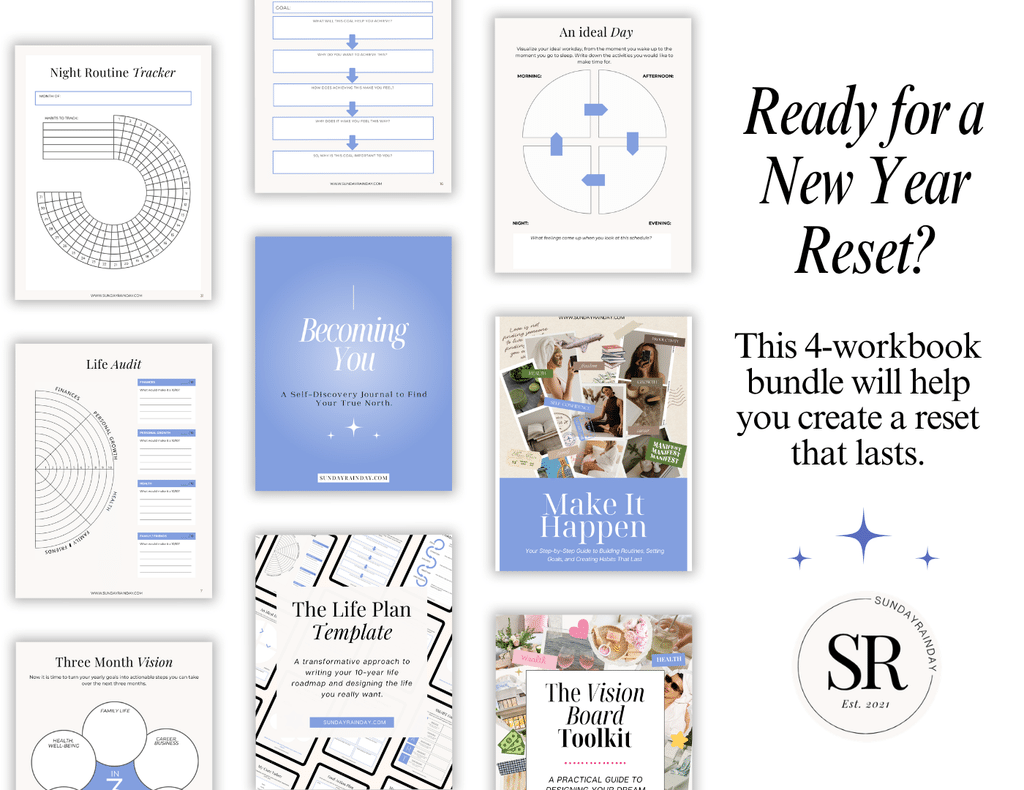
Each week also matches one of the four workbooks in The New Year Planning Bundle, if you’d like the exercises laid out with room to write. However, there’s no need to get the bundle to do the reset in this article. A notebook is all you need to follow along here.
The first of January is the worst day of the year to decide what you want, and the best day to start finding out.
Week 1: Look back before you plan (days 1–7)
The energy of the first week of January makes you want to fix things. You want the list, the goals, the fresh page with this year’s date on it. If you stumble upon this article on January 1st, hold off for seven days. The goals written before you’ve looked at last year are usually last year’s goals in new handwriting, chosen by a version of you who was tired, full of Christmas and working from memory.
This first week you only look: at how the past twelve months really went, at how each part of your life feels right now, and at what you care about these days, which may have shifted while you weren’t paying attention. Nothing needs deciding yet.
- Day 1. Open a notebook and say why. Pick one notebook for the whole month, or one file if you think better on a screen. On the first page, write a few honest lines about why you want this year to be different. Skip the version you’d say out loud at a dinner party and write the real one, the thought you had in your mind while resting on the sofa somewhere between Christmas and New Year.
- Day 2. Score your life as the year begins. Give each of eight areas a mark out of ten: work, money, health, family, social life, home, personal growth and how you feel about yourself. Go with your first instinct and don’t argue with the numbers. Two or three of them will make you wince, and those are the ones this month is about. If you’d like the full version of this exercise, here is how to do a life audit.
- Day 3. Remember what worked last year. Scroll back through last year’s calendar and your camera roll before you write anything, because memory tends to keep the last few months and forget about everything else. Then write down three things that went well and, next to each one, what made it possible and how they made you feel. You’re looking for the conditions you could create again.
- Day 4. Name what drained you. Think of the things you kept saying yes to last year while some part of you was already tired of them: the commitment you dreaded every Thursday, the habit that ate your evenings, the arrangement you stopped questioning a long time ago. Write down three. You need to finally see them on paper.
- Day 5. Work out what you value now. Write ten words for what matters to you, quickly, without editing. Then cross them out one at a time until only three are left. It gets uncomfortable around the fifth, but getting to the uncomfortable part is the most useful. The words that survive this exercise are the ones your year should be built around.
- Day 6. Describe an ordinary Tuesday next January. Leave the dream holiday and the perfect weekend out of it. Picture a normal working Tuesday a year from now, in a life that fits you, and write it down from the moment you wake up: where you are, what the work is, who you see, what you do with the evening. The details you add without thinking will tell you more than any list of goals. This is the life you will aspire to create this year.
- Day 7. Read the week back. Make a cup of coffee or your favourite tea and read everything you’ve written since the first day. Then finish one sentence: “This year I want more of ___ and less of ___.” Close the notebook and take the rest of the day off while keeping this sentence in mind.
If this week stirred up more than a notebook can hold, that’s the ground of Becoming You, the first workbook included in The New Year Planning Bundle covers, with guided prompts for each of these questions.
Week 2: Make room for what matters (days 8–14)
By now you probably want to change so many things that you might wonder if one year is really enough. That’s normal, and it’s also where most resolutions go wrong: we write down all nine things, feel motivated for an evening, and keep none of them.
This is the week you write your resolutions, maybe it’s a week later than everyone else but you have a complete review behind you, which is a far better place to choose from. The work is choosing two or three things and letting the rest go for now, on purpose and in writing. By Sunday, your whole year should fit on one page.
- Day 8. Choose two or three areas. Go back to your scores from Day 2 and your sentence from Day 7. Pick the areas where a change would matter most this year, and write “not this year” beside the others. That part stings a little. You will feel like you’re settling up for less. But it’s also what makes the two or three you kept possible.
- Day 9. Write this year’s resolutions, as things you’ll do. For each area, write one goal, and phrase it as something you’ll start. In a Swedish study of more than a thousand people making New Year’s resolutions, the ones who framed their goal as something to do were more likely to still be keeping it a year later than the ones who framed it as something to stop. So “stop scrolling at night” becomes “read for twenty minutes before bed”. And that alone makes a big difference.
- Day 10. Bring each goal back to March. December is too far away to feel real, and a goal you can’t feel is easy to put off. For each of your goals, write what would be true by the end of March if things were going well. That’s the version you’ll keep in mind and plan around.
- Day 11. Find the first step. Take each three-month goal and break it into steps, then keep breaking until the first step would take you less than an hour. If the first step still makes your stomach tighten, it’s too big. Make it smaller.
- Day 12. Map a normal week. Sketch your week as it really runs now that the holidays are over, with work, the commute, dinner and the evenings you’re good for nothing. Then mark the two or three slots where this year’s goals will happen. If you can’t find any, don’t panic. Tomorrow is for that.
- Day 13. Take one thing out. A new year can’t fit into a week that’s already full, so something has to go. Look at your list from Day 4 and cancel, decline or hand over one thing. Send the message today, while you still remember why.
- Day 14. Put the year on one page. Write out your goals, what each one looks like by March, the first step and the slots in your week. One page, in your own handwriting. Date it and keep it somewhere you’ll see it.
The Life Plan Template, the second workbook from The New Year Planning Bundle does this same work at full length, from a ten-year view all the way down to your next three months.
Week 3: Make your plan visible (days 15–21)
By the middle of January, the year has stopped feeling new already. You’re back at your desk, the inbox has filled up again, and the notebook you wrote in so carefully two weeks ago might be sitting in a drawer. This is the week most resets end, but nobody ever decides to quit. The plan just gets buried under busy days. So this week you take it out of the notebook by making a vision board and put it in the places you look at without thinking: a wall, your phone, the corner of the room where the work will happen.
- Day 15. Collect the pictures. For each of this year’s goals, find three or four images or phrases that show you doing the thing. Your Tuesday from Day 6 is the best place to start. Leave out anything that’s only pretty: a beach you’ll never visit says nothing about your year or what you’re trying to build.
- Day 16. Build the board. Give each goal its own corner, on paper or on a screen, and don’t let it turn into a craft project you never finish. A plain board you finish tonight will do more for you than a beautiful one you’re still arranging in March.
- Day 17. Add the obstacle. This is the day most vision boards skip. Beside each goal, write the thing most likely to get in its way, and what you’ll do when it shows up. It feels like spoiling the picture, and it’s what makes the picture useful.
- Day 18. Put it where you can’t avoid it. Take a photo of the board and make it your lock screen, or pin the board inside the wardrobe door you open every morning. If you created a digital vision board, use it as your phone and laptop wallpapers. You should see it at least once a day without trying.
- Day 19. Reset one space. Choose the spot where your main goal will happen: the desk, a corner of the kitchen, the hallway where your running shoes live. Clear it, and leave out only what the work needs. When you walk past it tomorrow, it should look like it’s waiting for you.
- Day 20. Rearrange your phone. Remember the slots you marked on Day 12? Check what usually fills them. Move those apps off your first screen, and put the one tool your goal needs where they used to be. Then, create reminders for the activities you plan to use these slots for. The reminders will keep them top of your mind on busy days.
- Day 21. Tell one person. Choose someone who’ll be supportive and tell them what you’re working on this year. Then ask them to check in with you at the end of February. You’ll be surprised how much easier it is to keep going once somebody else knows.
The activities from this third week are covered in detail in The Vision Board Toolkit, the third workbook of bundle. This workbook goes deeper into this stage, with guided self-discovery questions and templates if you’d rather not start from a blank page.
Week 4: Build one habit and one routine (days 22–28)
Everything so far has been preparation, and this is the week the plan starts to move. You’re going to build one daily habit for your most important goal, and one short routine to hold it in place. Only one. I know it feels too slow and it’s tempting to start a habit for every goal while you still have the energy, and that’s exactly how a reset collapses before February. One habit that survives the winter will do more for your year than five that don’t, and the others will follow once it has settled.
- Day 22. Choose the habit. Go back to the first step you found on Day 11 for your main goal, and turn it into the smallest thing you could do every day. You don’t need to make it last one hour. Ten minutes counts. So does one page.
- Day 23. Give it a trigger and a place. Finish this sentence: “After I ___, I will ___, in ___.” Tie the habit to something you already do without thinking, like your first coffee or closing your laptop, so you never have to remember to actually do it.
- Day 24. Do it for the first time. Today you just do it once. Notice how long it really takes and what got in the way, and change whatever needs changing in your plan before tomorrow.
- Day 25. Write the two-minute version. Some days will be busy and draining. You will feel tired, sick or sad. Decide now what your habit shrinks to on those days: one paragraph, one stretch, one page. This is the two-minute rule doing its job, and it’s what will keep your streak long enough to form the habit.
- Day 26. Build a short routine around it. Write three or four lines for your morning or your evening, with the habit in the middle, and keep it short enough to do on a Monday. If you’d like a method for this, here’s an article about building a morning routine around your goals.
- Day 27. Start a tally. Put a paper calendar or paper habit tracker somewhere you’ll see it and mark a cross for every day the habit happens. Two-minute days count. This simple step can be very motivating. There’s something about a row of crosses that makes you not want to break it.
- Day 28. Do the thing you’ve been avoiding. There’s one thing you’ve probably been putting off since Day 11. It’s usually an email, a booking or an awkward conversation, and you know which one it is. Do it today, while you still have a month of momentum behind you.
If you struggle with this stage, Make It Happen is the workbook from the bundle created to support you. It covers everything included in week four, from habits, routines and what to actually do when your consistency slips.
Days 29–31: Hand your reset over to February
Look at what you have now: a review of last year, a plan that fits on one page, a vision board you see every morning and a habit that’s less than a week old. That last part matters, because a week is nowhere near enough. When Phillippa Lally and her team at University College London followed people building a new daily habit, it took an average of 66 days to become automatic. So the real test of your reset comes around the end of March, long after everyone else has stopped talking about resolutions. These last three days make sure you get there.
- Day 29. Read the month back. Start from the page you wrote on Day 1 and read all of it. Notice what has changed since then. Notice which days you skipped, too, because the ones you avoided usually have something to tell you. Were they busy days at work? Days when you felt tired due to lack of sleep? Stressed by too many commitments?
- Day 30. Correct the plan. If one of your goals already feels like one too many, believe that feeling. Move it to “not this year” and rewrite your one page without it. A smaller plan you keep is still a changed year. And you’ll be able to start working on this goal again as soon as you have achieved the others.
- Day 31. Set February. Write three things you want done by the end of February, and plan the next review. The last day of the month or first of the following one works well, because every month is a small fresh start on its own.
Related read: 25 Things to Do in January to Start a New Life
What to do before January momentum fades
At some point in late January or February, your reset will stop feeling new. The notebook will sit unopened for a few days. You’ll miss the habit twice in a row, and a voice in your head will say: here we go again, I’m back to square one. When that happens, don’t read it as failure. The motivation you felt in January has run out, right on schedule, and what’s left is everything you built while you had it. Your plan still fits on a page, the board is still on your lock screen, and the two-minute version of your habit was written for exactly this moment.
The most useful thing you can do then is your next monthly review, on the date you set. It’s the last three days of this reset in miniature: read back, correct, set the month ahead. And remember what the research says about fresh starts, because it works in your favour here. The calendar hands you a new beginning every few weeks, and you only need to keep taking them. If your resolutions have a long history of fading, you might also want to read why New Year’s resolutions fail.
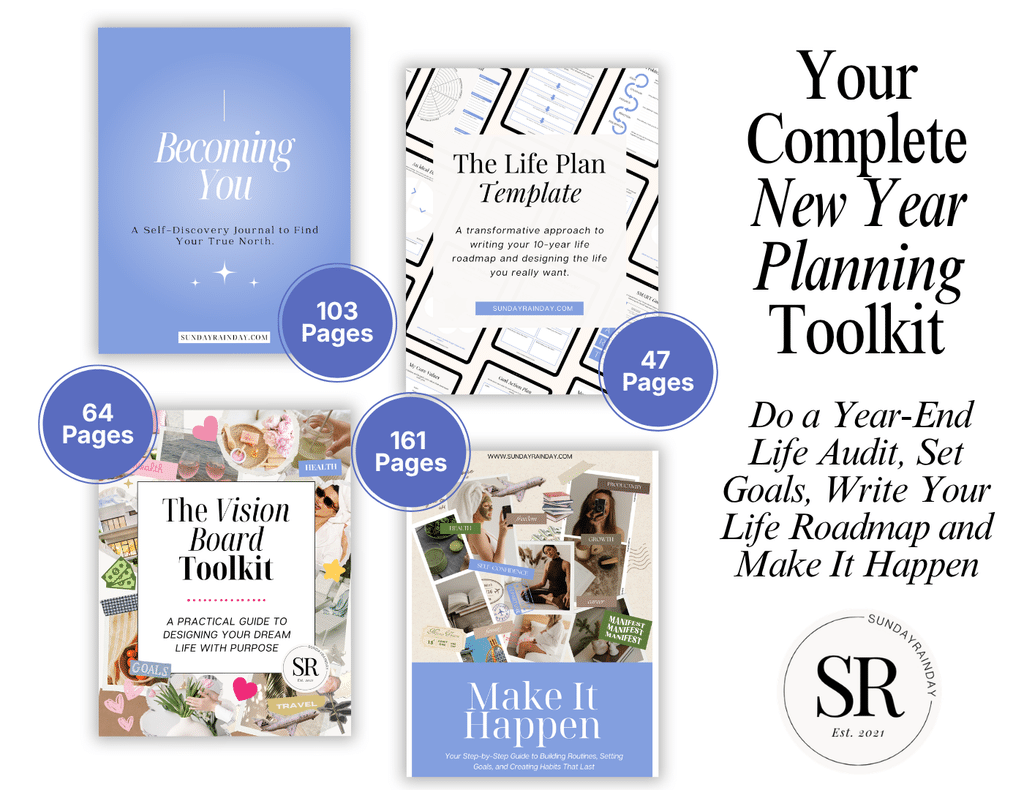
The New Year Planning Bundle was built in the same order as this reset, for exactly this reason. It holds four workbooks, 375 pages in all: Becoming You for the look back, The Life Plan Template for the decisions, The Vision Board Toolkit for making them visible, and Make It Happen for the habits that carry them through the year.
Frequently asked questions
What is a New Year life reset?
A New Year life reset is a deliberate pause at the start of the year to look at how your life is going and change its direction. It’s different from making resolutions, because you review the year behind you before you decide anything about the one ahead. A useful reset has four parts: an honest look back, a small number of decisions, a way of keeping those decisions in sight, and one or two habits that put them into practice. It doesn’t ask you to become someone new by February. Most resets change two or three things and leave the rest alone on purpose, which is a big part of why they last.
How long does a New Year reset take?
Planning it takes about a month, at ten to twenty minutes a day, and that’s what these 31 days cover. Living it takes longer. A new habit needs roughly two to three months of repetition before it feels automatic, so a reset you start on 1 January is really tested in March. It helps to think of January as the month you set the direction, and February and March as the months you prove it, with a short review at the start of each.
When should I start, and what if I’m late?
The first of January is the natural day, and the first week is gentle enough to fit around the end of the holidays. If you’d rather wait until life is back to normal, start on the first Monday of the year. And if you’re finding this in the middle of January, start today. You’ll finish in the middle of February and lose nothing, because the order of the days matters far more than the date you begin.
What if I miss a day of the challenge?
Pick up where you stopped. The days build on each other, so skipping ahead leaves a gap, and doing two in one evening usually means doing both badly. It’s completely fine for your reset to take five or six weeks. The one week I’d protect is the last, because a brand-new habit that lapses for several days is hard to restart, and that’s what the two-minute version from Day 25 is for.
How is a New Year life reset different from making resolutions?
A resolution is one decision. A reset is how you work out which decisions are worth making. Most resolutions are chosen in a hurry at the end of December, with no review behind them and no plan in front of them, which goes a long way towards explaining why so many are gone by February. A reset spends its first week looking and its second choosing, so the goals that come out of it are fewer, and they fit the life you really have.
