

38 Self-Discovery Questions to Find Yourself and What You’re Meant to Do
Maybe you found this article the way a lot of people do: late at night, typing a question into a search bar that you’re not ready to say out loud. Nothing is wrong, exactly. You’re doing everything you’re supposed to, ticking the boxes and keeping it all together, and yet you can’t shake the feeling that somewhere along the way you lost the thread of your own life.
This feeling tends to show up in ordinary moments. You’re answering the last email of the day, or scrolling through someone else’s holiday photos on social media, and a quiet question surfaces: is this actually what I want? The difficult part comes when you try to answer this questions, or visualize your ideal life and realise you’re no longer sure what you want, or even when you stopped asking.
If that sounds familiar, this article is for you. It brings together 38 questions to help you work out who you are now and what you want next, along with a few thoughts on how to use them so that your answers actually lead somewhere.
Finding yourself starts with the right questions
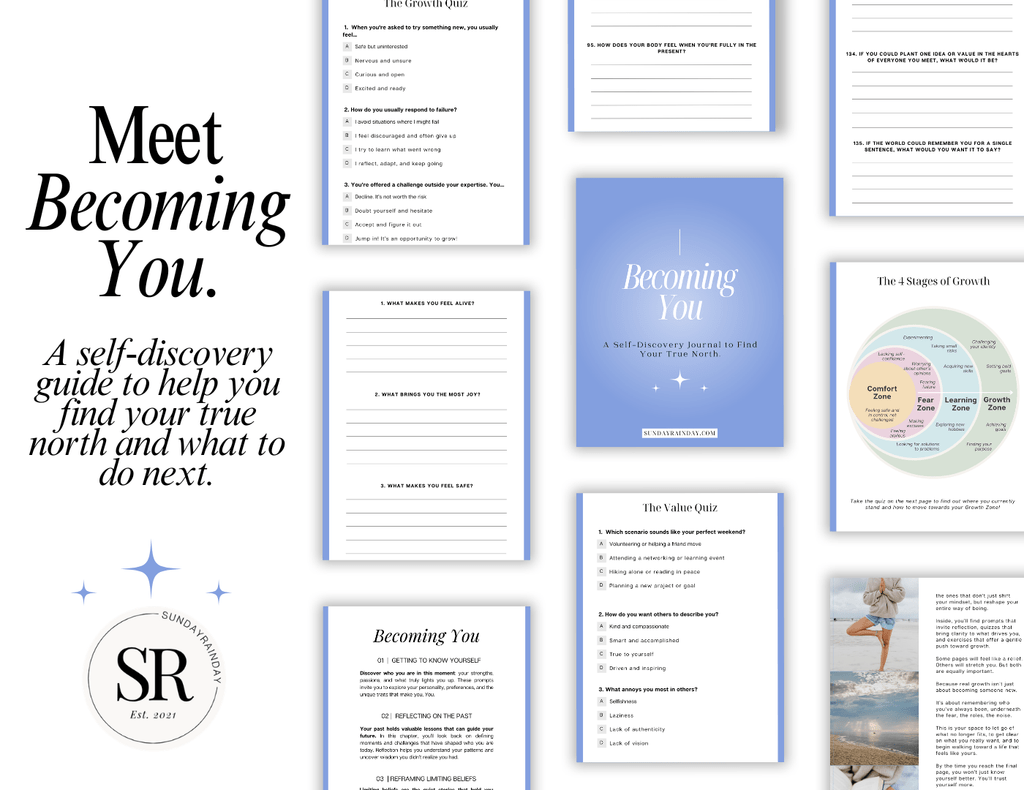
Most people don’t struggle to find themselves because they never ask questions about their life. They struggle because they ask them at random, without direction, and stop before anything meaningful takes shape. Becoming You is a 103-page guided self-discovery journal built around intentional prompts and self-discovery exercises designed to help you explore who you are before deciding what you’re meant to do.
Save this article
Why the right questions make the difference
Most of us assume we know ourselves reasonably well, but the organisational psychologist Tasha Eurich, who has spent years studying self-awareness, found that although most people believe they’re self-aware, true self-awareness is rare. Her research also showed that introspection on its own doesn’t reliably help. Thinking hard about your life can just as easily send you round in circles, which is probably something you’ve already experienced at two in the morning.
What seems to make the difference is the kind of question you ask. Eurich found that why questions tend to pull us toward our limitations and our past, while what questions keep us curious and point us forward. So why do I feel so stuck? usually ends with a list of everything that’s wrong with you, whereas what would help me feel less stuck? ends with something you can actually try.
That’s why nearly every question in this article starts with what, who or how, and why they’re grouped by what they tend to reveal, so that your reflection builds on itself instead of scattering in every direction. Finding yourself often has less to do with discovering someone new than with remembering what got buried under years of other people’s expectations, and you probably already know more of it than you think.
How to use these questions
Don’t try to answer these questions all at once. It’s tempting, but it turns a reflective practice into a chore, and you’ll end up writing quick, tidy answers just to reach the end. Quick answers tend to be the polished ones, and the polished ones are rarely the most honest.
Instead, pick one group and stay with it for an evening. Write your answers by hand if you can, because it slows your thinking down just enough for the honest answer to surface before the presentable one. Nobody is going to read this, so you can let go of the version of yourself that performs.
And come back to these questions over time. Your answers will change as you do, which is exactly the point, and a question you can’t answer today might turn out to be the one worth carrying with you all year.
38 self-discovery questions to find yourself
What you’d stand for
Everything else is built on top of this. Your goals, your relationships and the direction you keep reaching for all rest on what you value, and yet most of us have never once stopped to name it out loud. So this is where we start.
1. What is worth suffering for?
Every direction you could choose for your life comes with its own kind of difficulty. A creative career brings uncertainty, a stable one can slowly bring boredom, and building something of your own tends to bring a bit of both. Since some struggle is coming either way, the more useful question is what you’d be willing to struggle for.
Knowing this in advance lets you choose your battles deliberately and spend your energy where it actually moves you forward. Some things drain you because they’re wrong for you, and others drain you because they’re worth the cost. Learning to tell the two apart is a large part of finding your footing.
2. Who is worth suffering for?
No matter how kind we are (and I have a feeling you wear your heart on your sleeve too), we’ll never be able to keep everyone in our lives. Some people aren’t worth fighting for, and understanding that not everyone is meant to stay is part of growing into who you are.
When a friendship or relationship comes to an end, ask yourself how knowing this person helped you grow and what you learnt from your time together. Let yourself be grateful for what it gave you, and then let it go gently.
Not everyone is meant to stay.
And that’s okay.
3. What would you stand for if you knew nobody would judge you?
When you take away the fear of being watched, one conviction usually rises above the rest. If you could defend a single cause you truly believe in, with nobody’s approval to lose, what would it be? Fighting injustice, protecting children, cleaning up the oceans? Whatever comes to mind first is worth writing down, because it points to what you value when nobody is grading you.
4. What are the three things that matter most to you?
Think of the three things that, if they quietly disappeared from your life, would make everything else feel a little hollow. For one person that might be family, freedom and meaningful work, and for another it might be faith, health and making things with their hands. Write yours down before you go any further, because they’ll act as the compass for everything that follows.
5. How would you spend your life if you knew nobody would judge you?
Now widen the frame from a single cause to a whole life. With judgement completely off the table, what would you do? Would you swap the flat for a backpack and an open map, leave the job that empties you to make a living from your art, or finally let people see who you’ve been underneath the performance?
The gap between that answer and the life you’re living now is worth studying closely. If it’s small, that’s reassuring. If it’s wide, it may be a sign that you’re outgrowing your life and ready for a fresh start.
What’s quietly shaping you
A lot of who you’re becoming is being decided by things you barely notice: your routines, your feeds and the people you find yourself watching. These questions bring them into view.
6. Based on your daily habits, where will you be in 2, 5 and 10 years?
If you want a glimpse of your future, take a step back and look honestly at an ordinary Tuesday. What you give your time and attention to is gradually becoming who you are. Spend your mornings moving and you become someone strong, write every day and you become a writer, and return to the same craft often enough and it quietly becomes part of your identity.
That means where you’ll stand in ten years is largely being decided right now, in the small habits you hardly think about. It also means that changing those habits is one of the most practical ways to change where your life is heading.
Related read: How to Write a 3-Year Life Plan
7. If you had to live your current life on repeat forever, how would you feel?
Imagine that the life you’re living right now, with its routines, its work, its relationships and the way your evenings tend to unfold, simply played on a loop with no end date. Exactly as it is today, with nothing improved and nothing postponed until next year.
Then notice what happens in you when you picture it. If the thought feels mostly comforting, you’re probably closer to the life you want than you give yourself credit for. But if something tightens, it’s worth staying with that feeling for a moment before brushing it off, because it rarely points at everything at once. More often it’s one specific part, the job, the city, or the fact that nothing on your calendar makes you look forward to a Wednesday, and that part is usually where the first change needs to happen.
8. If social media didn’t exist, what would you do differently?
Imagine a world without feeds and likes, where nobody is documenting your every move and your choices exist for you alone. What would change? Would you dress differently, take the job you keep talking yourself out of, or move somewhere that feels more like home?
You don’t need to delete a single app for this question to be useful. What it does is separate what you genuinely want from what you’d like to be seen wanting, and those two blur very easily when there’s always an audience.
9. Whom do you admire the most?
Name one person you admire above anyone else, living or not. When you feel lost, role models can be surprisingly hard to find, because it’s difficult to know who you want to become while you’re still working out who you are.
So start more loosely. Whose life, work or way of being keeps holding your attention? You don’t have to want their exact life, and you don’t need to explain the pull yet. Just notice who draws you in, and then move on to the next question.
10. What’s so interesting about them?
Now try to be specific about what pulls you toward the people you admire. Is it the way they meet whatever life sends them, the fact that they built something rare from a difficult start, or a steadiness and warmth they hold on to no matter what?
What you’re looking for here are particular traits worth borrowing and building into your own life, whatever direction it eventually takes. Admiration is often a quiet preview of qualities you’d like to grow in yourself.
11. What’s one thing you love but would be mortified to share with the world?
Part of feeling stuck often comes from hiding what we actually enjoy. Performing a slightly edited version of yourself every time you step outside is exhausting, and over time it quietly convinces you that the unedited version isn’t enough.
So what would change if you decided that it was? Name one thing you secretly love and have always kept to yourself, whether it’s a reality show, singing badly in the car or the novel that’s been sitting in a drawer for six years. Then ask yourself how you could start doing it a little more openly, beginning this week.
What your past reveals
Your history holds more evidence about who you are than any plan you could make. These questions ask you to go back and read it with fresh eyes.
12. What are three things you thought you’d never get over?
We all carry battles that once felt insurmountable and were forgotten almost as soon as they were behind us. Naming three of them is a way of measuring the distance you’ve already travelled, and it gives you proof, taken from your own life, that you’re more capable than you tend to remember.
13. Why did they seem so insurmountable?
Look a little closer at those three moments. Why did each one feel impossible at the time? What was it about the situation that made you doubt your own strength, and what did you feel was at stake? The answers often reveal fears that still shape your decisions today.
14. And how did you get over them?
Since they’re now behind you, try to trace how you actually moved through each one: what you did, who stood by you and what you had to let go of along the way. Then ask yourself where those same lessons might apply to whatever you’re facing right now, because the things that carried you once can often carry you again.
15. What are your three most significant accomplishments so far?
Name the three achievements you’re proudest of, whether or not they would impress anyone else. Then go a layer deeper and ask why each one matters to you. Your pride is often more honest than your CV about what you truly value, and the accomplishment that looks smallest on paper can turn out to say the most about you.
16. What do you already have going for you right now?
When you feel lost, it’s normal for your attention to go straight to what’s missing: what you don’t have yet, what hasn’t happened, what still feels out of reach. This question gently turns it the other way. Take stock of what’s already working in your life, however small it seems, like the skills people rely on you for, the friend who always picks up, a bit of savings, a flexible job, a language you speak or a free hour most evenings.
These are the materials your next step will most likely be built from. So as well as noticing the distance between where you are and where you want to be, ask which of them you could start using more deliberately.
17. Who are you trying to impress?
One of the quieter reasons people feel lost is that they’re living for an audience without realising it. Usually there’s a specific person behind it, often a parent or someone close, whose approval you’re still chasing years later.
Naming who that is can explain a great deal about why you’ve pursued the goals you have. And once you can see it clearly, it becomes much easier to set new goals that serve the life you actually want to live.
When reflection becomes direction
If you’ve made it this far, you’ve probably noticed that some questions spark real insight while others only seem to raise more questions.
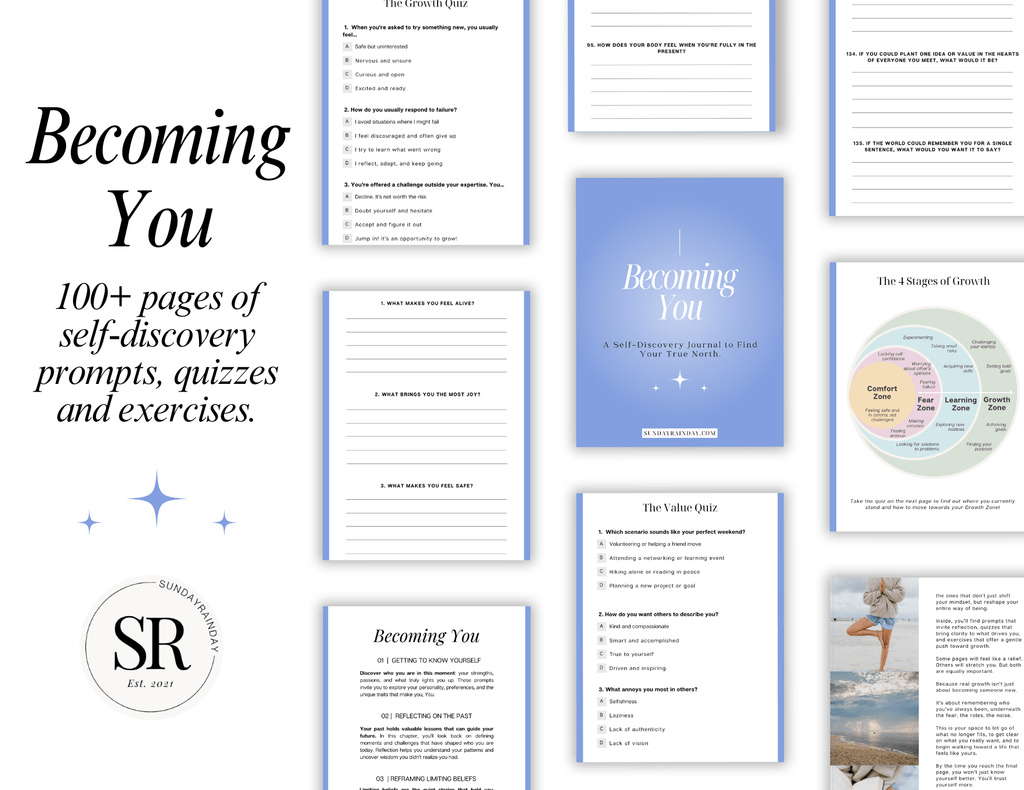
That’s part of the process, because clarity usually comes from connecting your answers over time, which is hard to do on loose pages. Becoming You was designed for exactly that: guided prompts and exercises that build on each other, so your reflections slowly turn into patterns you can act on.
How you actually spend your life
What we say we value and what we actually spend our days on are rarely the same list. This group gently compares the two.
18. If money were out of the equation, how would you spend your days?
Most lives are built around a job, and there’s nothing wrong with that, as long as you’ve chosen the work and found something in it worth doing. One way to check whether you have is to ask yourself whether you’d still show up if the salary disappeared tomorrow.
If the honest answer is no and there’s no plan in place to change that, it’s worth taking seriously. Quitting isn’t necessarily the answer, but the feeling tells you something important about where your work is heading and how much of yourself it’s really getting.
19. What are the five things you spend the most time doing?
Setting aside work, sleep and meals, what five things have taken up most of your hours over the past few months? If you want an honest answer, your phone’s screen time report is a good (if slightly uncomfortable) place to start.
Once you have your list, look at it for a moment and ask whether it’s carrying you toward the life you want. What we do repeatedly is what we slowly become, so time spent on autopilot has a way of building a life you never actually chose.
20. What do you wish those five things were instead?
If you already have a sense of where you’d like to be in three to five years, which five activities would help you close the distance? Try writing them next to your first list, because the difference between the two columns is, in a very real sense, the first rough draft of your plan.
21. What are you struggling with most right now?
Our struggles are uncomfortable, but they’re also some of the clearest signals we have about where our attention is needed. Loneliness, for instance, can point to a need for deeper connection, with other people or with yourself, while feeling stuck is often a sign that it’s time to take a risk you’ve been postponing.
Rather than pushing whatever feels hardest to one side, try approaching it with a little curiosity. This is also a good moment to remember Eurich’s advice: instead of asking why it’s happening to you, ask what would make it even ten per cent easier this month.
22. What are three things you struggle to accept in your life (things you can’t change)?
Patience and consistency can change a great deal in a life, though not everything, and confusing the two can cost you years of energy. So name three things you genuinely cannot change, whether it’s your family’s history, a decision someone else made or the fact that you’re starting later than you’d hoped.
Accepting them doesn’t mean you have to like them. It simply frees up the energy you’ve been spending on fighting them, so you can give it to the things you can actually influence.
23. What are three things you’ve been trying to change in your life?
Now name three things you’ve been trying to change and haven’t quite managed to yet. Try to be as specific as you can, because vague goals are very hard to act on. Get healthier is difficult to start on a Monday morning, while stop drinking on weeknights is something you could begin tonight.
24. What habits could help you make progress on those three things?
For each of the three, think of one habit small enough that you could keep it up even on a bad day. Could some of them fit into your morning routine, so that you’ve already worked on what matters to you before the day’s obligations start pulling you in every direction?
25. How many of the objects you own actually bring you joy?
Physical clutter has a way of quietly turning into mental clutter. If you walked through your home and looked at every object in it, how many would you honestly choose again today? A lighter, calmer space is one of the simplest ways to make room, in your home and in your head, for the life you’re trying to build.
26. Why are you keeping everything else?
For most of us it’s some mix of guilt, habit and the thought that it might come in useful one day. Try letting go of one object a day for a month, whether you give it away, donate it or recycle it, and notice how much lighter it leaves you, in more than the literal sense.
What makes you come alive
Energy is one of the most honest clues you have about who you are, because it’s very hard to fake to yourself. These questions follow it.
27. What activities make you lose track of time?
Psychologists call it flow: that state where you’re so absorbed in something challenging that time seems to disappear and you forget to worry about how you’re coming across. If you haven’t found your sense of purpose yet, the activities that pull you into flow are among the best clues you have.
Try to remember the last three times it happened to you and what you were doing each time. You may find they have more in common than you’d expect, and that common thread is worth building more of your life around.
28. What in your life gives you a subtle, unexplainable nudge?
Some interests keep coming back to you without an obvious reason: the photography course you keep looking at, the documentaries about restoring old houses, the quiet but persistent wish to work with animals. Because they don’t seem practical or logical, they’re very easy to dismiss.
You don’t have to act on every one of them. It’s worth keeping a note of them for a month or so, though, and seeing which ones survive. The nudges that keep returning usually deserve at least a small, low-risk experiment, like a class, a weekend or a coffee with someone who already does it.
29. What activities did you enjoy as a child?
This is where finding yourself looks most like remembering. As free time shrinks with age, most of us abandon the things our younger selves loved, often without ever deciding to. Children, for all their impressionability, tend to gravitate toward what genuinely delights them, and they don’t much care who’s watching. That makes their choices surprisingly useful evidence. So what did you love doing before anyone started grading it?
30. When was the last time you did any of them?
Returning to those activities can do more than stir up warm memories, because it often reopens a channel to the kind of creativity and play that adult life rarely makes room for. When did you last do any of the things your younger self enjoyed, and why did you stop? And how could you make a little room for one of them this week, even if you’re rusty?
31. If your 10-year-old self saw your life today, what would they say?
Take a moment to picture the child you once were, the one who looked at the world with curiosity and a nearly limitless sense of what was possible. Now imagine them walking into your life as it is today: your flat, your job, your calendar, the way you spend your evenings. What would they be proud of? What would confuse them? And what would they ask you about the things you once said you’d do when you grew up?
Try to be kind to yourself with whatever comes up. The point is to notice which early hopes still pull at you and which ones you’ve simply and happily outgrown, and most people find a bit of both.
The life you’re building
This last group looks forward: how you’d like your life to go, and how you’d like it to have gone when you look back.
32. What’s your biggest regret in life?
And, perhaps more importantly, what does it tell you about what you value? Regrets can be painful to look at, but they usually mark something that mattered to you deeply and didn’t get acted on in time, which makes them some of the clearest pointers you have.
33. If you died yesterday, what would you most regret not doing?
This question can feel a little morbid, and it’s useful for exactly that reason. In a well-known series of studies, the psychologists Thomas Gilovich and Victoria Husted Medvec found that the things we do tend to cause more regret in the short term, while the things we don’t do cause more regret in the long run. In other words, it’s usually the chances we never took that stay with us.
So try to be concrete. Is it the trip you keep postponing until the timing feels right, the business you never started, or a conversation you still haven’t had? Once you’ve named it, pick the smallest possible first step, even if it’s only looking up flights tonight.
In the short term, people tend to regret what they did. Over the long run, they regret what they didn’t do.
34. What’s one thing you want to be remembered for?
If people could remember you for only one thing, what would you want it to be? It’s a big question, but once you have even a rough answer, it becomes a surprisingly practical filter for smaller decisions, because you can ask whether each one moves you closer to being that person.
35. What are you truly good at?
If you’re not sure, ask the people closest to you, because they often see it long before we do. Then look for the overlap between what you’re good at, what you genuinely enjoy and what’s useful to other people.
Your job doesn’t have to sit right in the middle of that overlap. But if something in your life does, whether it’s a role, a project or a side interest, it’s a direction well worth building on.
36. What activities bring you peace?
What settles you after a difficult day, or quietens your mind when you’re anxious or low? It might be a long walk, cooking something slowly, or an unhurried phone call with a friend. Name those things, and consider giving them a regular place in your evenings so they’re already there when you need them.
37. How would you describe yourself in five words?
Once you have your five words, write down the five you’d like other people to use when they describe you. The distance between the two lists is worth noticing, and so are any words that appear on both, because those are probably the qualities you’re already living.
38. What does one day in your ideal life look like?
Given complete freedom over your time, what would a perfect ordinary day look like? Try to describe it in real detail: the hour you wake up, the work you do, the people around you, the pace of it all, even what you have for lunch. Then imagine living that exact day on repeat for the rest of your life, and notice which parts you’d still want and which would start to feel a little thin.
Most of us can’t live that whole day yet, and that’s fine. You can usually live parts of it already, though. Which pieces could you plan into next Saturday?
What to do with your answers
Answering these questions is the beginning of the work, and what makes the difference is what you do with your answers afterwards. Once you’ve worked through a group, read back what you wrote and look for repeats: a value that shows up in three different answers, or a person you’ve mentioned twice without meaning to. Those patterns are usually more trustworthy than any single answer, precisely because you didn’t plan them.
Then choose one thing to act on, something small enough that you could start it this week. It rarely has to be dramatic. A changed evening or one honest conversation will often tell you more about what you want than a notebook full of good intentions.
If you’d like some structure for this part, Becoming You is the guided self-discovery journal I created for exactly this stage. Its prompts, quizzes and exercises take questions like these further and in a deliberate order, so that your answers slowly add up to a clear picture of what you value and what you want next, before you start making plans.

Frequently Asked Questions
How do I find myself?
For most people, finding yourself starts with clearing away what was never really yours: the expectations, roles and borrowed goals that quietly pile up over the years until it’s hard to tell which ones you actually chose. Set aside some quiet time, work through a few honest questions like the ones above, and write your answers down so you can see them in front of you. It’s also something you’ll come back to more than once, because you keep changing, and the answers that feel true at 30 will probably look quite different at 40.
How do I find my life purpose?
Your purpose usually lives somewhere in the overlap between what you love, what you’re naturally good at and what’s useful to the people around you. So instead of waiting for a single moment of clarity, it helps to look at the clues you already have: the activities that absorb you, the strengths other people rely on you for and the problems you can’t stop caring about. The questions about flow, childhood interests and how you’d like to be remembered (27, 29 and 34) are a gentle place to start, and over time those clues tend to come together into a direction.
How do I know if something is right for me?
Something that’s right for you tends to feel like it fits, even when it’s hard. You usually come away from it with more energy than you went in with, and you’d probably still choose it if nobody were watching. It helps to notice how a decision sits with you over a few days and to check it against the values you named in the first group of questions. Doubt on its own isn’t always a warning sign, because most worthwhile choices come with some, but a quiet and persistent no usually deserves to be listened to.
Is it normal to feel lost in life?
Yes, and it’s far more common than it looks from the outside. Feeling lost often means you’ve outgrown an old version of your life and haven’t yet built the next one, which is an uncomfortable place to be but rarely a sign that something has gone wrong. For many people, it’s actually where clarity begins.
Why do I feel lost even when my life looks fine on paper?
Because a life can tick every box and still feel as though it belongs to someone else. When your days are built around other people’s expectations, or around goals you set before you really knew yourself, you can meet every one of them and still feel strangely adrift. That feeling doesn’t make you ungrateful. It’s usually your own values asking, quite reasonably, to be heard, and how to tell when you’re outgrowing your life explores it in more depth.
Is it normal to feel lost in your 20s or 30s?
Completely. Your twenties and thirties are often when the plans you inherited meet the person you’re actually becoming, and the friction between the two can be deeply disorienting. Feeling lost at this stage rarely means you’re behind. More often, it means you’ve started paying attention and you’re ready to choose more deliberately than you did the first time round.
Does feeling lost mean something is wrong with me?
No. Feeling lost is a very human response to change, and it tends to ease as you reconnect with what matters to you, which is exactly what these questions are designed to help with. If the heaviness stays with you most days and doesn’t seem to lift, it’s worth talking to someone you trust or to a professional, and reaching out for that kind of support takes strength.
Can feeling lost actually be the start of something good?
Often, yes. The moments when your old map stops working are usually the ones that push you to draw a new one that fits you better. Feeling lost clears space in a life that may have been too full to hear yourself think, and if you use that space to pause and ask who you are and what you actually want, it can become one of the most useful turning points you’ll have.
