
How to Change Your Life: 25 Things to Stop Doing (Habits, Mindsets & Patterns to Let Go)
Most people think that changing their lives means adding more. More goals, more routines, more discipline, more habits to track. And sometimes adding the right thing does help. But just as often, real change begins with doing less.
I learned this the hard way.
I spent 10 years in finance, rewarded for how much I could carry, adding more structure and more output until my life looked impressive from the outside but felt like it belonged to someone else.
What finally changed things was not another habit. It was noticing the patterns I needed to stop, the ones quietly pulling me away from the life I said I wanted.
This is what makes the habits holding you back so hard to see. They look like overthinking, saying yes when you mean no, waiting until you feel ready, comparing your life to someone else’s, or filling your day with urgent tasks while avoiding the one thing that would move you forward.
Repeated long enough, these patterns start to feel like your personality but they are not who you are. They are learned ways of coping, and what was learned can be unlearned.
If you’re wondering how to change your life for good, here are 25 things to stop doing, organized into a simple framework you can actually work through.
Save this article
The Three Levels of Change
Here is the part most self-improvement advice skips: the things holding you back do not all live in the same place. Some are mindsets, the beliefs you carry about time, effort, and who you are allowed to become. Some are habits, the daily behaviors that shape your life whether you choose them or not. And some are emotional patterns, the inner reactions that decide how you treat yourself when you meet fear, comparison, and uncertainty.
To change your life, you have to work on all three, because a new habit will not hold if the mindset underneath it still says “not yet,” and the clearest plan in the world will not survive an inner voice that punishes you every time you fall short.
So this is not a random list of 25 things to stop doing.
It is a framework, and we will move through the three levels in order: mindsets, then habits, then emotional patterns because this is how lasting change is actually built: from the inside out.
Let’s begin.
Part 1: The Mindsets to Let Go Of
Everything starts with how you think. These are the beliefs that quietly decide what feels possible, and once you change them, the habits and emotions downstream get far easier to shift.
1. Waiting for the perfect time
One of the most common ways people delay change is by waiting for a better moment.
You tell yourself you will start when work is less stressful, when you have more time, when life feels more organized, or when you finally know exactly what to do.
It sounds responsible, but the perfect time rarely arrives. There will almost always be another reason to wait.
Waiting for the right time can become a quiet way to avoid discomfort.
You are not saying no to your dream. You are simply saying “not yet.” But if you repeat “not yet” for long enough, it quietly becomes years of your life.
Most meaningful change begins before you feel completely ready. People rarely change their lives overnight. They simply start with one honest, scary step that builds momentum.
2. Confusing maximum output with your full potential
Many people are praised for how much they can carry.
They are reliable, productive, available, and efficient. They answer quickly, handle everything, push through exhaustion, and keep functioning even when they are running on empty.
From the outside, this can look like success. But your maximum output is not the same as your full potential.
Your maximum output is how much you can produce when you are pushing yourself to the edge. Your full potential is what becomes possible when your energy, values, attention, and actions are working together.
You can be productive and still be disconnected from yourself. You can achieve a lot and still feel like the life you are building does not actually belong to you.
If you want to transform your life, stop treating your capacity as something to exploit. Your energy is not unlimited. It is something to protect, direct, and use intentionally.
3. Mistaking busyness for progress
Busyness can make you feel productive, needed, and responsible.
A full calendar gives the impression that things are happening. A long to-do list gives you proof that you are trying. Constant movement makes it look like you are making progress.
But movement and progress are not the same thing.
You can spend your entire day doing tasks and still avoid the one decision that would change your life. You can complete a hundred small things and still feel like nothing meaningful is moving forward.
A busy life is not automatically a meaningful life.
4. Relying on willpower instead of building systems
Most people try to change their life through willpower.
They decide to be more disciplined, promise to try harder, and brace themselves to resist every temptation through effort alone.
Willpower works, but only for a while. It is a limited resource. It fades when you are tired, stressed, busy, or discouraged, which is precisely when you need it most.
This is why so many changes collapse. Not because you lacked motivation, but because you built the change on the most unreliable foundation available.
A better approach is to design your life so that the right choice requires less effort. Put the book on your pillow instead of promising to read. Lay out your workout clothes the night before. Remove the distraction instead of resisting it a hundred times a day.
Systems carry you when motivation does not. They turn good intentions into default behavior, which is exactly how you make new habits stick without depending on willpower.
5. Blaming your circumstances without choosing your next step
Your circumstances matter.
It is not honest to pretend that everyone has the same amount of time, support, money, energy, safety, or opportunity. Some obstacles are real. Some seasons are heavy. Some responsibilities genuinely limit what you can do.
But if your circumstances become the entire story, you may lose sight of your agency.
You may stop asking what is possible. You may stop looking for small openings. You may stop taking action because the action available to you feels too small to matter.
A more useful truth is this: you may not be responsible for everything that has happened, but you are still responsible for the next honest choice you make.
Agency is not the belief that you control everything. It is the belief that your choices still matter within the reality you are living.
6. Waiting for permission that is never coming
Many people quietly wait to be chosen. They wait for someone to notice their potential, approve of their plan, validate their idea, or tell them they are finally ready.
It feels safer to move once someone else has confirmed you are allowed to. If it goes wrong, the risk was shared. If it goes right, someone believed in you first.
But the permission you are waiting for often never arrives. Most people are too busy with their own lives to authorize yours. And the longer you wait to be chosen, the longer your life stays on hold.
At some point, the only permission that matters is your own.
You do not need everyone to understand your direction, a guarantee that you are right, or external proof that your goals are important before you begin working toward them.
7. Waiting to become someone else before you begin again
Many people delay change because they believe they need to become a different kind of person first.
More disciplined. More confident. More healed. More organized. More motivated.
But you do not become that person before you begin. You become that person through the act of beginning.
Discipline is built by keeping small promises. Confidence is built by taking action with uncertainty. Clarity is built by paying attention while you move. Self-trust is built by returning after you fall off.
You do not need to wait for a future version of yourself to rescue you.
Choose one area of your life where you have been waiting to feel different before you act. Then ask: What would I do today if I stopped waiting to become more ready?
You need to stop leaving your life in the hands of a future version of you.
8. Keeping what you actually want vague
It is difficult to change your life when you have never clearly defined what you want it to become.
Many people move through their days with only a blurry sense of dissatisfaction. They know something feels off. They know they want more, or less, or different. But they never bring the desire into focus, so it stays a feeling instead of becoming a direction.
Vagueness feels safer.
If you never name what you want, you never have to risk failing at it. You never have to be disappointed. You never have to be seen wanting something and not yet having it.
But a life you cannot describe is a life you cannot build.
Clarity is not a reward for people who already have it figured out. It is the starting point and if the answer feels blurry, the right self-discovery questions will turn a vague feeling into a clear direction.
Part 2: The Daily Habits to Stop
No matter your goals in life, mindsets set the direction.
And habits decide whether you actually go there.
In this section, we will cover the habits holding you back in life. These are the everyday behaviors that quietly shape your life negatively, one repetition at a time.
9. Living on autopilot
Autopilot is dangerous because it often feels natural.
You wake up, check your phone, move through your responsibilities, respond to what is urgent, do what needs to be done, end the day tired, and repeat it all again tomorrow.
Nothing may be visibly wrong.
But nothing is being consciously chosen either.
Living on autopilot means your days are being shaped by habit, pressure, expectation, and convenience instead of intention.
You may be doing everything you are supposed to do, but still feel disconnected from your own life.
The way out is not to judge yourself. It is to create moments of reflection.
Ask yourself what feels aligned. Ask what feels heavy. Ask what you are doing only because you have always done it. Ask what you are tolerating that you no longer want to normalize.
Without awareness, you do not choose your direction. You inherit it from your habits.
10. Wasting your best energy on things that do not matter
Not all hours are equal.
There are times of the day when your mind is clearer, your focus is stronger, and your creativity is easier to access.
These are the hours that deserve your most meaningful work.
But many people spend their best energy on low-value tasks. They check emails, answer messages, scroll, handle small admin, and react to other people’s priorities. Then, by the time they get to the work that actually matters, they are mentally tired.
This is one of the quietest reasons people stay stuck.
It is not that they do not care about their goals. It is that their best attention is being spent before they ever reach them.
If you keep giving your most focused hours to things that do not move your life forward, your goals will always have to survive on leftover energy
11. Breaking promises to yourself
Self-trust is built through follow-through.
Every time you tell yourself you will do something and repeatedly ignore it, you weaken your belief in your own word. You skip the workout. You postpone the project. You stay up too late again. Each moment feels small, but over time, these broken promises create a pattern.
You begin to see yourself as someone who does not follow through. You make plans, but part of you already expects not to keep them.
Transformation requires self-trust. You need to believe that when something matters to you, you can show up for it.
The answer is not to become stricter with yourself. Often, the promises are too big, too vague, or not connected to your actual life.
Make smaller promises and keep them this is how discipline is actually built, one kept promise at a time.
12. Postponing your life through procrastination
Procrastination is not always laziness.
Sometimes, it is fear. Sometimes, it is overwhelm. Sometimes, it is unclear priorities. Sometimes, it is the result of making the task too big in your mind.
But even when procrastination has understandable reasons, it still has consequences.
The more you postpone something important, the heavier it becomes. A small task becomes a source of anxiety. A decision becomes a mental weight. A dream becomes a reminder of your inconsistency.
The way forward is to make the beginning smaller.
Do not wait until you feel motivated enough to do the whole thing. Start by doing the first visible action.
Not “get healthy,” but put on your walking shoes.
Not “write the article,” but open the document.
Not “organize my life,” but clear the desk.
13. Trying to do everything at once
Doing many things at the same time can feel efficient.
In reality, it usually means doing several things poorly while feeling twice as tired.
Your attention is not designed to be split.
Every time you switch between tasks, part of your mind stays behind on the last one, a hidden cost called attention residue that quietly drains your focus. You are technically busy, but your focus is fragmented, and fragmented focus rarely produces meaningful work.
This is one of the quieter reasons people feel exhausted yet unaccomplished.
It is not that they are not working. It is that their attention is scattered across too many things to make real progress on any of them.
Depth requires singular attention.
The work that actually changes your life tends to need you fully present, not divided.
14. Checking your phone before you check in with yourself
The first thing you give your attention to sets the tone for everything after it.
For many people, that first thing is a screen.
Before you have had a single thought of your own, you are already absorbing other people’s news, other people’s opinions, other people’s lives. So you basically wake up and immediately step into a world that is asking things of you.
This is not a small habit. It teaches your mind to start each day in reaction instead of intention.
The morning is one of the few moments your attention still belongs to you.
When you spend it scrolling, you trade the clearest part of your day for noise you did not choose.
You do not need a complicated routine to change this. You just need to take the first steps of building a calmer morning routine: creating a small gap between waking and reaching for your phone.
15. Saying yes when you really mean no
Every time you agree to something you did not want, you quietly hand a piece of your life to someone else.
It often comes from a good place. You do not want to disappoint people. You want to be helpful, generous, easy to be around. Saying yes feels kinder in the moment than saying no.
But a life made entirely of other people’s yeses slowly stops being yours.
Every yes is also a no to something else. When you say yes to the request you resent, you say no to the rest you needed, the work that mattered, or the evening you wanted to protect. The cost is invisible at first, and then one day you realize your calendar is full of things you never actually chose.
Boundaries are not rejection.
They are direction.
They are how you protect the energy your own life requires.
16. Ignoring your physical and mental energy
It is difficult to build a meaningful life when you are constantly exhausted.
And yet, many people treat their energy as an afterthought.
They sacrifice sleep, skip rest, ignore stress, push through exhaustion, and expect themselves to stay focused, motivated, and emotionally regulated.
Then they blame themselves when they cannot follow through.
But discipline becomes much harder when your body and mind are not supported.
Your physical and mental energy affect your clarity, focus, patience, creativity, confidence, and ability to make good decisions.
17. Staying in spaces that keep you small
Your environment shapes what feels normal.
This includes your physical spaces, relationships, routines, conversations, digital inputs, and the emotional atmosphere you spend time in.
Some environments make growth easier.
Others keep you attached to an older version of yourself.
They reward overgiving, normalize negativity, pull you back into old habits, or make your goals feel unrealistic.
This does not mean you need to remove every difficult person or leave every imperfect situation.
But it does mean you need to become aware of what your environment is reinforcing.
18. Consuming endlessly instead of creating
It is easy to spend your life absorbing other people’s work.
You read the articles like this one, watch the videos, save the ideas, and consume advice about the very life you keep postponing.
Consuming feels productive.
You are learning, after all. But consumption without action can become a sophisticated form of avoidance.
You gather more information as a way to delay doing anything with it.
At some point, you already know enough to begin.
The next book will not give you a permission the last ten did not.
The missing piece is rarely more input. It is the willingness to create something with what you already have.
Creating is harder.
Because it exposes you.
It can be imperfect and awkward and unfinished. But it is the only thing that actually moves your life forward.
19. Not finishing what you begin
Starting is often exciting.
The beginning of a goal comes with energy, possibility, and identity. You can imagine the outcome. You can feel the motivation of becoming someone different.
But finishing requires a different skill.
Finishing asks you to keep going once the excitement is gone. It asks you to continue through repetition, boredom, doubt, and slow progress. It asks you to return to the goal when it is no longer new.
This is where many people stop.
They begin the routine, then abandon it. They start the project, then move on to another idea. They create the plan, but do not follow it long enough to see results.
Sometimes, quitting is the right decision. Some plans stop being aligned.
But there is a difference between intentional release and repeated abandonment.
Part 3: The Emotional Patterns to Release
You can hold the right mindset and the right habits and still be quietly sabotaged from the inside.
These are the emotional patterns, the way you relate to yourself, to fear, and to other people, that decide whether change feels sustainable or exhausting.
20. Letting perfectionism delay your life
Perfectionism often looks like high standards, but it usually functions as protection.
It protects you from criticism, uncertainty, and the discomfort of being seen trying. So you wait. You wait until the idea is clearer, the plan is better, the timing is right, and your confidence is stronger.
But perfectionism can keep you preparing forever.
Confidence is not built only by thinking, planning, and refining. Confidence is built through evidence. And evidence comes from action.
You need the imperfect first attempt. You need the messy beginning. You need the version that teaches you what to improve.
21. Comparing your choices to someone else’s
Comparison is one of the fastest ways to lose connection with your own path.
It makes you question your timing, minimize your progress, and feel behind in a life that was never supposed to be measured against someone else’s.
But comparison gives you incomplete information. You see the result, not the private cost. You see the achievement, not the uncertainty. You see the beautiful moment, not the ordinary days that came before it.
The danger is not only that comparison makes you feel bad. It is that it distracts you from your own values.
22. Speaking to yourself like someone you do not love
The way you speak to yourself shapes the way you experience your life.
If your inner voice is constantly harsh, impatient, or critical, your own mind becomes an exhausting place to live.
Every mistake becomes proof that something is wrong with you. Every delay becomes a character flaw. Every imperfect effort becomes another reason to feel behind.
Many people believe they need self-criticism to stay disciplined. But shame is not a sustainable strategy for growth. Self-compassion is.
You can be honest without being cruel. You can hold yourself accountable without blaming yourself. You can admit that something needs to change without turning your entire identity into a problem.
23. Holding onto who you used to be
Sometimes the thing keeping you stuck is not a habit. It is an identity.
You describe yourself in fixed terms. You say you are someone who is always late, who never finishes things, who is not disciplined, who is bad with money, who is just not a morning person.
These stories may have been true once. But repeated often enough, they become a cage.
The problem is that you will rarely act in a way that contradicts who you believe you are. If you are convinced you are inconsistent, you will read every stumble as proof and every effort as temporary.
Growth requires letting an old version of yourself go, even when it feels familiar and safe.
You are allowed to become someone your past would not recognize.
You are allowed to outgrow the labels other people gave you, and the ones you gave yourself.
24. Letting the fear of failure make your decisions
Fear is not the problem. Everyone feels it.
The problem is when fear quietly becomes the thing making your choices for you.
When you let fear decide, you choose the smaller option. You stay in what is comfortable. You avoid the risk that might expose you. You talk yourself out of the thing you actually want, and you call it being realistic.
But a life organized around avoiding failure is also a life organized around avoiding growth. The two cannot be separated. Everything meaningful carries the possibility of not working out.
Failure is not the opposite of success. It is part of how success is built. Every skill you admire in someone else was preceded by attempts that did not work.
You will not eliminate fear before you act. You will feel it and move anyway.
25. Rehearsing the worst before it happens
Some people relive the past. Others live in a future that has not arrived and probably never will.
You imagine the conversation going badly. You picture the plan falling apart.
You run through every way something could go wrong, as if preparing for disaster might somehow prevent it.
Your mind believes it is protecting you. In reality, it is making you live through pain that has not happened, and often will not.
Worry disguises itself as care. It feels responsible to anticipate every problem. But most of what you fear never occurs, and the version that does rarely resembles the one you rehearsed.
This does not mean ignoring real risks or refusing to plan. It means noticing when your mind is solving problems that do not exist yet, at the cost of the life happening now.
How to Start Changing These Patterns
After reading a list like this, it can be tempting to want to fix everything at once.
But trying to change everything immediately usually creates more overwhelm. Transformation works better when it becomes focused.
Choose one pattern to work on first.
Choose the one that feels most costly right now. The one that keeps showing up in your days, the one that quietly affects your energy, confidence, focus, or sense of direction.
It does not matter which of the three categories it comes from. Start where it hurts most.
Then work with that pattern for the next 30 days.
Start by asking four questions:
- What is this pattern protecting me from?
- What is this pattern costing me?
- What would change if I interrupted this pattern for the next 30 days?
- What is one small action I can practice instead?
If you keep waiting for the perfect time, practice taking small action before you feel ready.
If you keep spending your best energy on things that do not matter, protect your first focused hour of the day.
If you keep breaking promises to yourself, make one small promise and keep it daily.
If you keep comparing yourself to others, reduce the inputs that trigger self-rejection.
The goal is not to become perfect. The goal is to interrupt the pattern.
And every time you interrupt an old pattern, you create evidence that your life can be different.
FAQ About Things to Stop Doing to Change Your Life
1. How do I actually start changing my life?
Start by choosing one pattern to interrupt rather than trying to fix everything at once. Pick the mindset, habit, or emotional pattern that costs you the most right now, and work with it for 30 days. Ask what the pattern protects you from, what it costs you, and one small action you can practice instead. Real change is built through repeated small choices, not one dramatic decision.
2. What should I stop doing to be happier?
Often the things quietly draining your happiness are subtle: waiting for the perfect time, comparing your life to others, breaking promises to yourself, saying yes when you mean no, and speaking to yourself harshly. You do not have to stop all of them at once. Interrupting even one of these patterns tends to free up the energy, clarity, and self-trust that happiness is actually built on.
3. How long does it take to change your life?
There is no fixed timeline, but meaningful change usually starts to feel real within about 30 days of consistent, intentional effort on a single pattern. Deeper transformation unfolds over months. The goal is not speed. It’s clear direction. Each time you interrupt an old pattern, you create evidence that your life can be different, and that evidence compounds.
4. Why is it so hard to change your life?
Because many of the patterns holding you back are not obvious flaws. They are learned ways of coping, protecting, and surviving that have become familiar. They can even feel like your personality. Change also often requires letting go of an old identity, which feels unsafe even when it is limiting. It gets easier when you stop relying on willpower and start changing your environment and systems so the better choice takes less effort.
Final Thoughts
Learning how to change your life is not always about doing more.
Sometimes, it is about doing fewer things with more intention and removing the habits that drain your energy before you add new routines.
Sometimes, it is about admitting that the life you are repeating is not the life you want to keep building.
Change always starts with being honest.
About what is costing you too much, where your attention is going, which patterns are keeping you stuck.
Honest about what you want your life to feel like, not just what you want it to look like.
A more intentional life is not built through one dramatic decision. It is built through the repeated choice to stop abandoning your own direction.
You stop waiting. You stop hiding behind busyness. You stop giving your best energy away. You stop treating your needs as optional. You stop letting old patterns decide what your future gets to become.
And slowly, your life begins to feel less like something you are surviving and more like something you are consciously creating.
That is where real transformation begins.
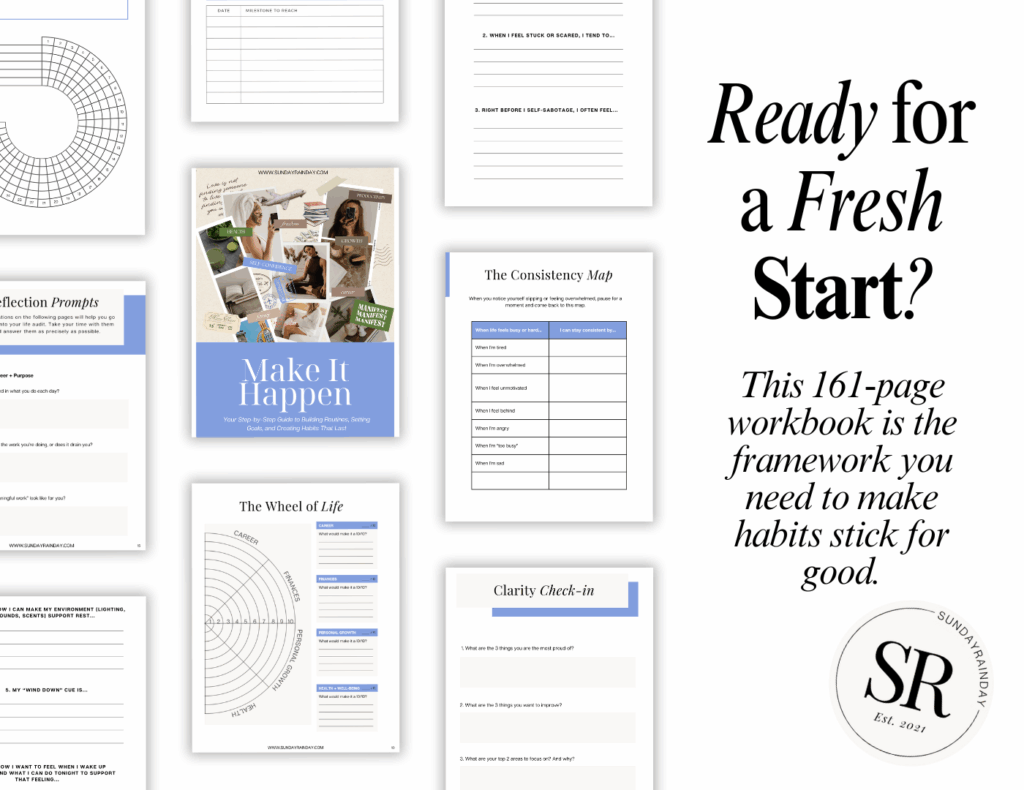
And if you want the complete system for building the mindsets, habits, and routines that actually last, that is exactly what Make It Happen was designed for.