
How to Start a New Life: 15 Steps to a Fresh Start That Actually Lasts
There’s a specific kind of Monday morning that makes you want to start over. The alarm goes off, and before your feet even hit the floor, you already know how the week is going to feel. You’re not tired. You’re just tired of this. The version of your life that runs on autopilot while the one you actually want stays permanently on “someday.”
Here’s what I want you to know before we go any further: you don’t have to wait for January, a birthday, or some tidy turning point to begin again. You can start a new life at any moment you decide to, including this very moment. But I’m not going to hand you a list of feel-good affirmations and send you off. Because fresh starts fueled by motivation alone tend to collapse by week three, and you probably already know that from experience.
What actually changes a life is structure: a clear sense of where you’re going, a plan you can follow, and habits that hold when the initial excitement fades. That’s exactly what this guide gives you: 15 steps, grouped into three phases, that take you from “I want something different” to “I’m actually living it.”
Ready to build your dream life?
Real change isn’t created by motivation alone. It’s built through clear goals, consistent habits, and structure you can rely on when life gets busy.
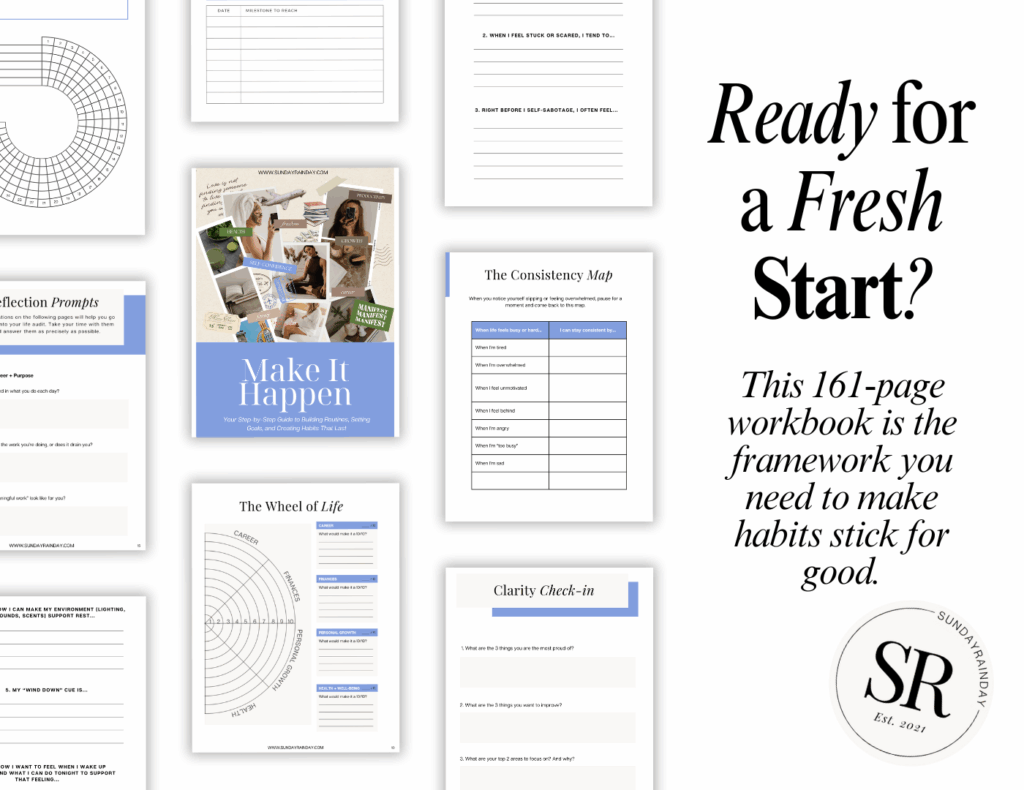
That’s why I created Make It Happen, a 161-page, step-by-step framework designed to help you:
- define goals that matter
- build habits and routines that fit your real life
- follow through long enough to see real results
If you’re serious about making a fresh start—not just thinking about it—this is the structure that helps you follow through.
Save this article
What does it really mean to start a new life?
Starting a new life means intentionally redesigning how you live from your goals, habits, environment, to your daily choices so they line up with the person you want to become.
It rarely requires moving cities or blowing everything up. But it does require clarity about what you want, a realistic plan to get there, and consistency long enough for the change to stick.
In other words, a new life isn’t a single dramatic decision. It’s a series of small, deliberate ones, repeated until they create the change you want.
How to Start Fresh
Phase 1—Get honest about where you are
You can’t redesign a life you haven’t looked at clearly. This first phase is about facing your starting point without flinching.
1. Run a life audit
Before you change anything, take stock of everything.
A life audit works like a financial audit, except instead of assets and liabilities, you’re assessing every area of your life honestly.
The simplest tool for this is the Wheel of Life. Doing a life audit will help you rate your satisfaction from 0 to 10 across the following dimensions:
- Career
- Finances
- Personal Growth
- Health
- Family
- Relationships
- Physical Appearance
- Environment
Then, for each one, note what you’d change to move it closer to a 10.
The goal isn’t to depress yourself with low scores. It’s to replace a vague sense of “something’s off” with a clear picture of what is off and by how much.
That clarity is your baseline.
2. Reflect on who you are and what you actually want
Most people skip this and jump straight to goals which is one of the reasons their goals don’t stick.
Before you decide where you’re going, sit with a few honest questions.
- Where would you like to be in 20 or 30 years?
- What does a good day look like?
- What would you do with your time if no one were watching and nothing were at stake?
You don’t need to have your life’s purpose figured out to begin. That will unfold over the years through experiment and a few aha moments.
You just need a direction honest enough to keep you going on the hard days. And there will be hard days; knowing why you started is what carries you through them.
If you don’t know where to start, these 38 self-discovery questions will help you find yourself.
3. Get clear on your real motivations
Here’s where a lot of fresh starts quietly fail.
People set priorities that sound impressive but don’t actually move them and when things get hard, they find an exit.
So for each thing you want to change, dig underneath it.
You don’t want to stop worrying about money to buy nicer things; you want the freedom to leave a job that drains you.
You don’t want to get healthier in the abstract; you want the energy to keep up with your life and the people in it.
If you can’t find a motivation strong enough to survive a bad week, that’s not a willpower problem. It’s a signal to rethink the goal itself.
Phase 2—Design the life you want
Clarity without a plan is just a vague dream. This phase turns your reflection into something you can actually execute.
4. Set your long-term life goals
Take the direction you defined in Phase 1 and shape it into concrete long-term goals.
These will be the anchors everything else hangs from.
Would you launch your own business?
Retire early and travel?
Build a calm, rooted life close to the people you love?
There’s no correct answer, only your answer.
Once you’ve decided, write it down, because a written goal is dramatically more likely to happen. A study from Dominican University of California found people who wrote their goals down were significantly more likely to achieve them than those who only thought about them.
5. Write a 3-year life plan
Once you know where you want to be, map the path by describing the milestones that would need to happen over the next three years for that vision to become real.
People spend more time planning a one-week vacation than they spend planning the next five years of their lives, then wonder why life keeps happening to them instead of for them.
Don’t be one of them and start writing your 3-year life plan today.
6. Break big goals into 90-day and weekly milestones
Long-term goals are motivating but too distant to act on.
So break them down: from a 3–5 year vision, to this year, to a 90-day focus, to this week.
Ninety days is the sweet spot for goal-setting.
It’s long enough to create real change and short enough to create urgency unlike a 12-month goal, which gives you 52 weeks to tell yourself you’ll start on Monday.
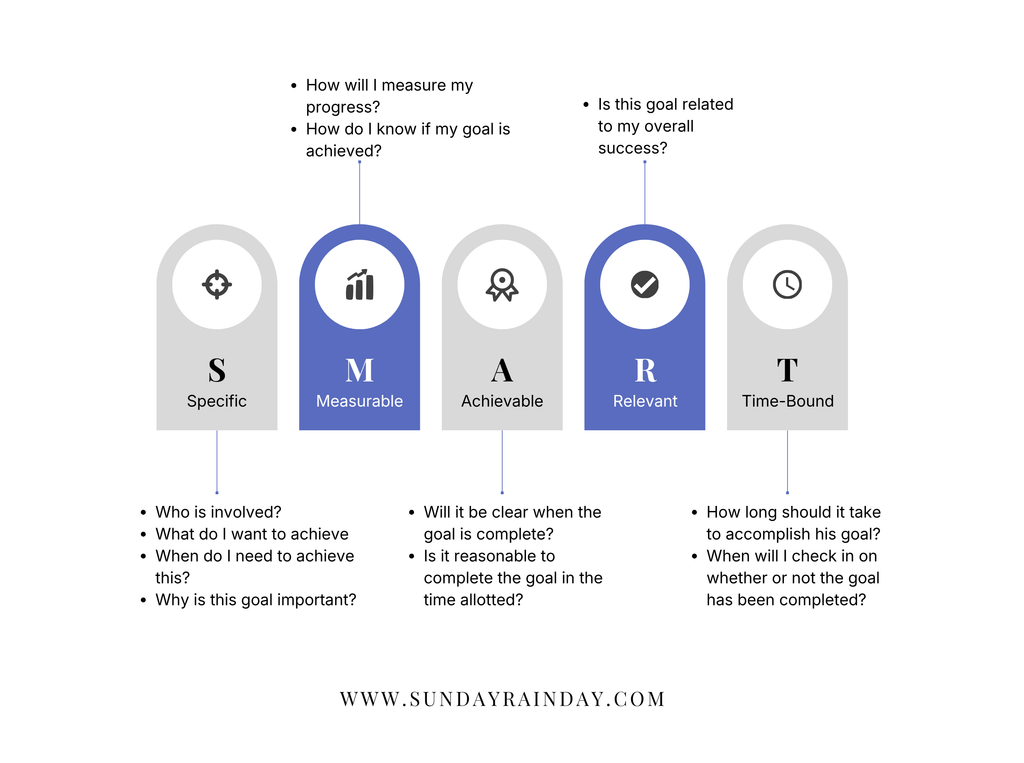
Make each near-term goal SMART (specific, measurable, attainable, realistic, time-bound) so you always know exactly what you’re working toward and whether you’re on track.
And when you miss a milestone—you will, sometimes—treat it as information, not failure.
7. Work with your energy, not against it
Two people can follow the identical plan and get opposite results because one scheduled hard work during their energy peak and the other fought their own biology.
Your chronotype describes when your focus naturally rises and falls across the day. Some people do their sharpest thinking before noon; others don’t fully switch on until the afternoon.
Instead of forcing deep work into a slot where you’re running on empty, notice your peaks and build your plan around them. It’s one of the simplest ways to make consistency feel less like a battle.
Why most fresh starts never last
Everything above is the clarity which is half of starting over.
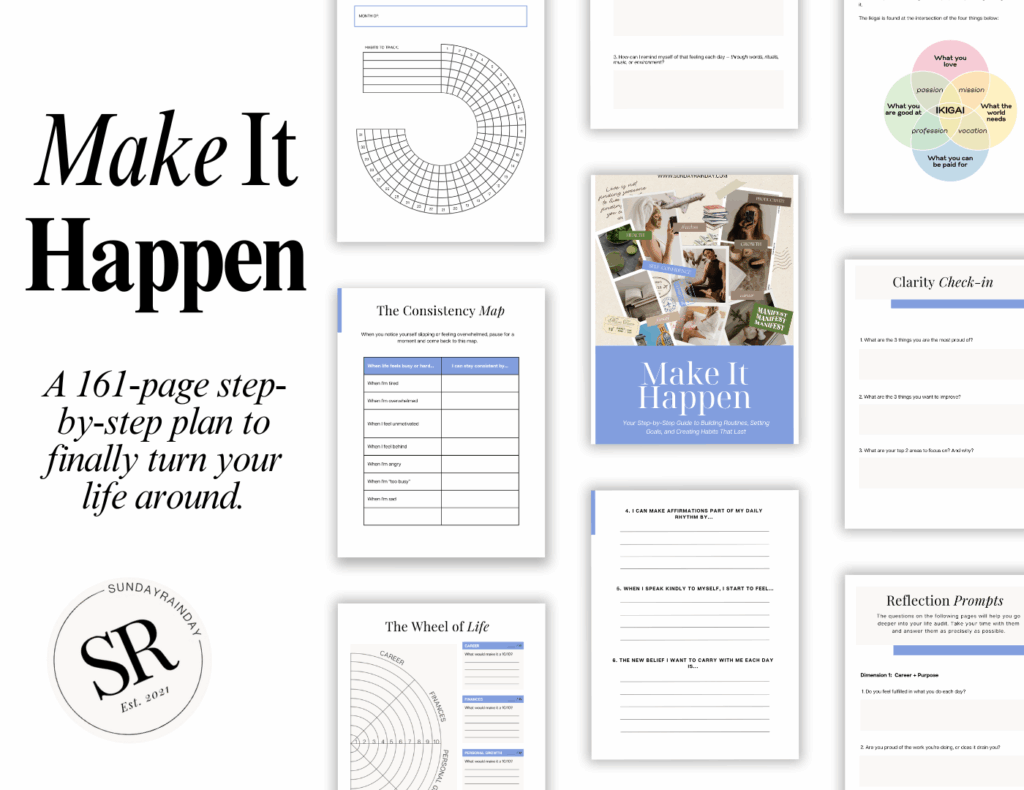
The reason most people stall is the follow-through half. And that’s exactly what I built Make It Happen for.
This workbook is a 161-page framework that turns the vision you’re forming here into goals, habits, and routines you can actually sustain.
This system does what an article alone can’t:
- It helps you turn the desire for change into clear, realistic next steps
- It guides you in building habits that fit your real life
- It removes the all-or-nothing mindset that leads to burnout
- It helps you stay consistent without relying on motivation
- It gives you a calm framework to keep moving forward, even when progress feels slow
If structure has been your missing piece, start there.
Phase 3—Build the system that makes it stick
This is where a new life is actually won or lost. Not in the deciding—in the daily doing.
8. Build habits that support your goals
Your goals set the destination and your habits are the only way to get you there.
Choose a small number of daily habits that directly serve what you’re trying to build, and start with the version you can stick to.
Aiming too high from the beginning is often the reason people fail to stick to habits.
Consistency beats intensity every time.
There’s one thing you need to make peace with early: making habits stick takes longer than the internet promised you. The popular “21 days” figure is a myth.
According to research from University College London, it takes an average of 66 days for a new behaviour to become automatic and anywhere from 18 to 254 days depending on the person and the habit.
So if week three still feels hard, nothing is wrong with you. You’re right on schedule. You just need to give it time.
9. Break the habits keeping you stuck
New habits pull you forward; old ones quietly pull you back.
And the most toxic ones usually aren’t the obvious ones. They’re the small, invisible loops: the phone check every few minutes, the automatic scroll the moment you get home, the “I’ll start tomorrow” that’s run for years.
You don’t break these with willpower.
You break them by changing your environment so the cue never fires, which is exactly why step 14 matters so much.
10. Turn your habits into routines
To make habits stick more easily, stack them into routines.
A morning routine sets the tone before the day can hijack it.
You don’t need a sophisticated routine to make it work. In fact, the simpler the better. Create routines that are repeatable enough to become part of who you are.
11. Build systems, not just willpower
Here’s the distinction most people never make and it’s the one that separates the people who change their lives from the people who stay stuck.
A routine is a set of habits. A system is what makes those routines easy to follow when life gets in the way. Systems aren’t just what you do; they’re how you set things up so the right action is the path of least resistance.
Meal-prepping is a tiny example: choosing recipes, writing the list, shopping, and prepping on Sunday is a system that makes eating well on a chaotic Wednesday almost automatic.
Everyone plans for the version of the week where everything goes right. Systems plan for the version where it doesn’t which is most weeks.
Build them, and you’ll stop relying on motivation you can’t guarantee.
12. Do the inner work: mindset, self-sabotage, and letting go
You can have a flawless plan and still quietly undermine it because the person executing the plan is carrying old stories.
Self-sabotage is the act of getting in your own way: procrastinating on the thing that matters, shrinking from the opportunity, quitting right before the breakthrough.
It almost always comes from a part of you trying to stay safe. Naming your specific patterns is the first step to interrupting them.
Letting go of the past matters just as much. You can’t build forward while relitigating old failures every night. Find a healthy outlet—journaling, talking to someone you trust and, crucially, stop waiting for an apology that may never come.
If you’re struggling to move on, here’s a step-by-step guide that will help you close a life chapter with grace.
Related read: 11 Self-Sabotaging Behaviors and How to Stop Them
13. Get uncomfortable on purpose
Growth lives outside your comfort zone, and nowhere else. Staying comfortable is the single biggest reason a life stalls.
We tend to overestimate the risk of trying and underestimate our ability to handle the outcome. When you’re afraid of failure, ask yourself honestly: what’s the actual worst case?
Usually it’s that nothing changes and you already know how to survive that, because you’re living it. So take the smaller-than-you-think risk. Here’s how to step out of your comfort zone without overwhelming yourself.
14. Reset your environment
You don’t have to move to start over but you do have to reckon with how much your surroundings shape your behavior.
Physical clutter creates mental clutter.
So decluttering your space isn’t about aesthetics; it’s about removing friction and the constant low-grade signal that things are out of control.
A cleared space makes new habits easier to keep and old ones easier to drop, because you’ve quietly removed their triggers.
Make your environment work for the person you’re becoming. Not against it.
15. Protect your foundations: yourself, your health and your money
Your entire life runs on a stable base. Neglect it and the whole thing wobbles.
Yourself comes first, not last. Learning to say a clean “no” to what drains you—including relationships that hold you back—is what protects the time and energy this whole process requires.
Health is the engine. Regular movement, real sleep, and decent food aren’t a separate goal. They’re what give you the energy to pursue every other goal. Start absurdly small if you have to.
Finances are the freedom layer. A simple budget, some savings, and a plan to reduce debt don’t just reduce stress. They will also buy you options: the option to leave, to rest, to choose.
Frequently asked questions
Can you really start a new life?
Yes, but “starting a new life” rarely means erasing everything overnight. It means deliberately changing your goals, habits, and environment until your daily life reflects who you want to be. The transformation is real; it just happens through consistent small changes rather than one dramatic leap.
How do I start a new life with no money or support?
Begin with the free, foundational moves: a life audit, a clear set of goals, and one or two small daily habits. Improving your finances and finding your community become goals within the plan, not prerequisites for starting it. Online communities can supply the support your immediate circle may not.
Is it ever too late to start over?
No. Reinvention isn’t age-bound. People rebuild careers, health, and relationships at every stage of life. The only thing that makes it “too late” is deciding not to begin. Your starting point is simply your starting point.
How long does it take to start a new life?
You can start today, but expect the new patterns to take root over months, not days. Individual habits average around 66 days to become automatic, and a meaningful life redesign typically unfolds over a season or more. The timeline matters less than the consistency.
Why most fresh starts don’t last
Starting a new life doesn’t require having everything figured out.
But it does require structure.
Without it, most fresh starts fade—not because of a lack of willpower, but because there’s nothing holding the change in place once motivation drops.
Make It Happen was created to solve that exact problem.
This 161-page, step-by-step workbook helps you:
- set goals you can actually follow through on
- build habits and routines that support those goals
- create consistency instead of starting over
If discipline and follow-through have been the missing pieces in your life changes, this framework gives you something solid to work with.