
How to Write a 3-Year Life Plan (Step-by-Step Framework)
A 3-year life plan is a structured roadmap that helps you translate your long-term vision into clear goals, actionable priorities, and daily habits, so you can stop drifting and build a life that actually feels like yours.
In this step-by-step guide, you’ll learn:
- Why a 3-year horizon is the most effective timeframe for meaningful personal growth
- How to audit your life and clarify your values before setting any goals
- How to break your vision into 90-day goals you can act on today
- Which habits and routines will make your long-term life plan stick
If you know what you want from life but don’t have a clear plan to get there, you’re not alone.
A life plan is what bridges that gap.
This isn’t about motivation or a vague plan you keep in your head.
It’s about building a 3-year life roadmap that’s grounded in strategy, shaped by your core values, and broken down into manageable steps you can actually follow through on.
Read on to discover the exact framework and walk away with the clarity and structure you need to start designing the life you really want.
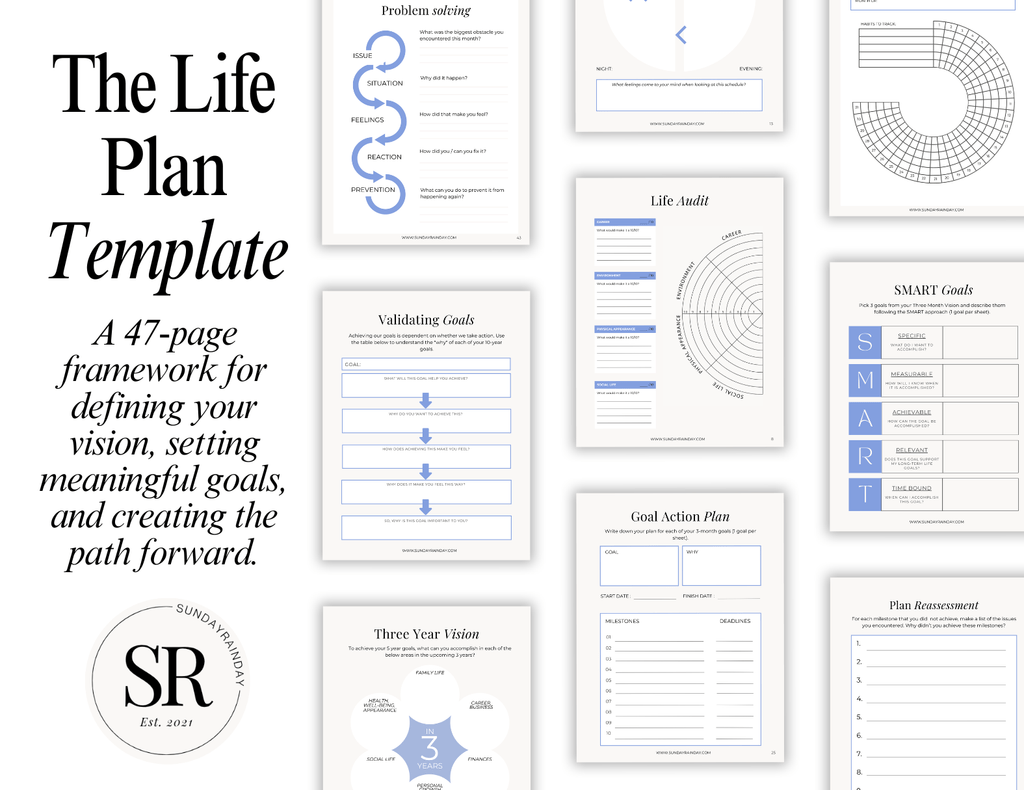
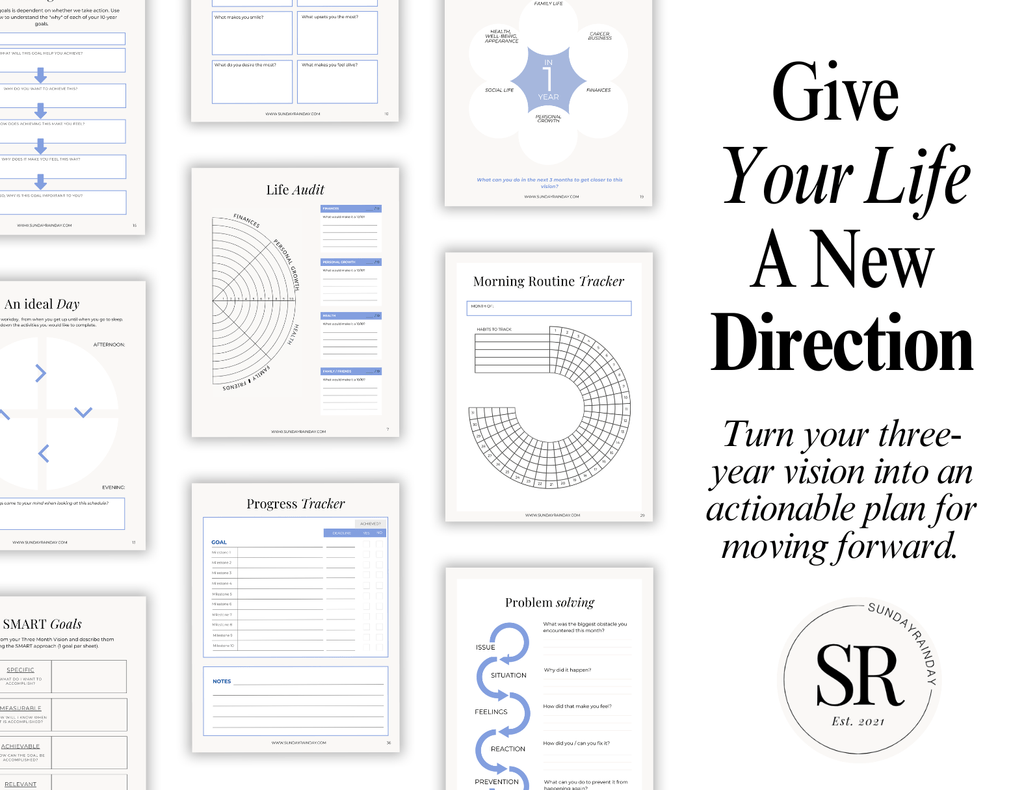
Want a Done-For-You 3-Year Life Plan Template?
Download the exact template hundreds of people used to turn three-year goals into clear, actionable steps in less than 2 hours.
Save this article
Why a 3-Year Life Plan is the Sweet Spot For Personal Growth
Most planning advice lives at two extremes: the abstract 10‑year plan and the minute‑to‑minute to‑do list.
But both miss what really makes change possible.
While a 10-year life plan is incredible for mapping out your long-term goals, it feels too distant to drive the kind of day-to-day progress that a personal development plan requires.
As noted in Psychology Today, planning too far into the future (like 5 or 10 years) can be counterproductive because the future becomes increasingly unpredictable, making shorter horizons more practical and effective.
That’s why a 3‑year horizon hits the sweet spot. It’s long enough to achieve life‑changing milestones and short enough to feel urgent and real.
Within a 36-month horizon, you can reinvent your identity, redirect your career or completely redesign your daily life without burning out.
This time frame also makes prioritization possible. Three years is enough to uncover behavioral patterns, understand what truly matters to you, and eliminate the noise.
If you want to change your life, writing a 3‑year plan helps you cut through the clutter so you can focus on what moves you forward most.
Think of it as your personal life roadmap, one that connects your long-term vision to your everyday decisions.
Here’s how to write yours.
The SUNDAYRAINDAY Life Planning Framework
This framework is a layered, flexible system that helps you connect your long-term vision with everyday execution.
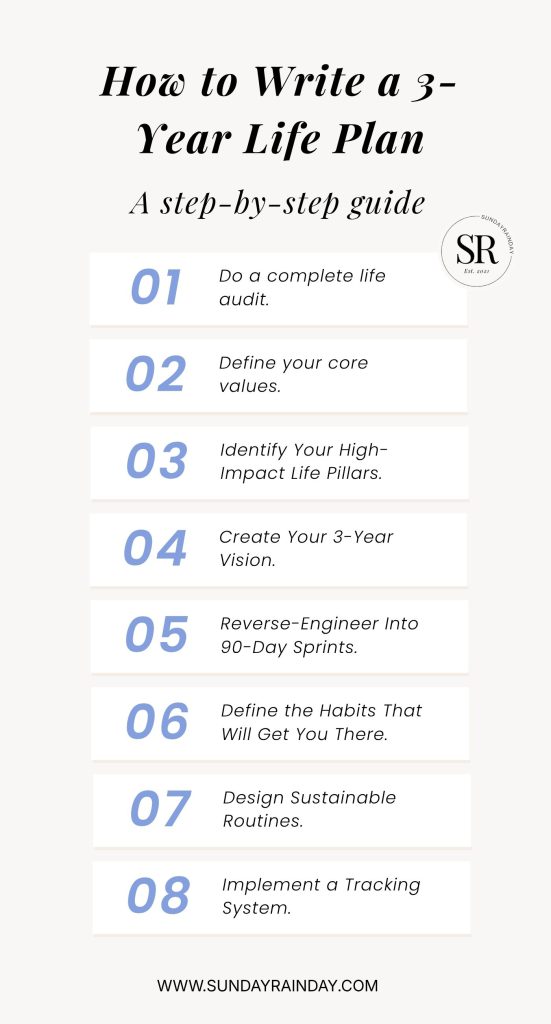
Here are the 8 steps to build a 3-year life roadmap that will support your goals and help you stay consistent until you achieve them.
Step 1: Do a Complete Life Audit
Before you can plan forward and set new goals, you need to pause and understand where you currently stand.
And a life audit is the perfect first step in any long-term life plan as it gives you a clear picture of where you stand before you decide where you’re going.
This exercise helps you reflect on what’s working, what isn’t, and discover the gaps between your current life and your ideal one.
To do your life audit, ask yourself:
- What areas of my life feel aligned? Which feel neglected?
- Where am I spending my time, energy, and money?
- What drains me vs. what energizes me?
- What patterns keep repeating?
This step is all about honest reflection.
When you take the time to answer these questions, your audit becomes the baseline for every decision that follows.
The ‘Wheel of Life’ is a proven coaching tool designed to help you holistically review your life priorities and identify the gaps between your current reality and your ideal future.
Read the post below to get a step-by-step guide on how to do a life audit with the Wheel of Life and download your free life audit template.
Related read: How to Do a Life Audit with The Wheel of Life (Free Life Audit Template Included)
Step 2: Define Your Core Values
Now that you’ve reflected on where you stand in life, it’s time to reconnect with your values.
Your values are your internal compass. They should guide every important decision you make.
If you’re not sure of what they are, start by asking yourself the following questions. They will give you an idea of what matters most.
- What do I need to feel fulfilled?
- What qualities do I admire in others?
- When have I felt most proud of myself?
- What do I want to be remembered for?
Choose 3–5 values that resonate deeply.
These will guide your goal-setting and help you align your daily life with your vision.
Answering these questions also helps you create goals that reflect your identity, not just your environment.
This step is important because building a plan based on values will make it easier to stick to it. When you do so, your plan is no longer about performing or proving, but about becoming.
And that alone changes everything.
Related read: 30 Deep Self-Discovery Questions to Find Yourself
Step 3: Identify Your High-Impact Life Pillars
Once you have clarity on your core values, the next step is to choose where to direct your energy.
If you try to optimize every area of your life simultaneously (career, health, finances, relationships) you will end up spreading yourself too thin to make meaningful progress.
You will be busy, but you won’t really be moving.
To create a 3-year goals framework that actually sticks, you need to identify your High-Impact Pillars.
These are the 3 to 4 areas of your life that, if improved, would have a “domino effect” on everything else.
The main life pillars are:
- Work & Contribution (Career, business, or education)
- Well-being (Mental health, physical well-being)
- Connection (Marriage, parenting, or community)
- Security (Financial health and physical environment)
Look at the results of your Life Audit and your Core Values and ask yourself:
“Which area of my life, if I focused on it for the next 3 years, would make everything else better?”
- Example: If your core value is “Freedom,” but you are currently drowning in debt, your High-Impact Pillar is Financial Health. Solving this “domino” will eventually provide the freedom you value.
- Example: If your core value is “Vitality,” but you have zero energy to play with your children, your High-Impact Pillar is Physical Well-being.
Step 4: Create Your 3-Year Vision (The Horizon)
With your priorities defined in the previous step, it’s time to look toward the horizon.
Imagine yourself three years from now. This isn’t just about what you have, but how you feel and who you have become.
Once you have your vision, it’s time to go back to your main pillars.
Instead of setting ten disconnected goals you will quickly give up on, look back at the pillars you identified in Step 3.
Your 3-year vision should be a clear description of what “success” looks like within those specific areas.
If a goal doesn’t sit inside one of your pillars, it’s a distraction. Don’t make it a priority.
By narrowing your focus, you create the ability to move forward fast without trying to change everything at once.
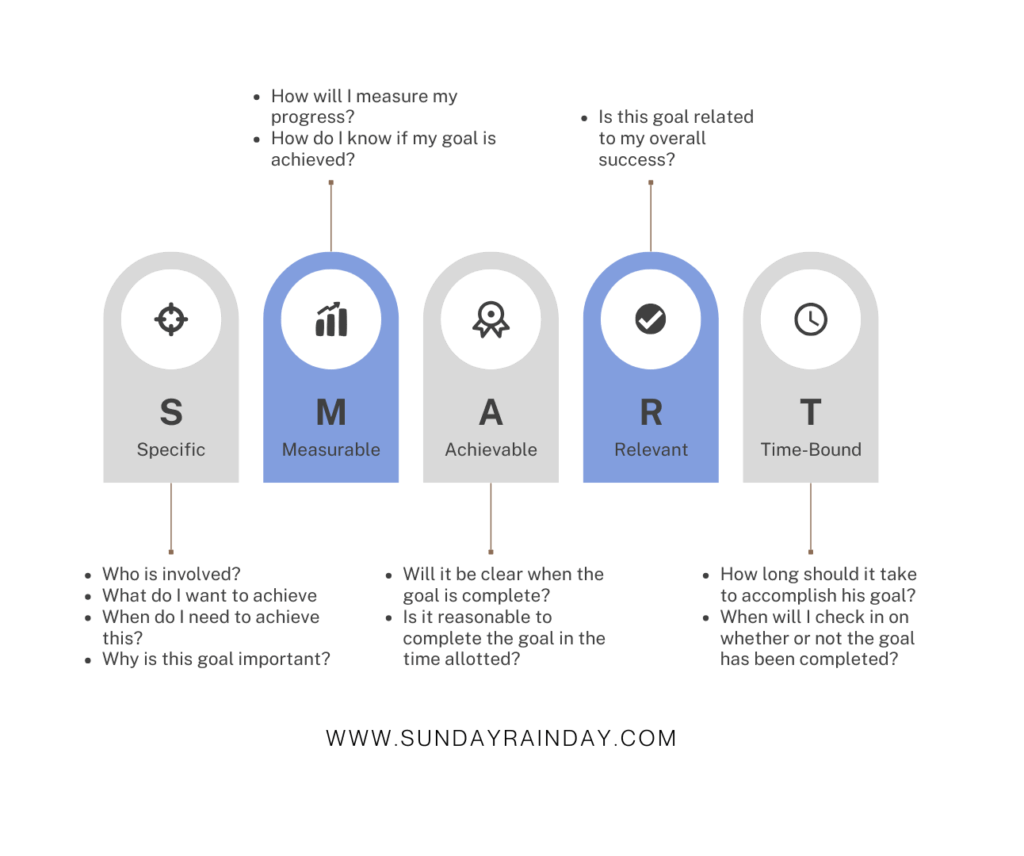
Translate this vision into 4–6 specific milestones. Then use the SMART framework (Specific, Measurable, Achievable, Relevant, Time-bound) to ground them in reality.
Research by Dr. Gail Matthews, psychology professor at Dominican University of California, found that 62% of participants who wrote down their goals achieved them compared to just 43% of those who kept their goals in their head.
These milestones are your horizon, your “why” and your “where.”
Step 5: Reverse-Engineer Into 90-Day Sprints
It’s now time to take your 3-year milestones and work backward by breaking each milestone into smaller goals you can achieve over 90 days.
These 90-day sprints help you maintain a sense of urgency while keeping your end goal in mind.
This is the core of any effective goal setting framework: turning a distant vision into a series of short, winnable cycles.
Why 90 days? Because it’s long enough to build meaningful progress, yet short enough to stay present and engaged. It introduces urgency without pressure.
Plus, it gives you enough time to recalibrate if you fail to stick to your plan.
Life will get in the way and your priorities will evolve from one day to another.
A plan that can be reviewed and adjusted quarterly stays aligned with reality, rather than becoming something you give up on when life gets busy.
Additionally, research from the Chicago Booth Review suggests immediate rewards and short-term milestones are good predictors of whether you will persist and succeed.
3-Year Life Plan Example
| Life pillar | 3-Year Vision | Year 1 Focus | Year 2 Focus | Year 3 Focus | First 90-Day Sprint |
|---|---|---|---|---|---|
| Career | Build a flexible, meaningful career path | Clarify direction and learn new skills | Build practical experience | Get promoted | Choose one career goal and map 3 first milestones |
| Well-being | Feel energized and strong | Focus on the basics: movement, sleep, diet | Build strength and consistency | Keep routines | Walk 4x/week and plan meals |
| Finances | Feel financially stable | Track spending and reduce debt | Build emergency savings | Start long-term investing | Create a simple monthly money review |
| Relationships & Social Life | Feel more supported and present | Reconnect with the people who matter most | Create simple rituals for quality time | Build a social life that feels nourishing | Plan one intentional catch-up each week |
Step 6: Define the Habits That Will Get You There
Your daily habits are where your life plan either thrives or dies.
You can have the most precise life planning template, but if your daily habits don’t reflect it, it will remain a dream.
Long-term goals are always achieved through short-term consistency.
So to reach your milestones, ask yourself: what daily, weekly, or monthly habits will support my milestones?
If you’re unsure, a simple trick I use to define the habits that will help me reach my goals is to ask myself: what would a person who already achieved this goal do?
If you want to get fit, ask yourself “What would a fit person do?” when planning what to do after work, when deciding what you will have for lunch or what you will do on a rainy Sunday morning.
Then, instead of saying “I want to get fit,” shift to “I am becoming a fit person.”
Identity-based habits tend to stick more easily because they’re rooted in who you believe you are, not just what you’re trying to do.
This makes the behavior feel natural, meaningful, and aligned with your sense of self.
For each 90-day sprint, identify 2–3 key habits you should start.
The next step is to design routines around them.
Related read: How to Make New Habits Stick
Step 7: Design Sustainable Routines
Habits become automatic when they’re part of a system because lasting change doesn’t come from willpower alone.
It comes from structure.
Habits become effortless when you add them to routines that are already familiar.
This approach is called habit stacking and allows small, supportive behaviors to blend seamlessly into what you’re already doing.
By adding your new habits into existing routines, your new habit no longer feels like “extra effort.” It becomes part of how your day flows.
If your days currently feel unstructured, this is your invitation to create a simple morning or evening routine.
The purpose of routines isn’t productivity for productivity’s sake.
It’s to design a life structure that reduces decision fatigue, and makes progress feel natural rather than forced.
Related read: How to Create Your Ideal Morning Routine Based on Your Goals
Step 8: Implement a Tracking System
Another important part of your 3-year life plan is to track your progress towards your goals.
A simple tracking system, whether it is a habit tracker, a planner, or a digital dashboard, creates visibility.
It turns intention into something you can actually respond to and measure.
But what really matters is not the medium you use, it’s how consistent you are with your check-ins.
- Weekly reflections keep you close to your day-to-day reality.
- Monthly reviews reveal emerging patterns.
- Quarterly overviews give you a chance to refine your direction if needed.
Tracking isn’t about control or vanity metrics. It’s about awareness.
It helps you adjust early, rather than drifting off course and it also reminds you of the progress that’s already been made.
This is how momentum becomes sustainable.
Common Life Planning Pitfalls (And How to Avoid Them)
Even with the best intentions, many life plans quietly fail.
Here are a few reasons why:
1. Lack of structure. People often keep their plan in their head or scattered across notebooks. A written system creates clarity.
2. Misaligned goals. If your goals are based on outside pressure instead of internal values, you’ll quickly lose motivation.
3. Rigid expectations. Plans are not promises. Allow yourself to adapt as your life changes so you don’t give up.
4. Ignoring self-sabotage. Even with clear goals, old patterns can pull you off track. Procrastination, avoidance and perfectionism; these habits don’t disappear on their own. You have to understand and rewire them.
5. No feedback loop. Without tracking and review, you won’t know what’s working (or what’s draining you).
The goal isn’t to control every part of your future. It’s to design it thoughtfully, so you can create it with clarity and confidence.
Frequently Asked Questions
What should a 3-year life plan include?
A 3-year life plan should include a life audit, your core values, 2–4 high-impact life pillars, a clear 3-year vision, 90-day goals broken down from that vision, key habits, and a simple tracking system. Each element builds on the previous one to connect your long-term vision with daily action.
How do I stick to my 3-year life plan?
The key to stick to your long-term plan is to review it regularly. Weekly for habits, monthly for progress, and quarterly to adjust your direction if needed. Breaking your vision into 90-day sprints makes it easier to stay focused without feeling overwhelmed by the long timeline.
What’s the difference between a 1-year and a 3-year plan?
A 1-year plan is tactical. It focuses on what you can realistically accomplish in the short term. A 3-year plan is more strategic. It gives you enough time to achieve meaningful transformation across multiple areas of your life while staying close enough to feel urgent and real.
Why 3 years and not 1 or 10?
A 3-year horizon allows time for meaningful transformation while retaining urgency and clarity. It’s long enough to achieve big goals and short enough to stay actionable.
What if my priorities change?
That’s normal. Life planning is dynamic. Quarterly reviews help you adjust your milestones and habits without losing momentum.
How does this framework help with burnout?
By dividing progress into manageable 90-day sprints and aligning daily habits with values, you create sustainable momentum rather than pressure.
Do I need a printable or template?
Yes. Using a visual tool like The Life Plan Template helps bridge strategy with action. It’s especially helpful for revisiting your plan regularly.
Can I apply this at any age?
Absolutely. Whether you’re in your 20s, 30s, 40s, or beyond, this life planning framework meets you where you are with clarity and direction.
Final Thoughts on Designing Your 3-Year Life Plan
You don’t need more ideas. Or more motivation. Or another burst of willpower.
What you need to give your life a new direction is a system.
One that bridges the gap between your long-term vision and your everyday life.
A 3-year life plan is a personal life roadmap that creates structure, not pressure.
It helps you stop spinning your wheels and start moving forward with purpose.
With this framework, you’re not just chasing goals. You’re designing a life that feels aligned, focused, and truly yours.
Most people don’t fail because they’re lazy or unmotivated. They fail because they try to hold their entire life plan in their head.
They have no clear structure, no defined priorities, no realistic way to connect vision to daily decisions.
That’s exactly why I created the Life Plan Template.
It’s more than a workbook. It’s a strategic tool to help you:
- Turn your big-picture goals into specific, time-bound priorities
- Break down your vision into 90-day sprints and daily habits
- Organize your goals across every area of life
- Build a written plan you can revisit, refine, and actually follow through on
If you’re ready to move from intention to execution and design a future you’re excited to live, the Life Plan Template is your next step.
Save this article