

How to Reinvent Yourself Without Starting Over
You’ve probably already tried the quick version of reinventing yourself. The new haircut, the fresh notebook, the Sunday evening promise that from tomorrow you’d be someone who gets up at six and has her life in order. For a week or two it even worked, and then your old routines took you back as if nothing had happened.
And yet your hope of making it happen hasn’t gone anywhere. You still look at your days and feel that they belong to an earlier version of you, someone with different priorities and a smaller idea of what her life could be. You don’t necessarily want to burn everything down and move to another city. You want to become the person you can already half see, without losing everything you’ve built along the way.
That’s what this article is for. It explains why the quick version rarely lasts, and how to reinvent yourself from the inside out instead, whether you’re 30, 45 or well past 50, and without starting your whole life over.
Save this article
What it really means to reinvent yourself
Reinventing yourself has a dramatic reputation. We picture someone quitting their job, cutting their hair and boarding a one-way flight, and because most of us can’t or don’t want to do that, we conclude that reinvention isn’t for people with a mortgage and a Tuesday meeting.
In reality, to reinvent yourself is to deliberately change who you are and how you live, so that both fit the person you’ve become. Some of it shows on the outside, but most of it happens in your habits, your choices and the way you see yourself.
It also helps to know that you’re far less fixed than you feel. When the psychologists Jordi Quoidbach, Daniel Gilbert and Timothy Wilson studied more than 19,000 people aged 18 to 68, they found that people of all ages believed they had changed a lot in the past but would change relatively little in the future. They called it the end of history illusion: we tend to see ourselves as finished, when the evidence of our own lives says otherwise. You’ve already reinvented yourself several times, whenever you left home, changed jobs, ended a relationship or recovered from a setback. What’s new this time is that you’re doing it on purpose.
Why reinventing yourself from the outside rarely lasts
The quick version nearly always starts with what’s visible: a haircut, a new wardrobe, a morning routine borrowed from someone who seems to have it all together. These changes are appealing because they’re fast and because other people notice them, and for a few days they really do make you feel like someone new.
The trouble is that they change one visible thing while the rest of your life stays arranged around the old you. Your calendar is the same, the people around you expect the same person, and what you believe you’re capable of hasn’t moved. So the old life gradually absorbs the new detail, and within a month you’re the same person with a better fringe.
A reinvention that lasts works the other way round, from the inside out. It begins with understanding who you are now and what you want to keep, moves through letting go and experimenting, and only at the end shows up in how you look and how you introduce yourself. By then, the outside change has something to stand on. The six steps below follow that order.
How to reinvent yourself from the inside out
1. Get honest about where you are
Before you can move toward a new version of yourself, you need a clear picture of the one you’re starting from. It’s tempting to skip this part, because looking closely at your life as it is can be uncomfortable, but it’s what stops you from reinventing the wrong things.
A simple way to begin is a life audit: rate areas such as your health, work, relationships, finances, social life and personal growth from 1 to 10, and notice which numbers surprise you. Then, for a week, pay attention to when you feel most alive and when you feel most disconnected, and write down what you were doing each time. You’re gathering evidence at this stage, so try to observe yourself with curiosity and without judgement. If you’re not sure what to ask yourself, these self-discovery questions are a good place to start.
2. Decide what you’re keeping
This is the step most advice skips, and it’s the one that makes it possible to reinvent yourself without starting over. Before you think about what to change, write down what you want to carry with you: the values you’d defend, the strengths people rely on you for, the relationships that still feel like home, and the parts of your current life you’d choose again tomorrow.
It matters for two reasons. The first is practical, because these are the foundations your next chapter will be built on, and you’ll make better decisions once you can see them. The second is emotional. Change feels far less frightening when you know how much of you is staying, and people who try to reinvent everything at once often abandon the whole project because it starts to feel like losing themselves. Think of it as editing your life: a good edit keeps most of the original.
3. Let go of what no longer serves you
Most of us try to change our lives by adding things: new goals, new habits, a new routine. We rarely ask what needs to leave first. The psychologist William Bridges, who spent his career studying how people move through change, observed that every transition begins with an ending. Something has to be released before something new can take its place, and when we skip that part, the old life simply absorbs the new habits.
So look at what’s keeping the old version of you in place. It might be a routine that leaves you drained, a commitment you said yes to out of guilt, clutter in your home or on your phone, or the way you talk to yourself when things go wrong. You don’t have to clear it all at once. Declutter one drawer, say no to one thing this week that belongs to the old chapter, or write a goodbye letter to your old self and thank her for getting you this far.
Related read: How to Close a Chapter in Your Life: 10 Steps to Closure
4. Picture who you’re becoming, then test it
With some space cleared, you can start to imagine who you want to become. The psychologists Hazel Markus and Paula Nurius called these images possible selves: our ideas of what we might become, what we’d like to become and what we’re afraid of becoming. They argued that these pictures work as incentives for future behaviour, which is a more formal way of saying that a clear image of your future self gives you something to move toward. A vision board, a life plan for the next few years, or a letter written as if it’s three years from now can all help you see it.
A vision on its own can keep you dreaming for years, though, which is where most reinventions stall. Herminia Ibarra, a professor at London Business School who has studied career reinvention for decades, argues that we tend to get the order wrong: we think we need to know exactly what we want before we act, when in her research knowing is the result of experimenting. So once you have a rough picture, test it. If you think you want a more creative life, spend ten minutes writing or sketching before work for a month. If you’re curious about a different career, take a short course or ask someone in that field out for a coffee. None of this commits you to anything, and each small experiment tells you something real about whether the person you’re picturing is someone you’d actually enjoy being.
Related read: how to make a 3-year life plan
5. Practise being that person in small ways
You become a new version of yourself mostly by behaving like her, a little, every day. So choose two or three qualities you’d like to grow into, perhaps calmer, braver or more curious, and give each one a small daily habit to live in. If you want to be calmer, that might be ten minutes without your phone before work. If you want to be someone who’s always learning, it could be five pages of a book each evening.
Then look for chances to practise in ordinary moments. When a difficult email arrives or a friend asks for a favour you don’t have time for, ask yourself how the person you’re becoming would handle it, and try doing that, even if it feels slightly unnatural at first. A short question at the end of the day helps too: did I show up today as the person I want to be? Give this stage time, because new habits take months to feel automatic, and there’s more on that in how to make habits stick.
6. Let the people around you catch up
The last part of a reinvention happens in public, and it’s often the hardest. The people in your life know the old version of you, and without meaning to, they hold her in place. They offer you the same role at family dinners, expect the same yes at work and tease you gently when you act out of character. Ibarra’s work points to the same thing: new identities take shape partly through new circles of people, who meet the person you’re becoming as simply who you are.
So spend some time with people who already live the way you want to live, whether that’s a class, a community or one colleague you admire. Give the people you love time to adjust, and expect a little friction while they do, because many relationships adapt once the change proves to be real. And start telling the new story. It will feel strange the first few times you say I’m retraining or I’ve started writing out loud, but saying it is part of how it becomes true.
This is also where rebranding yourself on the outside belongs. A new haircut, clothes that suit the person you’ve become, a different way of carrying yourself: after the first five steps, these simply show on the outside what has already changed underneath, and they can do a great deal for your self-confidence.
Expect to miss the person you were
There’s a part of reinventing yourself that rarely gets mentioned: at some point, you’ll miss the old you. Even when the change is entirely your own choice, letting go of an identity is a loss, and it can show up as nostalgia for a life you were keen to leave, or as a few weeks of not quite knowing who you are. Bridges called this stretch the neutral zone, the in-between where the old life no longer fits and the new one hasn’t settled.
It helps to know it’s coming, because this is the point at which many people decide they’ve made a mistake and go back. In most cases nothing has gone wrong. The old identity has loosened its hold and the new one is still forming, and the discomfort eases as your new habits become familiar. If you’re in that stretch right now, how to tell when you’re outgrowing your life explains the in-between in more depth.
Reinventing yourself at 30, 40, 50 and beyond
A lot of people wonder whether they’ve left it too late, so it’s worth saying clearly: the six steps are the same at every age. What changes is what you’re working with.
How to reinvent yourself at 30
In your thirties, reinvention is often about separating what you want from what you were told to want, since many of the choices you’re living with were made in your early twenties. You have time on your side, which makes this a good decade for experiments (step 4).
How to reinvent yourself at 40
By 40, you know yourself far better and you probably have more to protect, which makes the gradual approach more valuable than the dramatic one. Steps 2 and 3 tend to matter most, because a life built over twenty years holds a lot worth keeping and a lot you took on for reasons that no longer apply.
How to reinvent yourself at 50 and beyond
At 50 and later, many people find they have more freedom than they’ve had in decades. The study behind the end of history illusion included people up to the age of 68, and they too underestimated how much they would go on changing. Reinvention at this stage is often about finally making room for the things you set aside along the way.
Where to begin
You don’t need to work through all six steps this month. If you only do one thing this week, make it the first, because everything else depends on seeing clearly where you are. Then write the list of what you’re keeping, which usually takes less than an hour and changes how the whole project feels. Those two steps are the real beginning of a reinvention, and they count for far more than another Sunday evening promise.
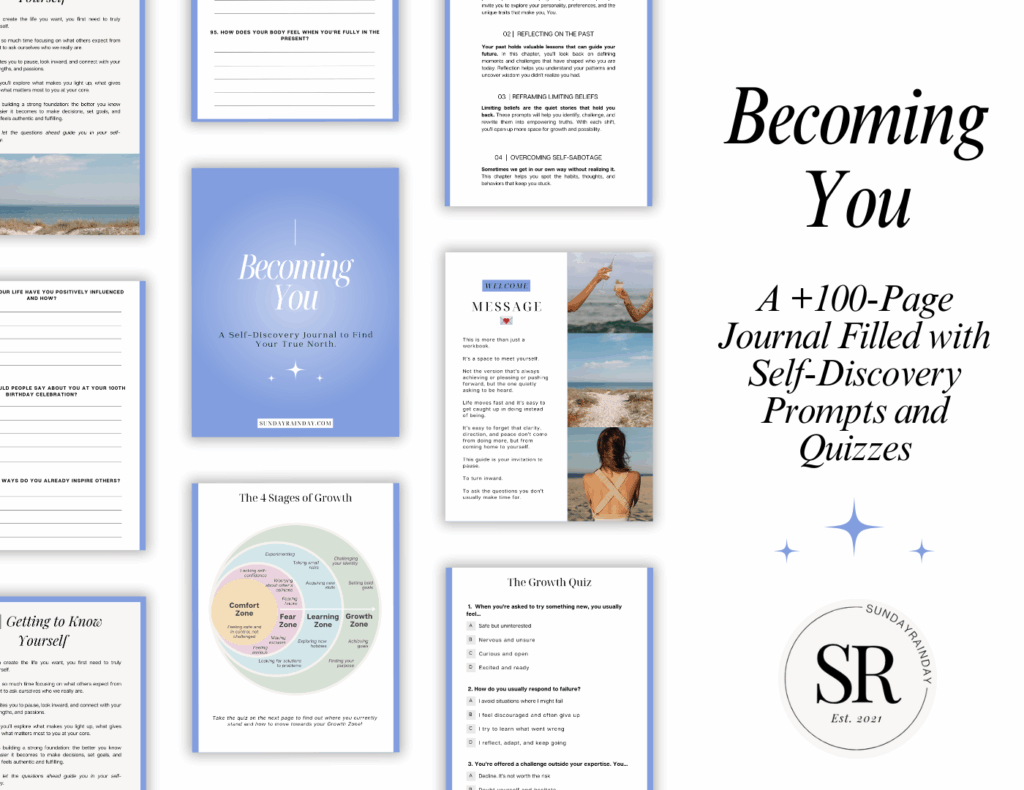
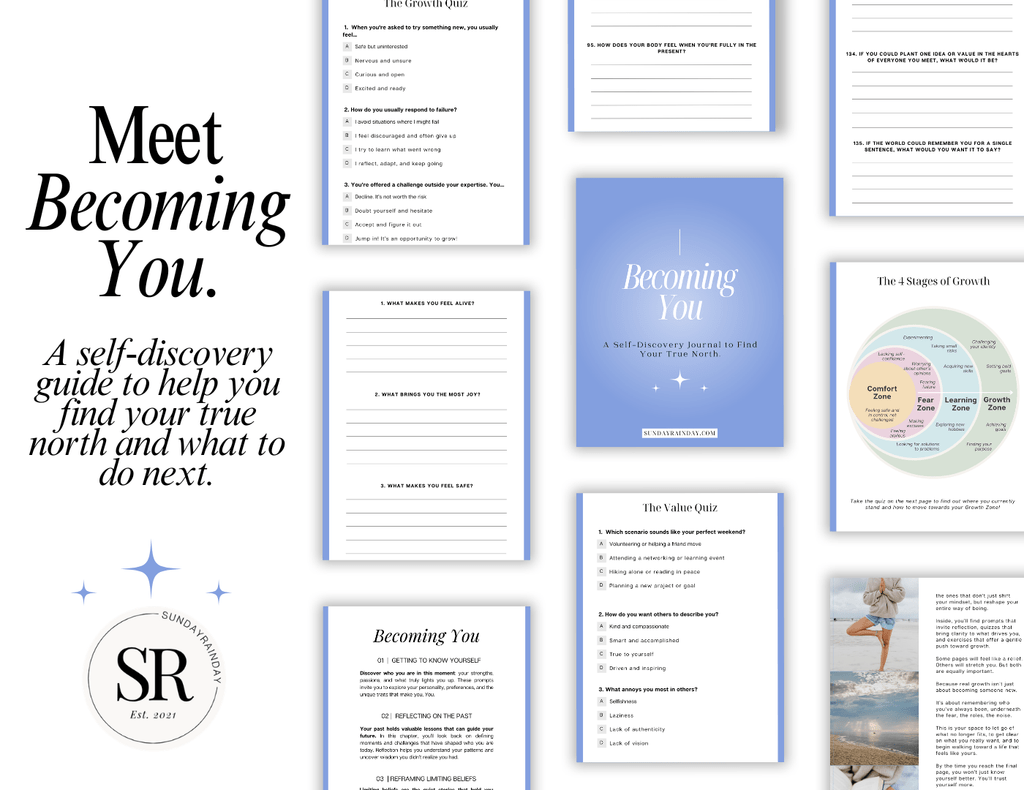
If those first steps are where you feel least sure, Becoming You is the guided self-discovery journal I created for exactly that part. Its prompts, quizzes and exercises help you work out who you are now, what you value and who you want to become, so that the changes you make afterwards are built on something solid.
Frequently asked questions
What does it mean to reinvent yourself?
To reinvent yourself is to deliberately change who you are and how you live, so that your habits, choices and identity fit the person you’ve become. It doesn’t have to be dramatic or visible. For most people it’s a gradual process of deciding what to keep, letting go of what no longer fits and practising a new way of living until it feels like their own.
Can you reinvent yourself without starting over?
Yes, and it’s usually the version that lasts. Starting over throws out the values, strengths and relationships that your next chapter needs, whereas reinventing yourself from the inside out keeps those foundations and changes what’s built on top of them. Deciding what you’re keeping before you decide what to change is what makes that possible.
How do I start reinventing myself?
Start by getting honest about where you are, with a simple life audit and a week of noticing when you feel most alive and most disconnected. Then write down what you want to keep, and let go of one thing that belongs to your old chapter before you add anything new. Starting small matters, because a reinvention built on one or two real changes tends to last longer than one that tries to change everything at once.
How long does it take to reinvent yourself?
There’s no fixed timeline, and it depends on how much you’re changing. As a guide, research on habit formation by Phillippa Lally and her colleagues found that new habits took between 28 and 254 days to become automatic. So it’s reasonable to think in months. The visible changes can happen quickly, while the habits and identity underneath take longer to settle.
Is it too late to reinvent yourself at 40 or 50?
No. Research on the end of history illusion shows that people of all ages, including those in their fifties and sixties, underestimate how much they’ll keep changing. At 40 or 50 you also bring experience and self-knowledge that make your choices better informed, and a gradual, inside-out approach is designed to work alongside the commitments you already have.
How do I completely reinvent myself?
A complete reinvention uses the same six steps, applied to more areas of your life and over a longer period. It still works best in order: understand where you are, decide what stays, let go of what doesn’t fit, test who you’re becoming, practise it daily, and let the outside change come last. Trying to change everything in one go is the approach most likely to send you back to your old routines.
